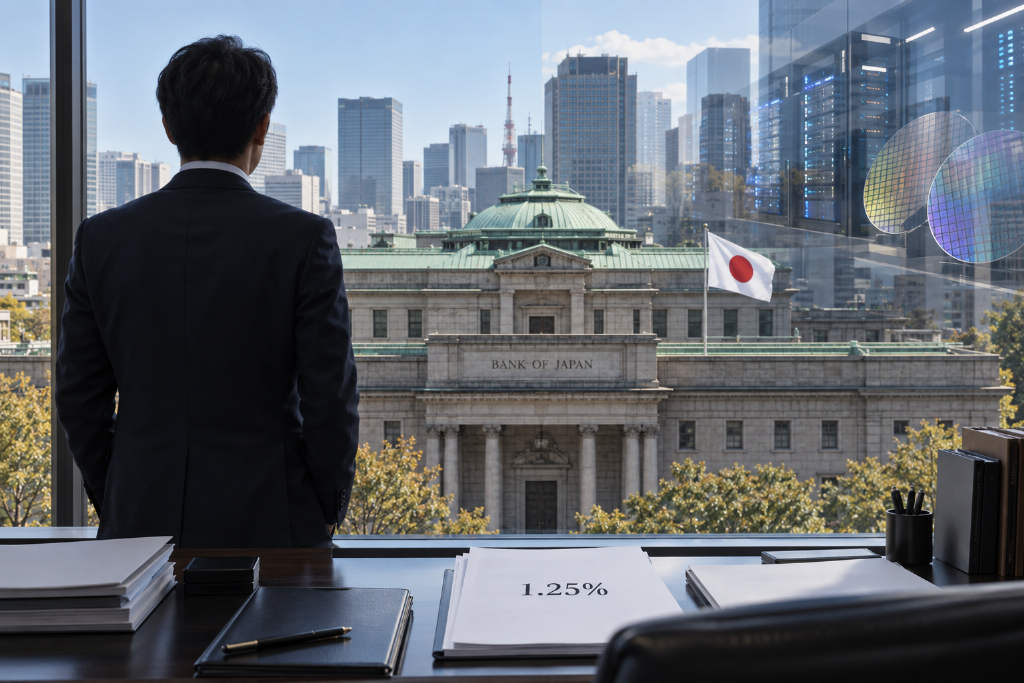
Bank of Japan2026-09-18 04:42:09Bank of Japan raises rate to 1.25%, cites AI demand as one factor behind price pressureThe Bank of Japan voted 7-2 at its Sept. 18 monetary policy meeting to raise its target for the uncollateralized overnight call rate to around 1.25%, with the change taking effect on Sept. 24. The decision also lifted the interest rate applied under the complementary deposit facility to 1.25% and the basic loan rate to 1.5%. In the policy statement, the BOJ explicitly referred to AI-related demand in two places, saying stronger global AI demand could support Japan’s economy while also contributing to elevated producer prices alongside high crude oil prices and a weaker yen. Two policy board members dissented for different reasons: Toichiro Asada said recent core CPI gains remained below 2% and did not necessarily show a strong economy, while Ayano Sato argued that economic and price developments had not clearly accelerated enough to justify a rate hike now. After the decision was released, Bitcoin traded above $77,000 around midday Taipei time.460
Bank of Japan2026-09-18 01:10:05BOJ rate decision seen tilting toward a hike, while softer guidance could weigh on the yenThe Bank of Japan is set to announce its target rate on Sept. 18, and several institutions are lining up behind the view that a 25-basis-point increase is the most likely outcome. Reuters, citing surveyed economists, said the policy rate is expected to reach 1.5% by the end of March next year and 1.75% in the second quarter of 2027, with most economists seeing the terminal rate at least that high. BNP Paribas expects a move to 1.25% now, followed by additional hikes in December and next March. Goldman Sachs described the decision as effectively locked in and said another increase could come as early as December. TD Securities projected a longer tightening path to 2.25%, while MUFG said markets already expect both a hike and a signal of more to come. Several of those institutions also warned that if the BOJ fails to deliver sufficiently hawkish guidance, the yen could come under pressure, with TD pointing to a possible move into the 157-160 range.540
Treasury yiel2026-09-11 09:30:41Treasury buybacks failed to calm long bonds as markets turned to U.S. CPIGlobal markets saw an unusual mix of signals on Sept. 10. The U.S. Treasury increased its long-dated bond buyback size to $6 billion from the previously announced $4 billion, yet the 10-year Treasury yield still climbed to 4.85%, its highest level since November 2023, while the 30-year yield moved above 5.3%. At the same time, U.S. August producer price data came in with a 0.4% month-on-month gain and 5.4% year-on-year growth, while July figures were revised higher, reinforcing expectations that inflation pressure has been rebuilding since mid-summer. Gold reacted sharply. Prices fell after the PPI release, touching $4,324.23 intraday and ending the New York session down 1.91% at $4,314.82, though the broader move was described as a V-shaped pattern. Outside the U.S., the European Central Bank raised its three key rates by 25 basis points, taking the deposit facility rate to 2.50%, and markets were also pricing about a 97% chance that the Bank of Japan would raise rates by 25 basis points to 1.25% next week. Against that backdrop, investors are now focused on the U.S. August CPI report due at 20:30 Beijing time. The article frames the release as the next major test for rate expectations, long-end Treasury yields, and the current gold narrative, which it says is increasingly tied not only to interest rates but also to concerns over U.S. fiscal credibility.1540
Yen2026-09-08 03:13:00Yen Surges to Six-Month High, Threatens to Unwind Largest Carry Trade in 30 YearsThe Japanese yen rallied to a six-month high against the U.S. dollar during Asian trading on Tuesday, breaking above the psychologically important 155 level and reaching 153.53, surpassing the level where the U.S. and Japan jointly intervened in late July to curb the yen's weakness. The advance was driven by expectations of accelerated rate hikes by the Bank of Japan and potential capital inflows into Japanese assets. Finance Minister Katsunobu Katayama said Japan will continue to coordinate with the U.S. to ensure market stability, keeping investors on alert for further intervention. OCBC's FX strategist Christopher Wong noted that markets are almost fully pricing in a 25-basis-point rate hike at next week's BOJ meeting, with comments from economic adviser Sanae Takaichi also shifting rate expectations. The yen has gained nearly 4% since September, triggering stop-losses and risks of unwinding yen-funded carry trades. Jefferies' data showed cross-border yen borrowing surged from 216 trillion yen in December 2021 to 360 trillion yen in March this year, making the current carry trade the largest in 30 years. Markets are now fully betting on a BOJ rate hike in September and discussing another increase within the year.940
yen2026-09-08 03:20:15Yen Hits Six-Month High Against Dollar on BOJ Rate Hike ExpectationsThe yen strengthened to a six-month high against the U.S. dollar on Tuesday, driven by expectations of faster BOJ rate hikes and potential inflows into Japanese assets. Japan's Finance Minister reaffirmed coordination with the U.S. to maintain market stability, while a strategist noted the market is fully pricing in a 25bp rate hike next week.810
Bitcoin2026-09-07 12:27:29Bitcoin Faces CPI and PPI Test as Fed Rate Hike Odds Hit 58.4%Bitcoin enters a macro-packed week as US CPI and PPI data loom, the Fed rate decision nears, and Japan's possible dollar-selling for yen intervention adds pressure. Derivatives activity drives the latest rally while spot demand remains negative, raising sustainability concerns. A bullish Supertrend signal appears for the first time since November 2025.830
Bank of Japan2026-09-02 06:51:49Yen firms after BOJ's Takata says large, back-to-back hikes possibleBank of Japan board member Takata, known as one of the central bank's most hawkish voices, said he does not rule out a large rate increase or consecutive rate increases. The yen firmed after the remarks. USD/JPY slipped as much as 0.5% to 159.44, after earlier trading at 160.39. Takata said a 25-basis-point increase is not a done deal and that consecutive hikes are also possible when the overall picture is considered. Aozora Bank's chief market strategist said investors had responded to Takata making the scenario explicit. “The market has reacted to Takata clearly saying consecutive hikes are possible,” the strategist said. “His remarks are more aggressive in the size and pace of hikes than recent comments from the BOJ governor and deputy governor.” The original report noted that Takata is regarded as one of the BOJ's most hawkish board members.820
Japan2026-08-13 04:53:47Japan PM Takaichi Backs BOJ Rate Hike, Next Move Seen in September or OctoberJapanese Prime Minister Takaichi has expressed support for the Bank of Japan's near-term rate increase, with the next move likely in September or October. According to ChainCatcher, the BOJ is worried that a weak yen is pushing up prices, and the government and central bank are now moving closer on the need to tighten. The prime minister's office said specific monetary policy steps should be decided by the BOJ, but the two sides should cooperate closely to "stably" achieve the 2% inflation target.1530