BVI

BiFu
2026-08-21 03:00:00

BiFu folds wealth products and RWA offerings into one entry point

BiFu has expanded its Wealth section around two lines: a portfolio-style wealth management shelf and an RWA section. According to the company’s public product pages cited in the article, the wealth side now includes five funds managed by licensed asset managers, spanning fixed income, gold, foreign exchange, Hong Kong IPO allocation and digital-asset quantitative strategies. The RWA side lists three fund-style offerings tied to private market equity exposure, including projects linked to StepFun, Sunrise and a Musk technology unicorn fund. The article says BiFu is positioning both sections as answers to the same question: what an exchange can offer once users move beyond short-term trading and start looking for multi-year allocation. It also cites RWA.xyz data showing that on-chain RWA reached about $38 billion as of August 2026, with more than 2 million holders and 281 issuers. BiFu argues that the bigger opportunity is not only yield, but access, especially in private equity and alternative funds that are often unavailable to ordinary investors through traditional channels. BiFu also outlines a future framework for asset-side issuers, covering tokenization, market trading and investor allocation. The company says its role will include compliance setup, issuance support, exchange distribution and secondary-market access, as it builds the Wealth section into an open gateway for more licensed managers and tokenized assets.

300
BiFu folds wealth products and RWA offerings into one entry point
Bitcoin
2026-08-11 11:13:55

Rising Treasury yields revive an old warning for bitcoin and stocks, CoinDesk says

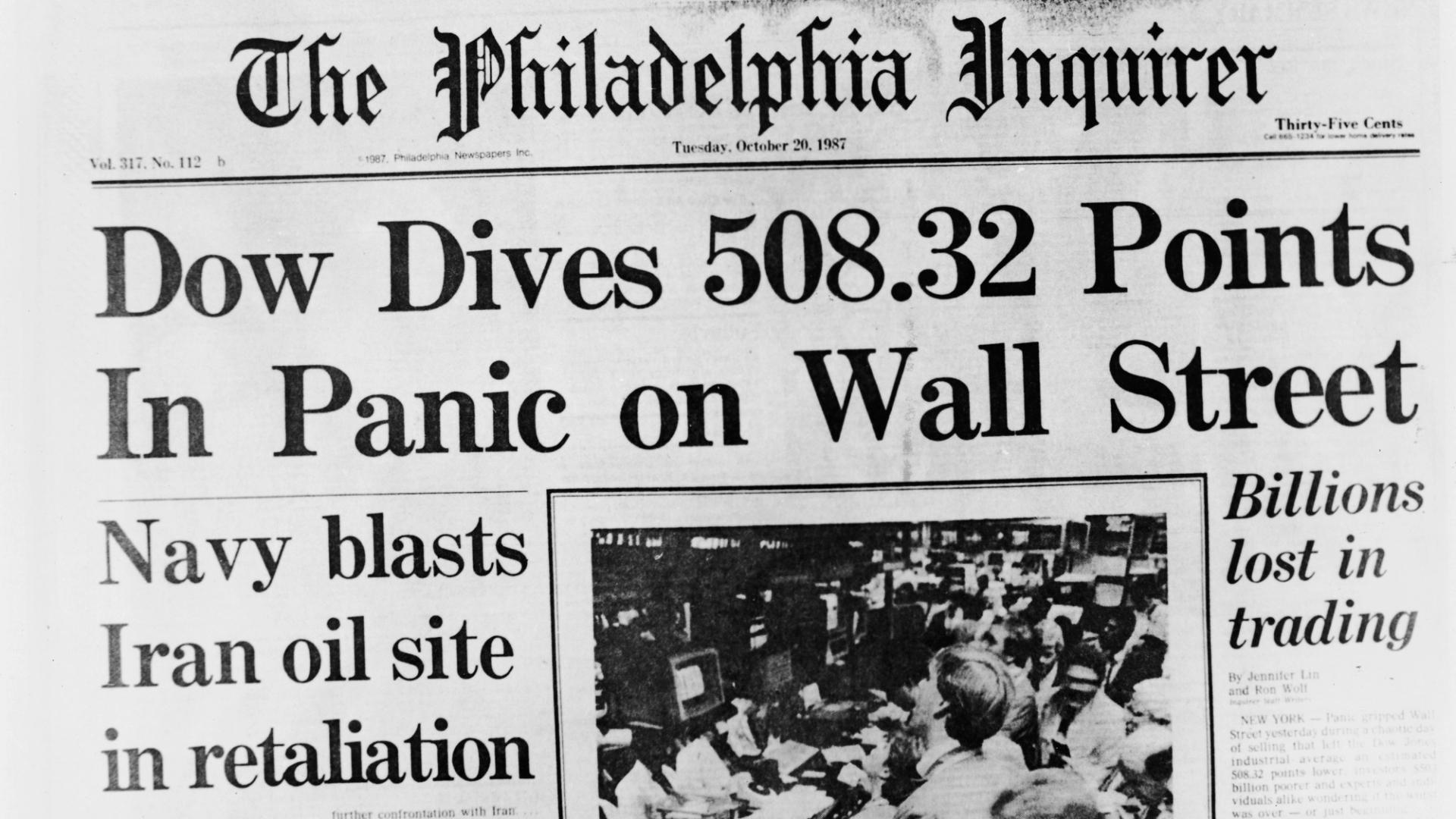
CoinDesk’s Aug. 11 Daybook argues that the recent rise in U.S. Treasury yields is not just macro background noise for crypto markets. The piece says that when the risk-free rate climbs sharply, government bonds begin competing more directly with stocks and other assets for capital, and history shows those adjustments can be painful. Fidelity Investments global macro director Jurrien Timmer pointed to the period from the 1960s through the mid-1990s, when rising Treasury yields made bonds more competitive with equities, and CoinDesk linked that reminder to the 1987 Black Monday crash, when the Dow Jones Industrial Average fell 508.32 points, or 22.6%, in a single day. The article says the comparison matters now because yields have generally moved higher since the 2020 Covid market crash. CoinDesk notes that the 30-year U.S. Treasury yield is hovering near its highest level since 2007 and could climb further if Wednesday’s U.S. CPI comes in above estimates, reinforcing expectations that the Federal Reserve will keep rates higher for longer. In that setting, stocks and bitcoin would both face a tougher valuation test. CoinDesk adds that bitcoin is in a more complicated position than equities because it has no earnings or cash flow, leaving its value tied to its appeal as digital gold and as a hedge against fiat-currency depreciation. The piece stops short of predicting a repeat of history, but says the return of a safer alternative for capital makes forecasts of $500,000 or $1 million bitcoin look stretched.

1110
Rising Treasury yields revive an old warning for bitcoin and stocks, CoinDesk says
Gate
2026-08-07 01:00:06

Gate data shows USD/JPY at 158.534 as gold, silver and oil edge lower

Gate’s latest market data showed the U.S. dollar rising 0.11% against the Japanese yen to 158.534, while USD/CNH added 0.01% to 6.74765. In precious metals, gold fell to $4,232.79 per ounce, down 0.27% on the day, and silver slipped to $61.18 per ounce, down 0.41%. The platform also showed no latest readings for nBVIX, the BTC volatility index, or EVIX, the ETH volatility index, with daily change data unavailable for both. In equities, the Euro Stoxx 50 rose 0.17% to 6,501.49, while the UK100 fell 0.04% to 10,855.4 and the GER40 lost 0.05% to 26,152.7. In commodities, WTI crude dropped 0.26% to $78.09 a barrel and Brent crude fell 0.14% to $84.07. Gate said its TradFi offering allows users to trade traditional financial market products on the platform, including precious metals, forex, global stock CFDs, major indexes and commodities, through its app and web interface.

1150
Gate data shows USD/JPY at 158.534 as gold, silver and oil edge lower
gold
2026-08-06 01:00:03

Gold rises to $4,294.84 an ounce as silver gains 1.99% intraday

Gate’s latest market data showed gold climbing to $4,294.84 per ounce, up 1.13% on the day, while silver rose to $62.645 per ounce with a 1.99% intraday gain. BTC and ETH volatility gauges, nBVIX and EVIX, were unavailable at the time of the update, with daily change fields left blank. In foreign exchange, USD/CNH slipped 0.03% to 6.74575 and USD/JPY edged down 0.01% to 157.729. Major European equity benchmarks were mixed: the Euro Stoxx 50 fell 0.57% to 6,481.97, the UK100 dipped 0.02% to 10,880.7, and Germany’s DAX40 added 0.04% to 26,198.3. In commodities, WTI crude eased 0.12% to $75.21 a barrel, while Brent crude rose 0.09% to $80.23. Gate also said users can trade traditional financial market products on the platform, including precious metals, forex, global stock CFDs, key indices, and commodities, through its integrated TradFi functions on the app and web version.

1080
Gold rises to $4,294.84 an ounce as silver gains 1.99% intraday
SpaceX
2026-08-05 02:32:00

SpaceX Bitcoin Losses, Coldcard Fallout and QUID Listings Lead a Packed Crypto Cycle

A heavy 24-hour news cycle in crypto and adjacent tech markets was led by SpaceX’s first earnings report as a public company, which showed $7.8 billion in second-quarter revenue, 18,712 BTC on its balance sheet, and roughly $540 million in unrealized losses after Bitcoin fell 33% in the quarter. Coldcard’s wallet security incident kept escalating as the company urged users to migrate funds, while Galaxy Digital’s Alex Thorn said at least 15 attackers have now been identified through victim reports and on-chain tracing. In South Korea, Upbit and Bithumb both moved to list QUID, while on-chain flows highlighted a new wallet buying CASHCAT, a 40x leveraged BTC short on Hyperliquid, HYPE unstaking, and another Strategy-linked BTC transfer. Elsewhere, U.S. crypto policy centered on the CLARITY Act and fresh political friction around Trump’s TRUMP meme coin, while institutions expanded tokenized finance, staking, and custody services through Wells Fargo, BNY Mellon, Circle, Dinari, and Cloudflare. Markets also tracked BIP-110 activation risk, lower Bitcoin implied volatility, Ethereum staking policy debate, major AI infrastructure deals, and a long list of company, macro, and semiconductor updates.

1700
SpaceX Bitcoin Losses, Coldcard Fallout and QUID Listings Lead a Packed Crypto Cycle
Silver
2026-08-05 01:01:00

Silver rises to $59.691 an ounce as gold, crude oil and European equities edge higher

Gate data showed a mixed cross-asset picture, with precious metals, oil and parts of Europe’s equity market posting gains. Gold rose 0.12% on the day to $4,082.52 per ounce, while silver climbed 0.74% to $59.691 per ounce. BTC and ETH volatility gauges, listed as nBVIX and EVIX, did not have available quotes, and their daily changes were shown as unavailable. In foreign exchange, USD/CNH was up 0.01% at 6.74836, while USD/JPY slipped 0.06% to 157.557. Among major European stock benchmarks, the Euro Stoxx 50 gained 0.79% to 6,509.12, the UK’s FTSE 100 added 0.05% to 10,911.1, and Germany’s DAX40 fell 0.02% to 26,367.4. In commodities, WTI crude rose 0.22% to $75.77 a barrel and Brent crude increased 0.45% to $80.15 a barrel. Gate also said users can trade traditional financial market products on the platform, including precious metals, foreign exchange, global stock CFDs, key indices and commodities, through its TradFi features on the app and web interface.

1050
Silver rises to $59.691 an ounce as gold, crude oil and European equities edge higher
Bitcoin
2026-08-04 11:23:33

Bitcoin volatility sinks even as hacks, ETF outflows and macro pressure keep piling up

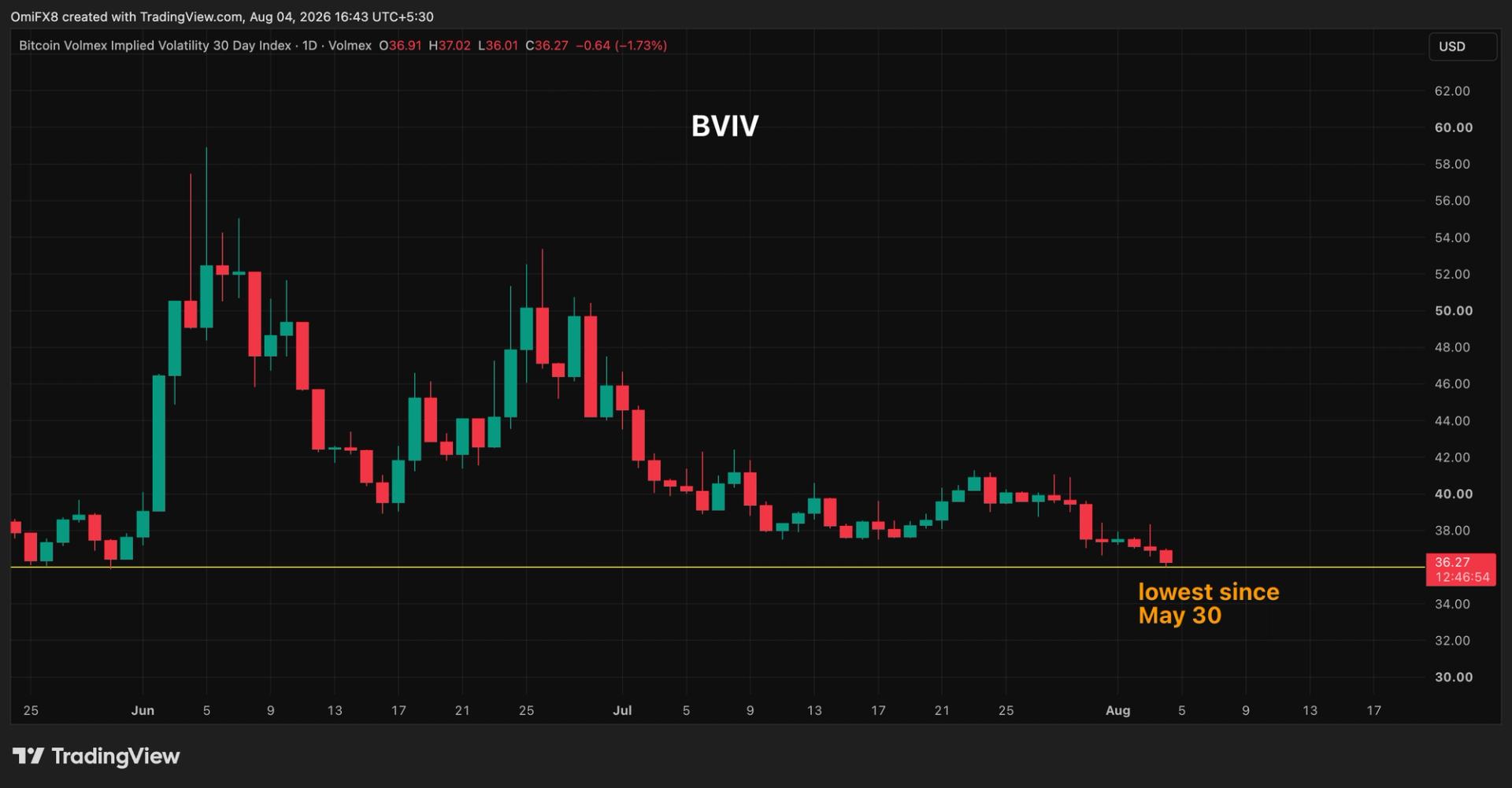
CoinDesk’s Aug. 4 Daybook excerpt says bitcoin is facing no shortage of pressure points: a multimillion-dollar Coldcard hack, weak institutional demand, regulatory uncertainty and a tougher macro backdrop. Even so, the market is not showing signs of panic. Bitcoin’s 30-day implied volatility index, BVIV, has fallen to 36%, its lowest reading since May 31, after being near 60% in early June. That drop suggests traders are not aggressively paying up for protection, even with negative headlines still in play. The report notes that low volatility can sometimes be read as constructive, but it also warns that volatility tends to mean-revert. BVIV is now hovering around levels that have previously acted as a floor, which means a pickup in volatility could follow. If that happens, the move may come with a sharp directional swing in bitcoin, either higher or lower. For now, several indicators still lean bearish. U.S.-listed spot bitcoin ETFs saw $61.53 million in outflows last week, ending a three-week run of modest inflows. USDT’s market cap has slipped to its lowest since October, while USDC remains in a downtrend. Against that backdrop, Bitfinex analysts pointed to roughly 155,000 BTC accumulated in the $62,000 to $65,000 cost-basis range, a cluster they said could help keep BTC range-bound until a stronger catalyst appears.

1180
Bitcoin volatility sinks even as hacks, ETF outflows and macro pressure keep piling up
Bitcoin
2026-08-04 11:27:00

Bitcoin implied volatility drops to 36% as traders stay calm despite a string of negative headlines

Bitcoin’s options market is signaling a far calmer backdrop than the headline flow might suggest. According to CoinDesk, the market has absorbed several sources of pressure without showing obvious signs of panic, including a Coldcard wallet attack involving tens of millions of dollars, softer institutional demand, and lingering uncertainty around regulation and the macro environment. At the same time, the 30-day Bitcoin Volatility Index, or BVIV, has continued to fall and now stands at 36%, its lowest level since May 31 and well below the nearly 60% level seen in early June. BVIV tracks expectations for future price swings in the Bitcoin options market and typically rises when traders seek protection or hedge risk. Analysts cited in the report said the market’s ability to remain composed during a run of bad news is often read as a constructive sign, suggesting Bitcoin may still have room to move higher. Even so, volatility tends to mean-revert. With BVIV now near levels that have previously acted as support, a sharp rebound in volatility could coincide with a larger directional move in Bitcoin, whether up or down.

1090
Bitcoin implied volatility drops to 36% as traders stay calm despite a string of negative headlines