BackBipartisan

Bipartisan

Policy Regula
2026-08-11 02:44:49

Patrick Witt: Administration Still Committed to CLARITY Act Passage in September

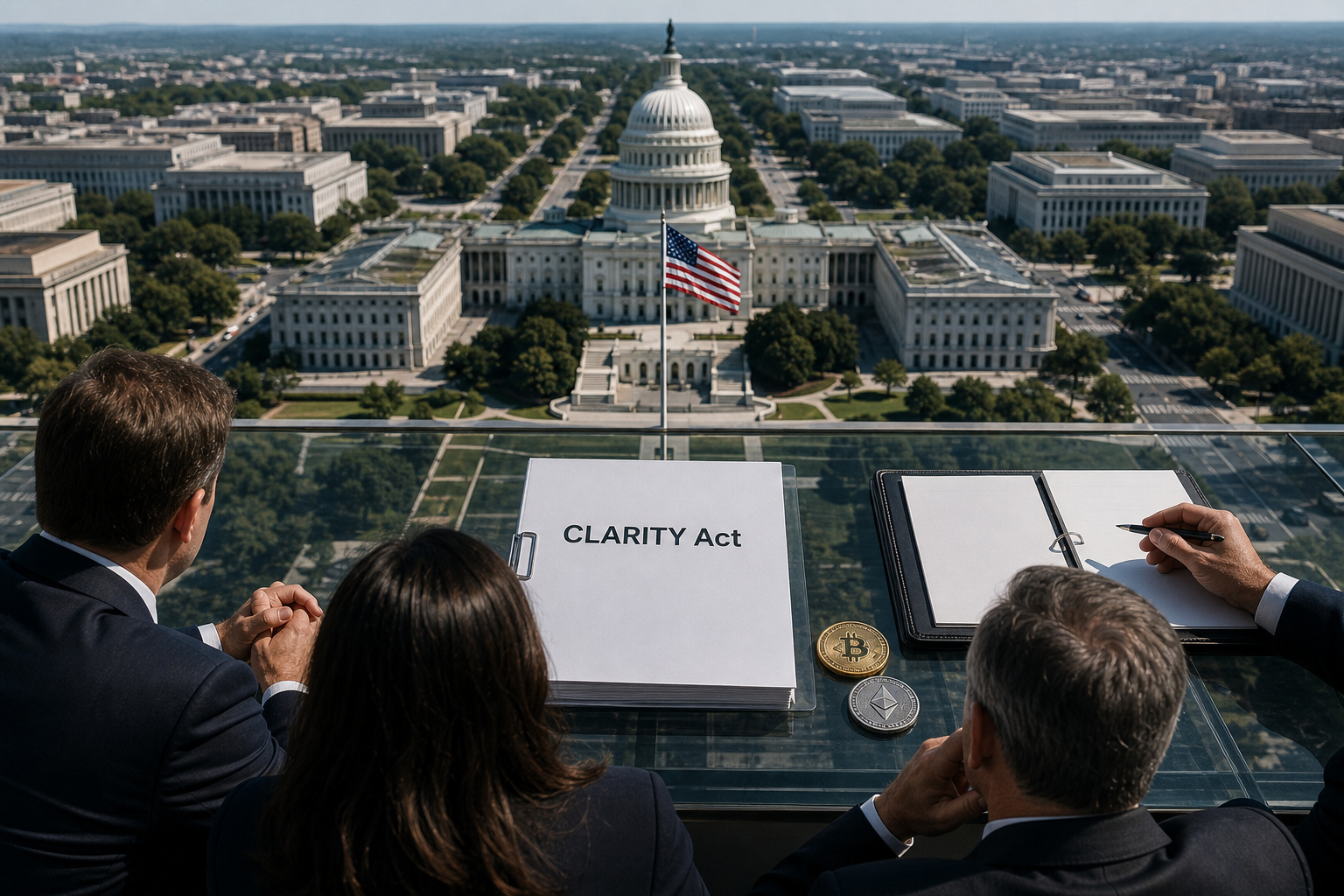
Patrick Witt took to X to state that the U.S. government remains committed to seeing the CLARITY Act pass in September. In his view, only legislation can establish durable rules for the digital asset sector, and the need for such rules is greater now than ever before. He directed criticism at Democrats, saying that each delay of the bill sets America further behind in the cryptocurrency race, eroding its position as a global financial market leader, weakening national security, and taking away the tools law enforcement needs to fight crypto-related crime. Witt described the CLARITY Act as the outcome of years of real bipartisan work, and reiterated that Democrats still have an opportunity to shape U.S. digital asset policy by assisting with its passage. He also stated that the government will maintain an open stance and keep engaging in good-faith negotiations right up to the September vote.

570
Patrick Witt: Administration Still Committed to CLARITY Act Passage in September
Brian Armstro
2026-08-06 23:19:28

Brian Armstrong Calls for Vote on Bipartisan Crypto Legislation

Brian Armstrong said in a post on X that the Senate secured CLARITY a year ago, followed by negotiation over hundreds of pages of changes, agreement on SEC and CFTC nominations, and unprecedented ethics commitments. With crypto and banking compromises in place, he argues the only remaining question is whether some groups will try to delay or block widely supported bipartisan legislation. Millions of Americans hold crypto and are watching; it is time to vote.

590
Brian Armstrong Calls for Vote on Bipartisan Crypto Legislation
CLARITY Act
2026-08-05 07:46:06

Lummis Urges Senate Democrats Not to Block Bipartisan CLARITY Act

U.S. Senator Cynthia Lummis is urging Senate Democrats not to block the bipartisan CLARITY Act, according to Cointelegraph. She says the measure would protect consumers and keep the cryptocurrency industry in the United States. The bill aims to provide legal clarity for digital asset regulation. Lummis’s push underlines the need for bipartisan cooperation in building a regulatory framework that balances innovation and protection.

600
Lummis Urges Senate Democrats Not to Block Bipartisan CLARITY Act
Apple
2026-07-30 02:36:37

Bipartisan U.S. senators press Apple to rule out CXMT and YMTC memory chips by Aug. 21

Six bipartisan U.S. senators have urged Apple CEO Tim Cook to publicly commit by Aug. 21 that Apple will not use memory products from China’s CXMT or YMTC in any Apple device. According to Bloomberg, the letter was led by Republican Senator Jim Banks of Indiana and Democratic Senator Chuck Schumer of New York, with four other lawmakers joining the appeal. The senators challenged the case for using Chinese memory on three fronts: price, supply-chain creep beyond China-only models, and export-control risks tied to technical data shared during supplier qualification. The pressure comes as Apple faces a tight global memory market. Research cited in the report said DRAM contract prices rose about 90% to 95% quarter over quarter in the first quarter of 2026, while NAND Flash prices climbed 55% to 60%. A DDR5 32GB module was said to have risen from $149 to $239. Bloomberg previously reported that Apple had been lobbying the White House for room to buy Chinese-made memory chips, while MacRumors said in early July that Apple had begun testing DRAM samples from CXMT. The lawmakers also tied the issue to U.S. industrial policy. Micron has expanded its investment plan to $250 billion across New York, Idaho and Virginia, with a target of bringing 40% of DRAM output back to the U.S., while SK hynix plans about a $4 billion advanced packaging facility in West Lafayette, Indiana.

690
Bipartisan U.S. senators press Apple to rule out CXMT and YMTC memory chips by Aug. 21
CXMT
2026-07-28 02:03:46

July 28 crypto and tech roundup: CXMT’s blockbuster debut, domestic DUV production, and a packed day for AI and regulation

July 28 brought a dense mix of crypto market moves, semiconductor headlines, AI developments, and regulatory updates. In equities tied to China’s chip sector, CXMT posted a 465.82% gain on its first trading day, with turnover topping RMB 140 billion and market capitalization reaching RMB 3.28 trillion. Separate reporting cited by The Information said a Shanghai state-backed company has started mass production of self-developed DUV lithography manufacturing equipment, with output planned at around five units in 2026 and about 20 in 2027; SMIC, Hua Hong Semiconductor, and CXMT were named as intended customers. In crypto, most of the highest-volume CEX tokens were down over the past 24 hours, while AEON led the OKX gainers list with an 84.28% rise. Hyperliquid data around the CXMT IPO drew attention after Allium said pre-listing volume reached $17.8 million and that 96% of smart-money accounts had established profitable shorts before the open. Elsewhere, Strategy disclosed its first buyback of Stretch STRC shares under its digital credit securities repurchase plan, and Triple-A’s reported exploit losses expanded to $11.8 million. On policy, BlackRock backed the CLARITY Act, but the U.S. Senate temporarily set the bill aside, while lawmakers in Japan called for easing the country’s 2x crypto leverage cap.

840
July 28 crypto and tech roundup: CXMT’s blockbuster debut, domestic DUV production, and a packed day for AI and regulation
Pennsylvania
2026-07-27 20:23:21

Pennsylvania bill would bar gambling companies from making markets on prediction platforms

Bipartisan lawmakers in Pennsylvania have introduced House Bill 2711, a proposal that would prohibit sports betting operators and other gambling businesses from serving as liquidity providers or market makers on prediction platforms. The measure was introduced on July 22 by state Representative Tarik Khan and has been referred to the House Consumer Protection, Technology and Utilities Committee. The bill would also block prediction platforms from entering contracts with, or sharing revenue with, companies that are normally engaged in gambling activities. Its scope extends to parent companies, subsidiaries, affiliates, joint ventures, employees, and entities acting for another company’s financial benefit. The proposal comes as DraftKings and Flutter have both moved into market-making activity, with DraftKings recently launching the DKeX exchange after acquiring CFTC-registered company Railbird Technologies. HB 2711 would set a minimum participation age of 21 and require platforms to exclude self-excluded users, company employees, settlement-source employees, and people with insider information. It also calls for commercially reasonable safeguards against fraud, manipulation, and misuse of material nonpublic information. A separate companion bill, HB 2497, would create a licensing requirement and impose a combined 22% tax on prediction betting platform revenue. Neither measure has yet received a committee vote or hearing.

640
Pennsylvania bill would bar gambling companies from making markets on prediction platforms
Policy and Re
2026-07-24 14:16:02

Bipartisan U.S. lawmakers introduce CATS Act to counter AI distillation attacks

A bipartisan group of U.S. lawmakers has introduced the Countering Adversarial Threats and Security Risks Act, or CATS Act, aimed at helping American AI labs and security teams respond to foreign attempts to extract advanced model capabilities at low cost. According to a news release from Senator Adam Schiff’s office, the bill would create a statutory antitrust exemption so non-federal entities can share threat intelligence in good faith when addressing covered AI security risks. It would also permit companies, with prior written notice and solely for risk-reduction purposes, to coordinate delays or limits on the deployment of high-risk AI models. The proposal specifically targets so-called AI distillation attacks, described as systematic efforts by foreign labs to issue millions of queries to leading U.S. models, harvest data, and train advanced systems more cheaply. The bill names coordination channels including the National Security Agency’s AI Security Center, the National Institute of Standards and Technology’s CAISI, and the Frontier Model Forum. It also includes safeguards allowing the attorney general to seek injunctions against misuse of the exemption. Supporters cited in the report include Google, Andreessen Horowitz, the Center for AI Safety Action Fund, and the Software & Information Industry Association.

980
Bipartisan U.S. lawmakers introduce CATS Act to counter AI distillation attacks