BackCALIBER

CALIBER

Galaxy Digita
2026-07-19 12:03:13

Galaxy says on-chain capital markets for AI inference are starting to take shape

Galaxy Digital research vice president Lucas Tcheyan argues that an “on-chain inference capital market” is beginning to emerge as AI inference, GPU supply, payment rails, tokenization tools and financing infrastructure converge into a more integrated system. In the piece, republished by WuBlockchain and translated by TechFlow, he frames inference as a fast-growing economic layer that is moving beyond centralized APIs controlled by companies such as OpenAI and Anthropic. The report breaks the market into several connected parts. On the off-chain side, GPU index providers including Ornn and Silicon Data are trying to standardize compute pricing, while ICE and CME have announced plans for GPU futures. On-chain, the stack includes decentralized inference providers, model developers, router layers, agent payment standards, tokenized access markets and credit protocols that finance GPU hardware. Tcheyan focuses on four examples. Venice turns future inference access into transferable claims through its VVV and DIEM token structure. Pearl and Ambient try to tie network security to real inference work through “useful proof of work,” though both still face open questions around real demand and token value capture. USD.AI takes a different route by using stablecoin deposits to fund GPU-backed loans for smaller compute operators. Galaxy’s conclusion is that the sector remains early: financing has found the clearest product-market fit so far, while the broader tokenized inference economy still needs to prove durable demand, execution and pricing power.

1550
Galaxy says on-chain capital markets for AI inference are starting to take shape
Galaxy Digita
2026-07-16 04:54:26

Galaxy maps the emerging market for AI inference as a financial asset, from GPU futures to tokenized access and on-chain credit

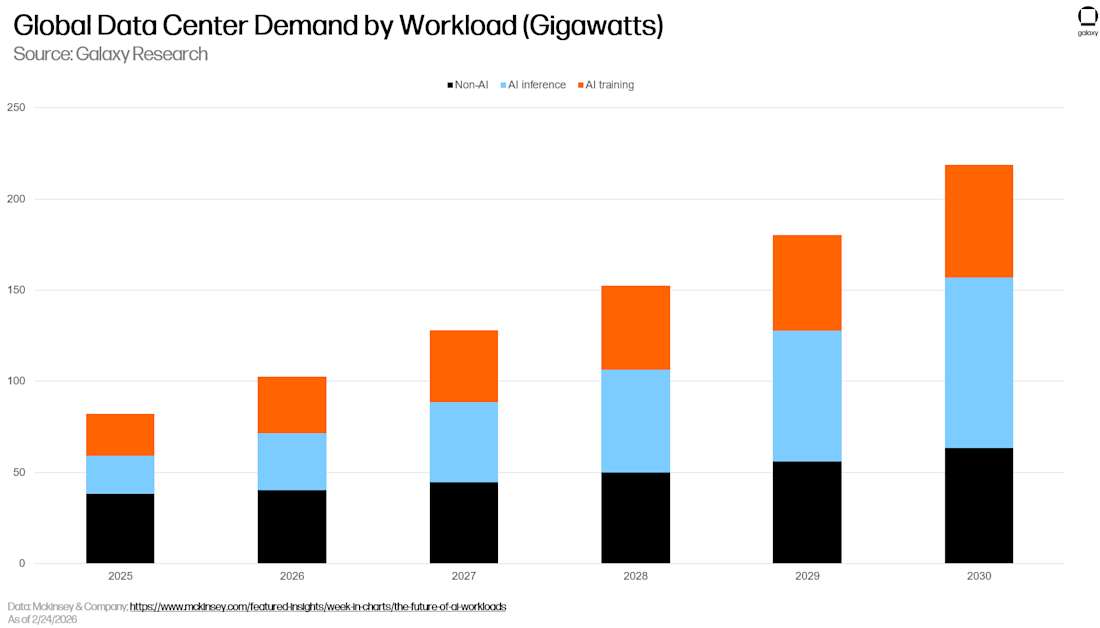
Galaxy Digital has laid out a broad framework for what it calls the “inference capital markets,” arguing that AI inference is moving from a purely technical service into an asset class that can be priced, hedged, financed and traded. In a research report written by Galaxy Digital Vice President of Research Lucas Tcheyan and circulated in Chinese by TechFlow, the firm links several parallel developments into one market structure: the rise of GPU price indexes, planned GPU futures from Intercontinental Exchange and CME Group, tokenized claims on future AI inference, useful proof-of-work networks that subsidize inference production, and stablecoin-funded lending against GPU hardware. The report’s central claim is that inference has now overtaken training as the main driver of global GPU demand, while autonomous agents are emerging as a new class of machine-native buyers that can pay for model output programmatically. Galaxy argues that the market is still early and fragmented. It sees progress on the off-chain side, where Ornn, Silicon Data and Compute Desk are building reference pricing for compute, and where Kalshi, ICE and CME are already moving toward tradable GPU-linked products. On-chain, the report highlights Venice’s VVV and DIEM system for tokenized inference access, Pearl and Ambient’s different attempts to turn inference production into useful proof-of-work, and USD.AI’s stablecoin-based credit model for financing AI hardware. Even so, the report says the sector has not yet solved its hardest questions: whether real demand for verifiable, censorship-resistant inference will grow beyond a niche, how token value can be tied to actual product usage instead of emissions and speculation, and whether legal enforcement and collateral recovery in GPU-backed lending can hold up in a true stress cycle.

1440
Galaxy maps the emerging market for AI inference as a financial asset, from GPU futures to tokenized access and on-chain credit
USDai
2026-07-10 15:39:13

USDai’s CALIBER Targets $300 Million Valuation After Launch

USDai’s CALIBER protocol is gaining strong market backing for a post-launch valuation above $300 million, driven by demand for on-chain AI financing and a model that uses tokenized NVIDIA GPUs as collateral on Base.

300
USDai’s CALIBER Targets $300 Million Valuation After Launch