CCTP

DeFi
2026-08-13 06:41:13

DeFi whale loses another $25 million as stolen funds move through CCTP to Hyperliquid

A DeFi whale lost roughly $25 million to $26 million after multiple wallets were drained within 15 minutes early on Aug. 13, according to Scam Sniffer and on-chain tracking cited by Foresight News. The stolen assets included DAI, WBTC, aUSDC, LDO, sUSDe, and native ETH. Analyst Ember said three wallets were affected, including one address with no prior token approval history, a detail that suggests the incident may have involved direct private key compromise rather than a standard approval-phishing attack. On-chain records show the victim’s main wallet and a related address moved assets to a newly created recipient wallet around 5:05 on Aug. 13. Within about an hour, tokens including WBTC, cbBTC, LDO, USDS, CRV, and sUSDe were swapped into DAI and ETH. Of that amount, 20 million DAI was sent to a downstream address labeled by Arkham as a separate entity and had not moved again as of publication. Other ETH was split into batches, routed through smart contracts, swapped to USDC on Uniswap, sent to Circle’s Token Minter, bridged to Arbitrum through CCTP, and then deposited into Hyperliquid. The same victim had already suffered a phishing loss of about $24.23 million in September 2023 after signing a malicious increaseAllowance transaction.

350
DeFi whale loses another $25 million as stolen funds move through CCTP to Hyperliquid
Circle
2026-08-08 15:26:54

Inside Circle’s “other revenue”: how chain integrations, USYC, CCTP and Arc shape CRCL’s second growth track

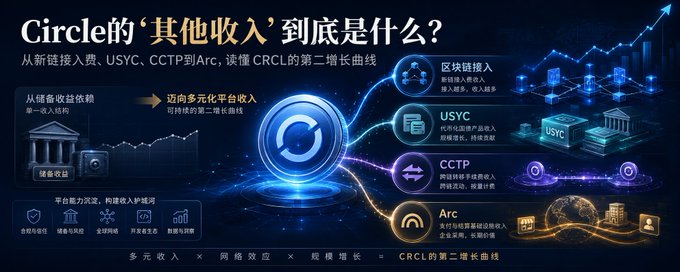
Circle’s core business is still easy to grasp: users hold USDC, and the company earns interest on reserves invested mainly in short-dated U.S. Treasuries, money market funds, and cash-like assets. What is harder to parse is the “other revenue” line in Circle’s filings, which management has used to support a broader pitch that the company should be valued as an internet financial platform rather than only as a stablecoin issuer tied to reserve yields. According to the company’s SEC disclosures cited in the source material, that line combines several very different kinds of revenue: one-time blockchain integration fees, recurring maintenance and subscription payments, software licensing, USYC fund management fees, redemption fees tied to Circle-issued assets, blockchain rewards, transaction revenue from infrastructure such as Cross-Chain Transfer Protocol, and Arc-related accounting revenue from token presales. That mix matters because growth in the line item does not automatically mean growth in predictable, high-quality recurring income. The article tracks Circle’s other revenue across 2025 Q4, 2026 Q1, and 2026 Q2, reviews which chains were launched in each period, and highlights why quarterly figures can be uneven. It also argues that the higher 2026 guidance appears to include about $160 million of ARC token presale revenue, a category that should not be treated the same way as recurring platform income when investors assess CRCL.

520
Inside Circle’s “other revenue”: how chain integrations, USYC, CCTP and Arc shape CRCL’s second growth track
Squid
2026-08-07 11:03:38

Squid’s token launch turned dramatic: funding, a hack three days later, and a Binance Alpha debut 74 days after

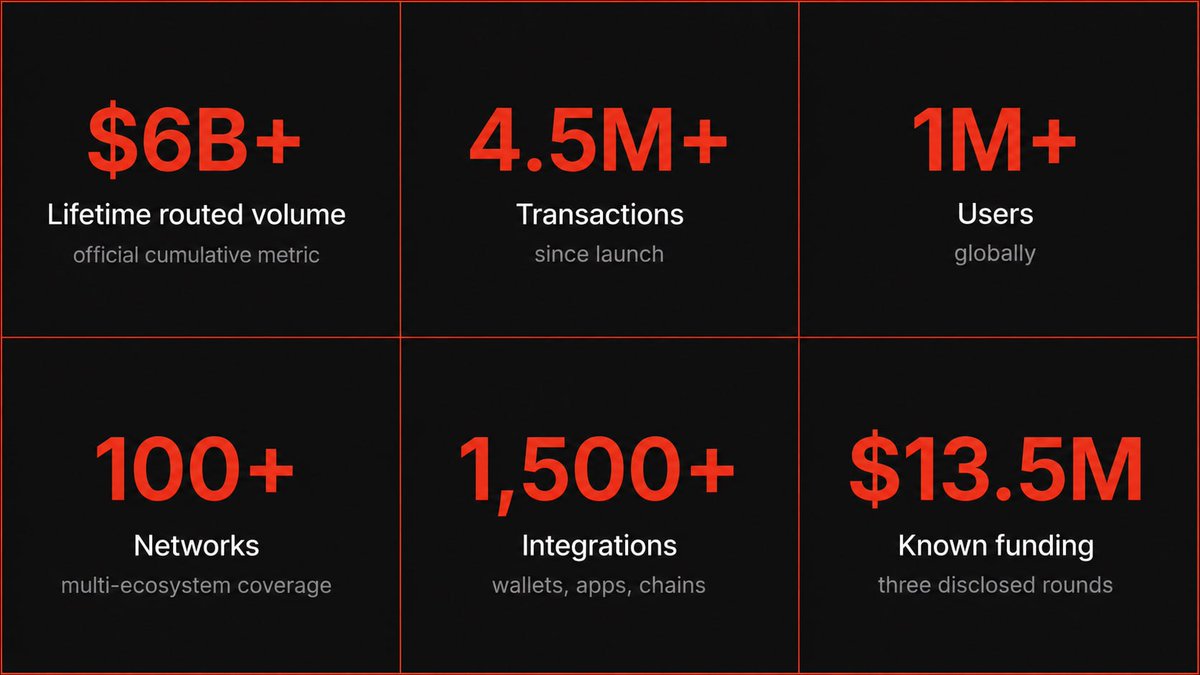
Cross-chain routing protocol Squid took an unusual path to token issuance. The project had already been running on mainnet for three and a half years, routing more than $6 billion in volume, before introducing its native token, QUID, in 2026. On May 22, Squid announced a $6 million strategic funding round led by North Island Ventures with participation from Ripple, bringing total funding to $13.5 million. Three days later, on May 25, a third-party Gnosis Safe module tied to the Squid name was exploited, with losses reported at roughly $3 million in the article’s headline framing and about $3.2 million to $4 million in the detailed account. The core routing contracts, according to Squid, were not affected. QUID’s public sale opened from June 30 to July 3 on Legion and Kraken at $0.045 per token, with a $2.25 million hard cap. The sale drew about $26.66 million in subscriptions, or around 11.9 times oversubscribed, from 3,542 participants across 78 countries. On Aug. 4 at 13:00 UTC, QUID held its token generation event and debuted first on Binance Alpha, followed by Kraken, Bitget, Upbit, Bithumb, MEXC, and later LBank, BingX, and XT. The token rose from its public sale price to a peak of $0.14 and was trading around $0.09 to $0.11 as of Aug. 7.

820
Squid’s token launch turned dramatic: funding, a hack three days later, and a Binance Alpha debut 74 days after
Circle
2026-08-06 13:34:07

Circle’s Arc targets stablecoin infrastructure with USDC gas, deterministic settlement, and institution-focused privacy

Circle, the issuer of USDC, has rolled out Arc, a purpose-built Layer 1 blockchain designed for stablecoin applications rather than general-purpose crypto activity. The company says the network is meant to fix several constraints it sees in existing chains, including volatile fees, probabilistic settlement, weak privacy controls for sensitive commercial use, and fragmented liquidity across ecosystems. Arc uses USDC as native gas and can also support other stablecoins through a paymaster model. Circle says its fee system borrows from Ethereum’s EIP-1559 design but replaces block-by-block adjustments with a weighted moving average tied to network demand, with fees denominated in USDC and routed to an on-chain Arc Treasury. The network’s public testnet launched in October 2025, while the public mainnet is scheduled to open on September 16, 2026. Circle says Arc is already in a private mainnet phase with more than 100 ecosystem and institutional builders. CEO Jeremy Allaire said in August 2026 that the testnet had processed more than 500 million transactions across nearly 3 million wallets. The company has also named a validator lineup that includes BlackRock, DTCC, Galaxy, Global Payments, ICE, Mastercard, MoneyGram, SBI Group, Standard Chartered, Sumitomo Corporation, Visa, and Circle itself.

310
Circle’s Arc targets stablecoin infrastructure with USDC gas, deterministic settlement, and institution-focused privacy
RWA
2026-07-31 10:31:16

RWA weekly: 10 European financial institutions launch RL1 as Ondo unveils Ondo Network

Real-world asset markets kept expanding in the week covering July 24 to July 31, 2026, even as stablecoin settlement activity remained weak. Data from RWA.xyz showed on-chain RWA market capitalization reached $36.82 billion as of July 31, up 2.43% from a month earlier, while the number of holders climbed to 1.4469 million, a 40.81% monthly increase and the largest monthly gain on record. In stablecoins, total market capitalization was largely unchanged at $296.63 billion, but monthly transfer volume dropped 29.29% to $5.07 trillion, extending a sharp slowdown in on-chain settlement demand. Regulation also moved across several jurisdictions. South Korea advanced work on a comprehensive digital asset bill that would cover stablecoin issuance and exchange standards, while lawmakers are also set to review an opposition proposal to scrap a crypto tax scheduled for 2027. Kenya lowered the minimum paid-up capital requirement for stablecoin issuers by 40% to about $2.32 million, and Zimbabwe approved seven crypto and tokenization projects for its regulatory sandbox. On the industry side, the Bank for International Settlements-led Project Agorá completed a live cross-border payment test worth about $1 million across six currencies with five central banks and 28 commercial banks. In Europe, 10 financial institutions formed the Regulated Layer One cooperative, or RL1, to build tokenized asset infrastructure for regulated markets. Ondo Finance also introduced Ondo Network, a new execution layer that replaces the prior Ondo Chain direction.

790
RWA weekly: 10 European financial institutions launch RL1 as Ondo unveils Ondo Network
Policy Regula
2026-07-25 09:07:00

Stablecoin exchange inflows hit 2025 low as U.S. spot Bitcoin ETFs post $240 million daily outflow

PANews’ July 25 daily roundup collected a broad set of crypto regulatory, market, project, funding, and data developments, led by two market signals: analysts said stablecoin inflows to exchanges have fallen to their lowest level of 2025, while U.S. spot Bitcoin ETFs recorded a combined net outflow of $240 million on July 24, with BlackRock’s IBIT accounting for $212 million of that figure. The report also covered a Hong Kong court sentencing Xiao Rui, son of former Wuhan supervisory official Xiao Jun, to six years and nine months in prison in a money-laundering case involving more than HK$64 million; Thailand’s SEC filing criminal complaints against Bitkub Online and two former directors over disclosures tied to a 2021 theft; and India’s move to ask GitHub to remove repositories for Bitchat, an offline messaging app backed by Jack Dorsey. On the project and corporate side, PANews highlighted Robinhood’s talks with Crypto.com on prediction markets, Across Protocol’s post-mortem on a relayer incident, LayerZero’s plan to wind down support for 20 low-activity chains, Phantom’s scheduled end of support for Monad, BlackRock’s transfer of about 3,126 BTC to Coinbase Prime, Circle’s mint of 250 million USDC, and World Foundation’s $52.5 million strategic WLD sale led by Pantera Capital. The roundup also included updates on Anduril, LMAX, B2C2, Capital Group, ARK, Kinetic Group, Bitcoin volatility, and Hyperliquid buybacks.

1000
Stablecoin exchange inflows hit 2025 low as U.S. spot Bitcoin ETFs post $240 million daily outflow
Across Protoc
2026-07-25 02:28:49

Across Protocol says Relayer incident left net loss below $4 million

Across Protocol has released a post-incident report on a Relayer security event tied to Solana operations. The report says an attacker exploited a vulnerability in Risk Labs’ offchain software for reading Solana events and forged 1,627 fake deposit events with a total face value of about $41.7 million. Before Solana services were paused, the Relayer advanced funds for 581 of those transactions, using roughly $4.5 million of its own capital. The remaining fake deposits, worth about $37 million, were rendered invalid. Across Protocol said the incident did not involve a smart contract vulnerability. It added that all user transfers were either completed the same day or fully refunded. According to the report, losses were limited to Risk Labs’ own relayer capital, and after accounting for about $500,000 in attacker funds, net losses were below $4 million. The team also said Solana order flow has now been shifted to route entirely through CCTP, while the ACX token buyback plan remains unchanged.

750
Across Protocol says Relayer incident left net loss below $4 million