CPU

GF Securities
2026-08-13 05:29:11

GF Securities says AI stock correction is nearing an end as capital rotates from memory to CPO optics

Hong Kong-based GF Securities said in its August technology sector report that the July pullback in AI-linked stocks is close to ending, with the Philadelphia Semiconductor Index seeing its forward P/E fall to 27x and crowded leveraged positions largely cleared out. The firm added AMD, Foxconn and Lumentum to its preferred list while removing United Microelectronics, MediaTek and ASML, arguing that current leadership is concentrated in GPU, CPU and optics rather than mature-node foundry, smartphone chips or front-end lithography. GF Securities also said supply-chain capital is rotating away from memory components toward optical interconnects, with near-packaged optics and co-packaged optics emerging as the next focus. It projected U.S. cloud service providers’ capital expenditure growth at 85% in 2026, 45% in 2027 and about 20% in 2028, while estimating debt issuance at $257 billion in 2026 and $419 billion in 2027. The report said net leverage should still stay around 0.5x by 2029. At the same time, it kept a cautious near-term view on smartphones and warned that NAND oversupply could begin to surface in the second half of 2027.


600
GF Securities says AI stock correction is nearing an end as capital rotates from memory to CPO optics
Bernstein
2026-08-13 02:02:49

Bernstein lifts WFE outlook through 2028, with DRAM and logic spending driving a 75% two-year rise

Bernstein has raised its global wafer fab equipment, or WFE, spending forecasts for 2026 through 2028 and says the current upcycle in chip equipment spending still has room to run. The firm now expects WFE to reach $148 billion in 2026, $204 billion in 2027, and $259 billion in 2028, up from prior estimates of $141 billion, $175 billion, and $198 billion. That implies cumulative growth of 75% over two years. The upgrade spans most applications and regions, but Bernstein said the larger contribution comes from memory outside China and from foundry and logic spending in China. DRAM and NAND are expected to post the fastest growth, outpacing logic and foundry. For 2027, Bernstein forecasts DRAM WFE at $69 billion, NAND at $20 billion, and logic/foundry at $104 billion, each above its earlier projections. The report also points to stronger-than-expected resilience in China. Bernstein forecasts China WFE demand at $57 billion in 2026, $57.3 billion in 2027, and $101 billion in 2028, with a sharp step-up tied to broad capacity expansion across memory, advanced logic, and mature logic. It also said recent pullbacks in semiconductor equipment stocks have created more attractive entry points, while warning that the views, ratings, and price targets cited are those of Bernstein analysts and do not constitute investment advice.

1530
Bernstein lifts WFE outlook through 2028, with DRAM and logic spending driving a 75% two-year rise
Goldman Sachs
2026-08-12 11:30:55

Goldman Sachs Holds Buy Rating on Nvidia, $285 Target Ahead of Q2 Earnings

On August 12, Goldman Sachs analyst James Schneider reaffirmed a Buy rating on Nvidia with a price target of $285, just ahead of the company's second-quarter earnings report. The bank expects investor attention to center on details of a $500 billion financing platform announced with partners, the second-half ramp of Rubin products, future gross margin trends, and potential upside for CPUs from agentic AI. The note, reported by BlockBeats, keeps Goldman's stance unchanged as Nvidia prepares to report results.

510
Goldman Sachs Holds Buy Rating on Nvidia, $285 Target Ahead of Q2 Earnings
Luke Dashjr
2026-08-12 02:56:51

Luke Dashjr selects BLAKE2b as the new PoW algorithm for the BIP-110 chain

Luke Dashjr has selected BLAKE2b, using a random process, as the new proof-of-work algorithm for the BIP-110 chain, replacing the SHA-256d algorithm currently used by Bitcoin. According to ChainCatcher, BLAKE2b is better suited to mining with general-purpose CPUs and GPUs and is more CPU-friendly than SHA-256d, which would reduce the advantage held by existing Bitcoin ASIC miners. The report also referenced an earlier update saying Dashjr plans to formally activate the BIP-110 hard fork on Sept. 1, turning it into an independent blockchain and creating a new token distinct from Bitcoin. Separately, earlier reports said Dashjr had already lost his Bitcoin BIP editor permissions after they were revoked by the Bitcoin BIP editor team.

2390
Luke Dashjr selects BLAKE2b as the new PoW algorithm for the BIP-110 chain
Strategy
2026-08-11 09:41:00

Strategy builds a $4.65 billion cash reserve as Trump Media posts $360.6 million crypto loss in the first half

PANews’ daily roundup on Aug. 11 centered on two balance-sheet stories with direct relevance to crypto markets. Strategy said it sold 1,690 BTC last week and lifted its U.S. dollar reserve to about $4.65 billion, while also raising roughly $653 million through its at-the-market equity program. CEO Phong Le said the company had adjusted its approach because bitcoin alone could not meet investor demand, adding that institutional investors place greater value on cash and that Strategy now holds $4.75 billion in cash, enough to cover roughly 2.7 years of preferred dividends. Trump Media, by contrast, reported a first-half loss of $360.6 million tied to the decline in crypto asset prices. As of June 30, the company held 9,477.16 BTC with a fair value of $557.1 million, down by 65 BTC from the end of March, while its Cronos holdings stayed unchanged at about 756.1 million tokens but fell in fair value from $68 million at the end of 2025 to $40.6 million. The report also noted that most of its bitcoin had been pledged as collateral. Elsewhere, South Korea approved tougher crypto rules that tighten scrutiny of exchange major shareholders and remove the 1 million won threshold for the Travel Rule, extending it to all transfers. U.S. spot bitcoin ETFs recorded a net outflow of $145 million on Aug. 10, with BlackRock’s IBIT seeing the largest single-day net outflow at $53.56 million.

610
Strategy builds a $4.65 billion cash reserve as Trump Media posts $360.6 million crypto loss in the first half
Whale Activit
2026-08-11 02:09:00

Overnight crypto and AI roundup: whale moves, treasury reshuffles, and fresh policy signals

A dense batch of overnight developments across crypto and AI put institutional treasury moves, exchange remediation, Ethereum roadmap changes, and U.S. regulatory timing in focus. Strategy disclosed share sales, BTC disposals, and a larger dollar reserve, while BitMine and Sharplink updated major ETH accumulation plans. Bitget published a compensation plan tied to abnormal price moves in TUT, LOBSTER, and BICO perpetual contracts, and the U.S. Securities and Exchange Commission said it will review a proposed customized issuance framework for certain crypto-related investment contracts on Aug. 14. Elsewhere, Vitalik Buterin’s latest Ethereum roadmap comparison elevated quantum resistance, privacy, and AI-assisted verification, large wallets continued moving BTC and ETH, and several AI infrastructure financings pointed to growing use of debt markets to fund chip purchases and compute buildouts.

950
Overnight crypto and AI roundup: whale moves, treasury reshuffles, and fresh policy signals
Intel
2026-08-11 03:36:19

Intel share sale draws more than $100 billion in demand, deal may expand to $20 billion

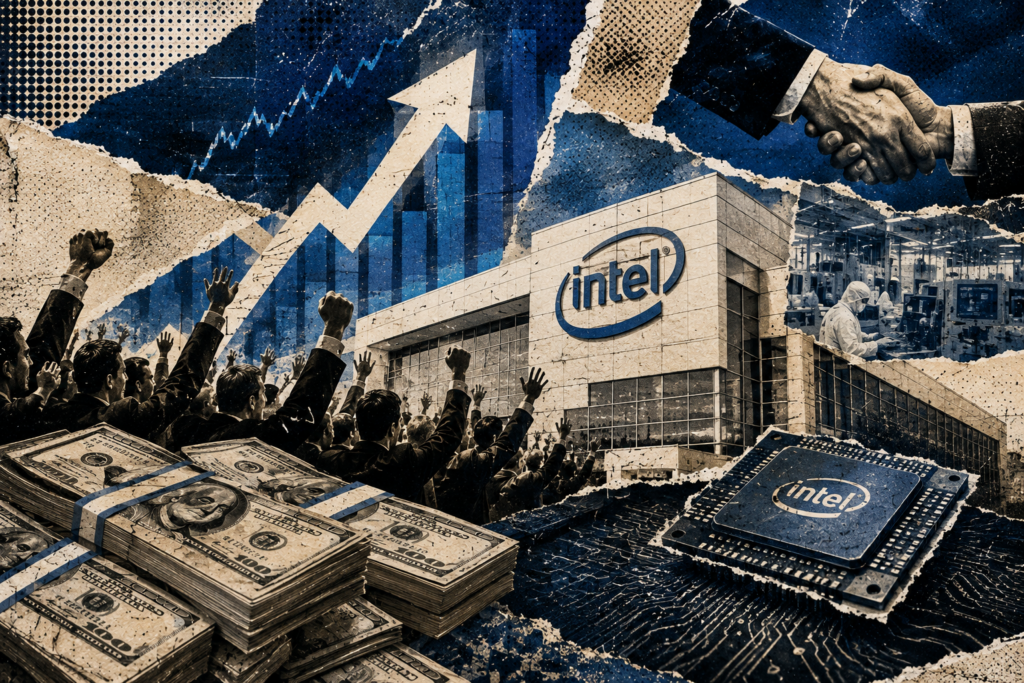
Intel’s planned common stock sale has drawn more than $100 billion in investor orders, according to people familiar with the matter, giving the chipmaker room to consider increasing the size of the deal from $15 billion to about $20 billion. The company announced the offering on Aug. 10, and the response has been far stronger than expected. People familiar with the sale said the shares are being marketed at around $95 each or higher, a discount of roughly 6.5% to the previous Friday’s close. JPMorgan, Goldman Sachs, Morgan Stanley and Citigroup are acting as underwriters. The syndicate also has a 30-day option to purchase up to $2.25 billion in additional shares. Intel said the proceeds would be used for general corporate purposes, including capital expenditures and working capital, with spending focused on physical AI, custom chips, advanced packaging and foundry operations. CFO Sinsner said the company wants to send a signal to customers that it has confidence across all of its businesses, while CEO Chen Liwu said AI demand is outpacing supply and CPU orders already exceed current manufacturing capacity.

140
Intel share sale draws more than $100 billion in demand, deal may expand to $20 billion
AI Agents
2026-08-11 00:17:09

AI agents are pushing storage into the runtime loop, reshaping the role of SSDs, HBM and memory tiers

A MarsBit report argues that AI agents are changing storage from a passive persistence layer into part of the execution path itself. As agents continuously observe, reason, call tools, write back results and preserve state, the value of storage is no longer limited to saving data after a task is complete. The report says SSDs are beginning to take on functions tied to model weights, KV cache spillover, indexing, encryption, compression, lifecycle control and long-term memory, pointing to a broader shift toward programmable, functional SSDs. The piece lays out how this transition could play out on both devices and in the cloud. On the edge, SSDs may become the long-lived state layer for personal agents, holding local models, adapters, vector indexes, personal memory and tool traces. In cloud deployments, storage nodes could move closer to the inference path, handling shared prefixes, KV data, adapters, vector search and governance. The report cites Mooncake and NVIDIA CMX as examples of systems where storage is already participating in token production rather than merely holding cold data. It also argues that the rise of agent systems does not diminish HBM. Instead, HBM, HBF, DRAM/CXL and SSDs are likely to be re-tiered by speed, mutability, capacity, cost and governance needs. Existing AI SSD efforts from Phison, Longsys, Maxio and partners are presented as early industrial samples of this shift, where the focus is moving from faster disks for AI workloads to a reallocation of responsibilities across runtime, memory hierarchy, controllers and flash.

700
AI agents are pushing storage into the runtime loop, reshaping the role of SSDs, HBM and memory tiers