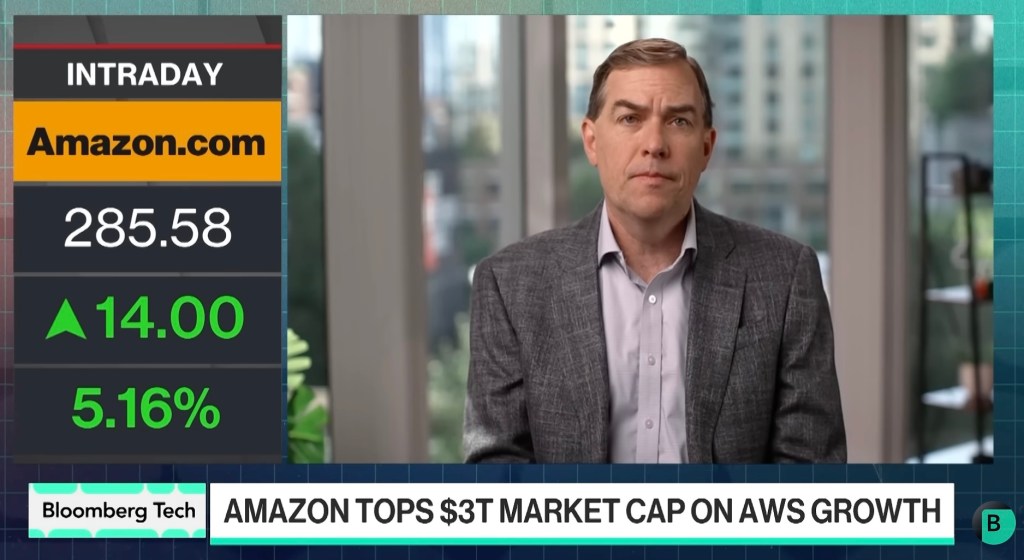
AWS2026-08-09 07:53:34AWS CEO says Trainium works with Nvidia systems and is not being sold as a standalone productAmazon Web Services is leaning on a mixed AI infrastructure strategy that combines Nvidia GPUs with its own Trainium ASICs and Graviton CPUs, according to comments from AWS CEO Matt Garman in an interview with Bloomberg. Garman said the approach gives enterprise customers more precise ways to allocate computing power while managing operating costs, and he tied that model to AWS’s ability to keep winning customers and support Amazon’s sales performance. Garman also said AWS’s annualized AI revenue has reached $25 billion, with demand coming from industries including finance, healthcare, and media. The business spans model training, inference, and agent workloads. To keep up, AWS plans to continue investing in cloud infrastructure and signing long-term agreements with customers. On custom silicon, Garman said AWS had considered selling its in-house chips externally, but the company’s current priority is using Trainium and Graviton inside its own cloud infrastructure. For now, AWS does not plan to offer either chip as a standalone product for outside buyers. The report also noted that custom chip development has become a broader trend across major cloud service providers, including Google Cloud, Microsoft Azure, and Meta.1870
AI servers2026-08-07 04:16:44TrendForce Sees ~90% Jump in 2026 Cloud Capex, Lifts AI Server Growth ForecastTrendForce expects capital spending by the world's nine largest cloud providers to climb roughly 90% year over year in 2026. The research firm points to stronger demand from hyperscale CSPs and tier-2 data centers for NVIDIA's rack-scale AI servers. It also notes that Google and AWS will ramp next-generation ASIC platforms in the second half of 2026. As a result, the annual growth forecast for AI server shipments has been revised up from 28% to nearly 31%.2170
Morgan Stanle2026-08-07 04:02:47Morgan Stanley Keeps Overweight on DDOG, SNOW and MDB, Warns Expectations Risk Is BuildingMorgan Stanley said in an Aug. 6 research note that accelerating growth at the three major cloud providers has improved the demand backdrop for Datadog, Snowflake and MongoDB ahead of earnings, but rising expectations now pose a separate risk. The bank kept Overweight ratings on all three names. The note said combined second-quarter growth for AWS, Microsoft Azure and Google Cloud rose to 48% from 39% in the first quarter, marking a fifth straight quarter of acceleration. AWS grew 37%, its fastest pace in 18 quarters. Azure grew 43%, while Google Cloud grew 82%, with management saying growth still accelerated even excluding the TPU systems revenue impact. Morgan Stanley argued that AI spending is increasingly feeding into core infrastructure demand. At the same time, it said valuations already price in a large share of the bullish case. For Datadog, market expectations for second-quarter revenue growth have climbed to 35% to 36%. Snowflake is seen benefiting from AWS strength, while MongoDB faces a tougher competitive setup as Microsoft’s managed PostgreSQL revenue grew about 55% for a third straight quarter of acceleration. The bank set price targets of $300 for DDOG, $300 for SNOW and $380 for MDB.630
Microsoft2026-08-07 00:57:06Microsoft launches fourth India cloud region in Hyderabad with focus on compliance and AI workloadsMicrosoft said on August 7 that its fourth cloud region in India, India South Central, has gone live in Hyderabad. The new region includes three availability zones and uses a resilient design built to meet Indian regulatory requirements as well as local seismic-zone standards, allowing it to support large-scale mission-critical workloads. With the launch, Microsoft said it now operates four cloud regions in India and has become the country’s largest hyperscale cloud provider. The company said the new region will give Indian enterprises more local deployment options as they modernize critical systems for the AI era, build new digital services, and move AI initiatives into measurable business results within enterprise-grade security, compliance, and governance frameworks. Microsoft also said early access demand has been strong, with companies including Adani Group, Bajaj Finserv, HDFC Bank, and PB Pay among early adopters. It added that Azure has maintained strong double-digit growth in India over the past two years, and that the new region is expected to accelerate that momentum.1900
US stocks2026-08-04 04:57:07Oil Slump Lifts Risk Appetite as Amazon Tops $3 Trillion in AI-Led Wall Street ReboundWall Street opened August with a broad risk-on move as falling oil prices, lower Treasury yields and a renewed bid for AI and cloud stocks pushed major U.S. indexes higher. The Dow Jones Industrial Average rose 1.32% to a record close, while the Nasdaq Composite gained 2.13% and the S&P 500 climbed 1.48%. Markets repriced energy risk after U.S. President Donald Trump said talks with Iran had begun and suggested the Strait of Hormuz could reopen soon. Iranian officials denied direct talks with Washington, saying discussions were limited to shipping security arrangements with Oman, but crude still sold off sharply. WTI dropped 7.42% and Brent fell about 6%, easing inflation pressure and helping Treasuries rally. The 10-year U.S. yield slipped about 5 basis points to around 4.68%, while gold held above the $4,000 mark. The strongest equity action came from AI and cloud names. Amazon rose 4.58% and crossed a $3 trillion market capitalization for the first time after stronger-than-expected AWS results. Nvidia gained nearly 3% and moved back above $5 trillion, Meta rose more than 6%, and Microsoft and Google each added close to 5%. Crypto-linked stocks also mostly advanced, with SoFi Technologies up more than 10%, IREN up over 8%, and Hut 8 and Robinhood both up more than 4%.2100
Amazon2026-08-03 16:56:28Amazon cloud chief says AI opportunity is massive as inference demand risesAmazon Web Services CEO Matt Garman said customers are shifting from using the company’s infrastructure to train AI models toward embedding those models into their own business processes, a change that is driving higher demand for inference computing. Speaking on Monday, Garman said Amazon still sees some companies relying on large training clusters, but wider adoption and stronger model capabilities are pushing more businesses to bring inference workloads into production. He described the potential size of Amazon’s AI business as “very large” and said the company will keep raising capital spending to meet demand. Amazon, the world’s largest provider of rented computing capacity and data services, said last week that it now expects capital expenditures to reach $220 billion in 2026, up from an earlier forecast of $200 billion. The increase reflects higher prices for storage chips and other components needed for data centers.1830
open-source A2026-08-03 15:53:55Citrini’s Jukan says open-source AI could weaken closed-model dominance and boost cloud providers’ pricing powerCitrini analyst Jukan said on Aug. 3 that the continued rise of open-source AI models, along with a weakening grip from closed-source model providers, could mark an important turning point for the cloud computing industry. His argument centers on a shift in how AI applications are being deployed: instead of relying on a single top-tier model for every task, usage is moving toward a layered routing approach, where advanced reasoning jobs remain with leading closed models while a large share of routine workloads can be handled by cheaper small models or open-source alternatives. In that setup, cloud providers could gain more control over user access, traffic allocation, and pricing. Jukan also argued that stronger open-source competition does not automatically reduce hardware demand. Lower inference costs may drive a rapid increase in AI usage, even as model compression, inference optimization, intelligent routing, and in-house ASIC chips reduce the amount of general-purpose GPU compute needed per token. He said the long-term growth outlook for AI infrastructure depends on whether token demand rises faster than gains in algorithm and chip efficiency.1810
US stocks2026-08-03 05:19:08Nasdaq posts its worst July since 2004 as money rotates back into cloud giantsU.S. stocks finished last Friday with a V-shaped rebound, but the late-session rally did little to change what was still a weak month for risk assets. The Dow Jones Industrial Average rose 0.53%, the S&P 500 gained 0.70%, and the Nasdaq climbed 1.00% on the day. For July, however, the S&P 500 was essentially flat, marking its weakest July since 2014, while the Nasdaq fell 3.2%, its worst July performance since 2004. Outside equities, oil sold off sharply after Donald Trump said he had canceled a planned new military strike on Iran following requests from Saudi Arabia, the UAE and Qatar, while OPEC+ agreed to lift September production quotas by 188,000 barrels per day. WTI crude dropped more than 8% at the Monday open and briefly fell below $78 a barrel. Gold, by contrast, edged up 0.91% in July and was trading near $4,050 an ounce after a roughly 30% pullback from its January peak. Markets were also digesting confirmed joint U.S.-Japan currency intervention that pushed USD/JPY below 156, as well as rising long-end Treasury yields, with the 30-year yield near 5.281%, the highest level since July 2007. In technology, de-leveraging continued across semiconductors and memory, but cloud names surged. Microsoft, Amazon and Google added nearly $1.5 trillion in combined market value last week, pointing to a clear rotation toward companies seen as converting AI spending into cash flow more effectively.2270