CoreWeave2026-08-14 08:03:08Morgan Stanley Keeps Equal-Weight on CoreWeave as Record 500MW Capacity Buildout Meets Debt and Customer Concentration RisksMorgan Stanley maintained an Equal-weight rating and a $99 price target on CoreWeave in its August review of the company’s second-quarter results, arguing that the GPU cloud provider is executing quickly in GenAI data center buildout but still faces valuation constraints from heavy leverage and concentrated customer exposure. In Q2, CoreWeave added 500MW of net active power, its largest quarterly increase on record and more than triple the year-earlier level, while management reiterated a goal of reaching at least 8GW by 2030. The company also raised guidance across capital spending, revenue and ARR, with FY26 revenue guidance moving to $12.4 billion-$13.2 billion and ARR guidance to $18.5 billion-$19.5 billion. Morgan Stanley pointed to Managed Inference ARR rising from $1 million to more than $100 million, with at least $250 million expected by year-end, as a sign that CoreWeave is extending beyond infrastructure rental into higher-margin software services. Even so, the bank said margin durability remains in question, free cash flow is expected to stay negative through 2028, and debt could reach about $38 billion by the end of 2026.510
Nvidia2026-08-13 09:57:55VC partner says Nvidia is becoming a “synthetic hyperscaler” in the AI compute stackAltimeter Capital partner Clark Tang argues that Nvidia is no longer just a chip supplier to the AI industry. In his view, the company has been building the two pillars that historically defined hyperscalers: an operating layer that abstracts and manages infrastructure, and a financing layer that funds capacity ahead of demand. Tang says this combination is turning Nvidia into a “synthetic hyperscaler,” one that is starting to displace Amazon, Microsoft, and Google in parts of the AI compute supply chain. His thesis begins with a shift in infrastructure economics. Traditional hyperscalers built strong margins by converting enterprise capex into opex and using software to maximize utilization of shared hardware. Tang says AI workloads break that model. Large-scale training depends on tightly synchronized GPU clusters, while inference is highly sensitive to tokens per watt and time to first token. In that setup, virtualization and networking layers that worked well in the cloud era can become a drag on GPU performance. He also points to the rise of neocloud providers, which offer lower-margin, AI-focused infrastructure but often lack the balance sheet strength to finance aggressive buildouts. Tang says Nvidia has moved to close that gap with software such as DSX OS, Mission Control, Omniverse, and Dynamo, while also standardizing hardware and bringing in third-party capital from firms including Apollo, BlackRock, Blackstone, Goldman Sachs, and KKR.1310
Tianfeng Secu2026-08-13 07:35:18Tianfeng Securities says earnings season has undercut bearish AI calls and revived the bull caseHong Kong-based Tianfeng Securities’ overseas technology research team says the latest round of quarterly results across the AI supply chain has strengthened the case for an AI bull market comeback. In its review, the firm argued that cloud growth has reaccelerated, demand for compute continues to run ahead of supply, and customers are no longer resisting higher prices. In some cases, they are paying upfront construction costs, which Tianfeng says is improving unit economics across AI infrastructure. The report points to record cloud contract activity over the past 20 quarters and says results from Google, Amazon Web Services and Microsoft Azure support the view that long-term cloud growth remains intact. It also highlights CoreWeave and Nebius as evidence that new compute providers have gained pricing power, with strong contract growth, prepaid terms and shorter payback periods. On the supply-chain side, Tianfeng says optical communications, memory and storage are showing signs that a bottom has formed, while debate over AI infrastructure returns has been weakened by fresh earnings data.1660
Market Analys2026-08-13 07:15:12CPI Lands on Target as Market Shifts to Neocloud for the Next AI TradeU.S. CPI came in at 3.4%, matching expectations and leaving little new macro impulse for markets. Attention instead turned to where the next leg of the AI trade might move after the storage-chip theme cooled. Earnings from CoreWeave and Nebius pushed that conversation toward Neocloud, or next-generation AI cloud providers, after the two stocks finished up 19% and 34%, respectively. The article points to a common message in both reports: compute capacity is effectively sold out, and demand still exceeds available supply. CoreWeave posted quarterly revenue of $2.58 billion, a backlog of $104.2 billion, and another $25 billion in newly signed contracts early in the third quarter. Nebius reported $582 million in quarterly revenue, 454% year-over-year growth, a $3 billion annualized run rate for its AI cloud business, and its first positive EBITDA. It also argues that the sector’s moat is moving away from simply securing GPUs and toward securing power. Pricing data cited for Nebius showed short-duration, rapid-delivery compute selling for $40 million to $50 million per megawatt, versus $20 million to $25 million per megawatt for long-term contracts. The piece further says recent company disclosures challenge short arguments around GPU depreciation, useful life, and profitability, especially for older clusters that continue generating renewal revenue after their original asset costs have already been recovered.1310
Policy Regula2026-08-13 06:58:53Jim Cramer Backs Six AI Infrastructure Names as Taiwan Supply Chain Stocks Rebound FirstJim Cramer said AI data center stocks are drawing attention again after several weeks of weakness, with selling pressure tied to the forced liquidation of leveraged fund Situational Awareness starting to fade. He highlighted Intel, Super Micro, Lumentum, Nebius, CoreWeave and Nvidia as key names regaining traction as company results and financing developments came in stronger than expected. The report said the sector began correcting in late June and stayed weak through July, largely because of liquidity pressure from forced sales. As that unwind nears its end, investor focus has shifted back to operating fundamentals. Intel’s equity sale was reportedly increased from $15 billion to $20 billion on strong demand and fully placed, while Super Micro and Lumentum posted better-than-expected quarterly results. Nebius and CoreWeave also delivered favorable updates. CoreWeave’s earnings were cited as evidence that older-generation Nvidia GPUs are retaining commercial value longer than many had expected. The article also pointed to Nvidia’s recent $500 billion financing plan with six global asset managers to support treating compute infrastructure as collateralizable physical assets. At the macro level, softer U.S. CPI data eased rate pressure, helping growth stocks. In Taiwan, server, cooling and optical communications suppliers had already rebounded ahead of the latest move in U.S. AI infrastructure shares.1590
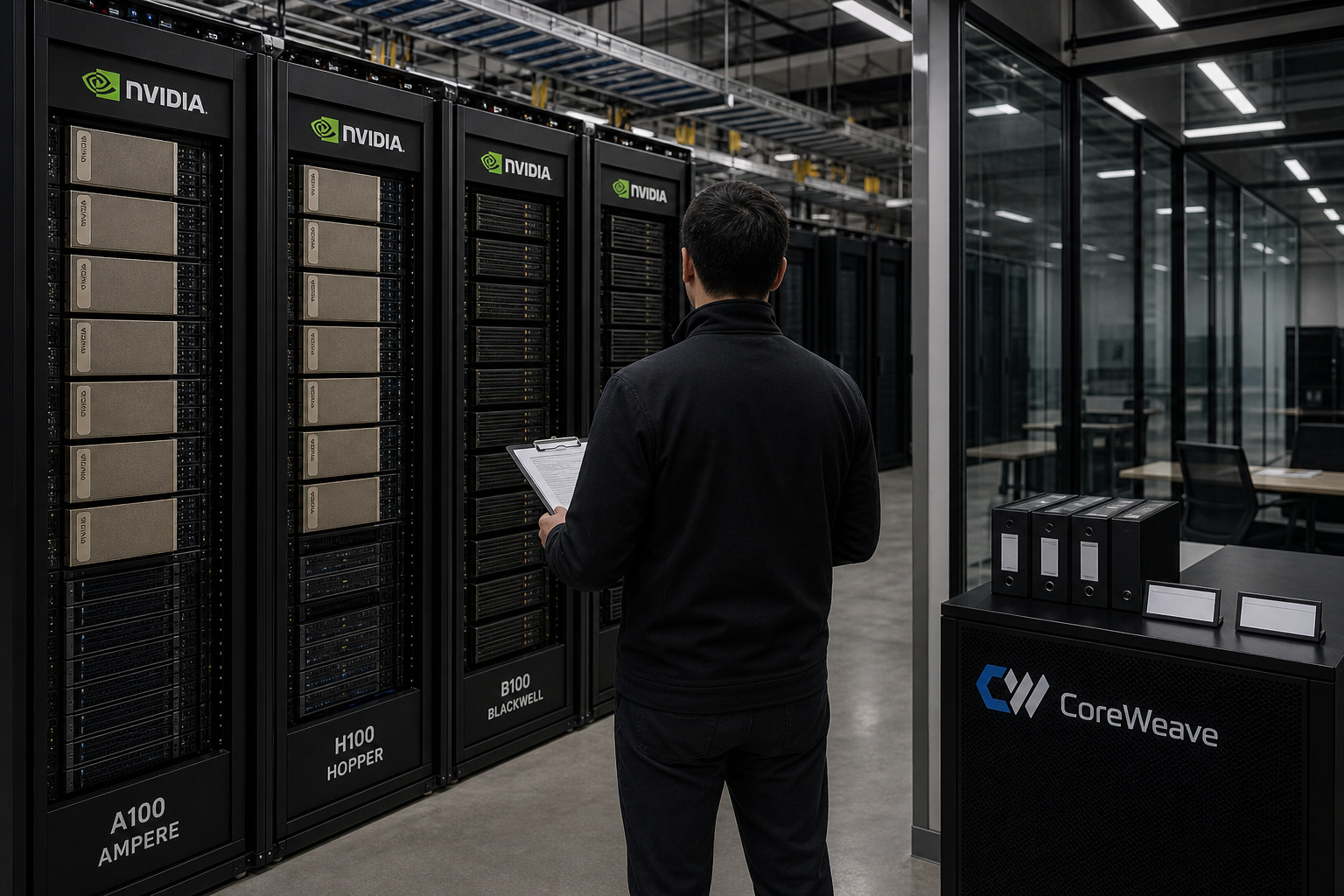
Jensen Huang2026-08-13 05:32:00Nvidia CEO Jensen Huang: A100 GPUs to Stay Usable Through 2029, Calling Compute a Productive AssetNvidia CEO Jensen Huang said on Aug. 13 that A100 GPU clusters will remain available from 2020 through 2029, emphasizing that CUDA provides a unified platform for developers and engineers, enabling Ampere, Hopper, and Blackwell architectures to receive continuous upgrades. He noted that CUDA boosts the versatility of Nvidia's compute power, which enhances substitutability, leading to higher utilization and longer lifespan, positioning Nvidia's compute as a productive asset with rentability, durability, and financing attributes. Previously, CoreWeave extended its Nvidia A100 lease agreement to 2029.1620
NeoCloud2026-08-13 05:40:07Why NeoCloud names are leading the tech rebound as investors reprice contracted AI capacityNeoCloud stocks such as CoreWeave and Nebius have emerged as one of the strongest groups in the latest U.S. tech rebound, according to MarsBit, as investors place a premium on contracted AI compute capacity that can be delivered quickly. The article argues that the market is no longer focused only on access to GPUs. What matters more now is whether a provider can combine GPUs, power, data center buildout, networking and operations into clusters that can go live within months. That shift changes how investors view these businesses. Revenue tied to multi-year capacity contracts, minimum commitments and, in some cases, customer prepayments is being treated less like ordinary IT services and more like infrastructure-style cash flow. Recent earnings helped reinforce that view. CoreWeave reported $2.575 billion in Q2 revenue and disclosed roughly $104 billion in backlog, while Nebius said its AI Cloud ARR reached $3 billion and pointed to several large long-term contracts. MarsBit says the appeal comes from three layers of leverage: operating leverage from high fixed-cost assets, financing leverage supported by long-term contracts, and equity leverage because a large new contract can sharply alter revenue expectations, utilization and access to capital. Investors are also watching power capacity closely, arguing that usable electricity and deliverable data center space remain harder to scale quickly than GPUs themselves.1360
Nvidia2026-08-13 05:29:12Huang Renxun: CUDA Extends GPU Economic Life, Making Compute a Financeable AssetNvidia CEO Jensen Huang reshared news that CoreWeave extended its Nvidia A100 GPU lease agreement to 2029. He said the 2020-era A100 will still handle compute tasks through 2029, crediting CUDA for enabling continuous upgrades across Ampere, Hopper, and Blackwell architectures. CUDA boosts utilization and cross-generation substitutability, turning Nvidia compute into a rentable, durable, financeable asset.1550