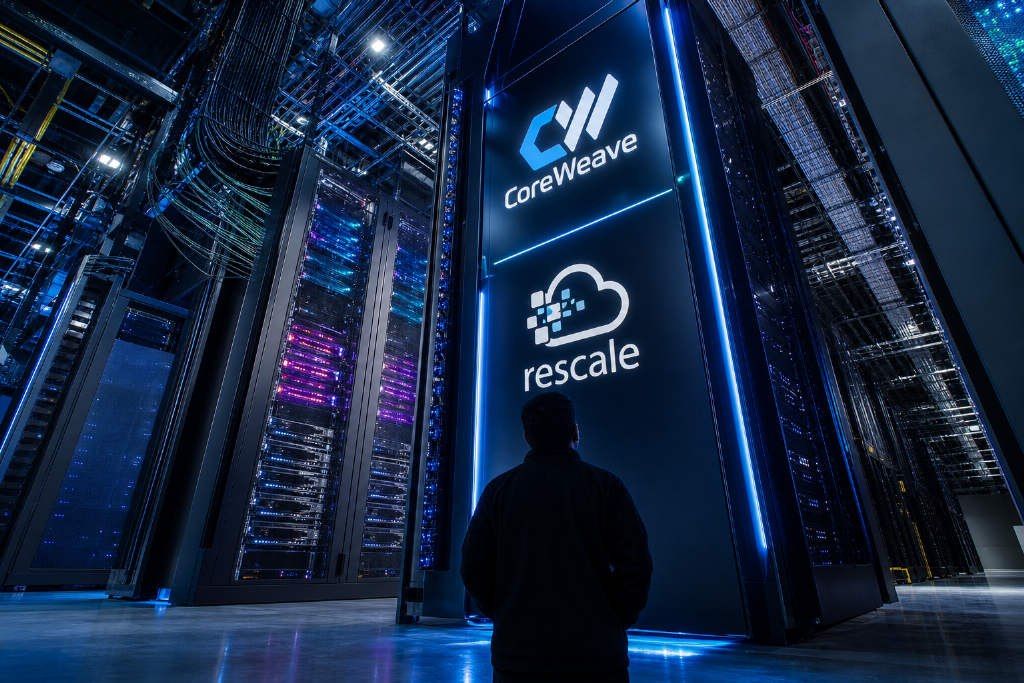
CoreWeave2026-08-25 12:06:58CoreWeave officially launches digital engineering platform RescaleCoreWeave, an AI compute rental provider, has officially launched Rescale, a digital engineering platform, according to a newsflash published by Odaily. The source material is brief and only confirms the launch itself. It does not include added details on product features, rollout plans, pricing, customer segments, partnerships, or technical specifications. Based on the information provided, the key fact is straightforward: CoreWeave has formally released Rescale. No further statement, executive quote, or supporting context was included in the input. As a result, this report stays tightly focused on the announced launch and does not extend beyond the facts available in the source.830
CoreWeave2026-08-22 18:34:48CoreWeave CEO sells more than 13,000 shares for about $1.2 millionCoreWeave Chief Executive Officer Michael Intrator recently sold more than 13,000 shares of the AI cloud computing company, with the sale valued at about $1.2 million. The insider stock sale came as competition in AI infrastructure has intensified and the sector remains capital-intensive. Techub carried the item and cited Crypto Briefing as the source. The report did not provide a more specific date for the transaction, nor did it disclose additional details on the exact number of shares beyond the stated figure of more than 13,000.1060
CoreWeave2026-08-21 08:03:28Goldman Sachs Keeps Neutral on CoreWeave, Raises 12-Month Price Target to $139CoreWeave shares rose 19% after the company reported second-quarter results, with Goldman Sachs saying the near-term setup is becoming clearer even as longer-term margin durability remains unsettled. In a report dated Aug. 20, Goldman maintained its Neutral rating and lifted its 12-month price target to $139 from $121, implying 53% upside from the current share price cited in the note. The bank said three core lines of evidence now support the company’s near-term case: demand remains ahead of supply, pricing is holding firm across both new and older chip generations, and capacity expansion continues on schedule. CoreWeave’s revenue backlog rose 5% quarter over quarter to $104 billion, while more than $25 billion of additional committed contracts had already been added after the start of the third quarter. Goldman’s bigger debate is over long-term monetization and margins. It pointed to managed inference, platform services, and CoreWeave Omni as the main software-related areas to watch. The firm said software and platform revenue must become a more dependable contributor to growth and profitability before a more constructive rating would be warranted.490
Mark Cuban2026-08-20 12:50:31Mark Cuban says AI chips could become a new asset class, likening them to “the new crypto”Billionaire investor Mark Cuban has floated a striking comparison between advanced AI hardware and crypto assets, arguing that chips may emerge as a standalone asset class as demand for computing power keeps climbing. In a post on X dated Aug. 16, Cuban wrote that “chips as an asset class will be the new crypto,” pointing to the growing financial value of the hardware that powers AI training and inference. The report frames that view around the scarcity of high-end GPUs and the expanding need for compute across large models, cloud infrastructure, and data centers. It also notes that financial markets are starting to treat GPU-backed infrastructure more like financeable assets: CoreWeave has used GPUs to support multibillion-dollar financing, while CME Group is set to launch futures tied to rental prices for Nvidia H100 and B200 GPUs on Oct. 5. At the same time, the comparison has limits. Unlike Bitcoin, GPUs are physical machines with depreciation, energy costs, and rapid upgrade cycles. Bitcoin advocate Pierre Rochard questioned the analogy, saying chips do not have mechanisms comparable to Bitcoin halving or mining difficulty adjustment. The article concludes that AI compute is not yet a fully independent asset class, but signs of collateralization, pricing, and derivatives trading are beginning to take shape.1230
a16z2026-08-18 12:43:00a16z Breaks Down the AI Compute Trade: Revenue Is Surging, but Capex and Profitability Still Cloud the PictureAndreessen Horowitz’s New Media team used its latest Charts of the Week to examine the AI infrastructure trade through a wider lens than headline demand growth. Moses Sternstein focused on neocloud companies such as CoreWeave, Nebius, and Applied Digital, arguing that the market’s question is no longer whether AI needs more compute, but whether providers can turn that demand into durable cash flow. The piece says many neocloud players entered the AI cycle with an advantage built during the crypto mining era: power access, data center capacity, cooling systems, and experience running dense compute loads. That legacy helped them scale revenue quickly, with CoreWeave reaching $2.6 billion in revenue in about 25 quarters versus 40 quarters for AWS after launch. Still, investors have not rewarded growth evenly. Over the past year, CoreWeave shares were down about 16%, while Nebius stayed closer to prior highs, highlighting concerns over capital intensity, depreciation, and rising interest expense. Sternstein also argues that AI is reshaping software unevenly rather than destroying SaaS across the board. Atlassian’s cloud revenue rose 31% year over year, and customers using its AI assistant Rovo were spending at nearly twice the growth rate of non-Rovo users. Databricks, meanwhile, said its Smart Router can cut average task costs by more than 30% by matching tasks with different model tiers. The article closes with data on widening enterprise AI spend gaps and diverging hiring patterns at OpenAI and Anthropic.1320
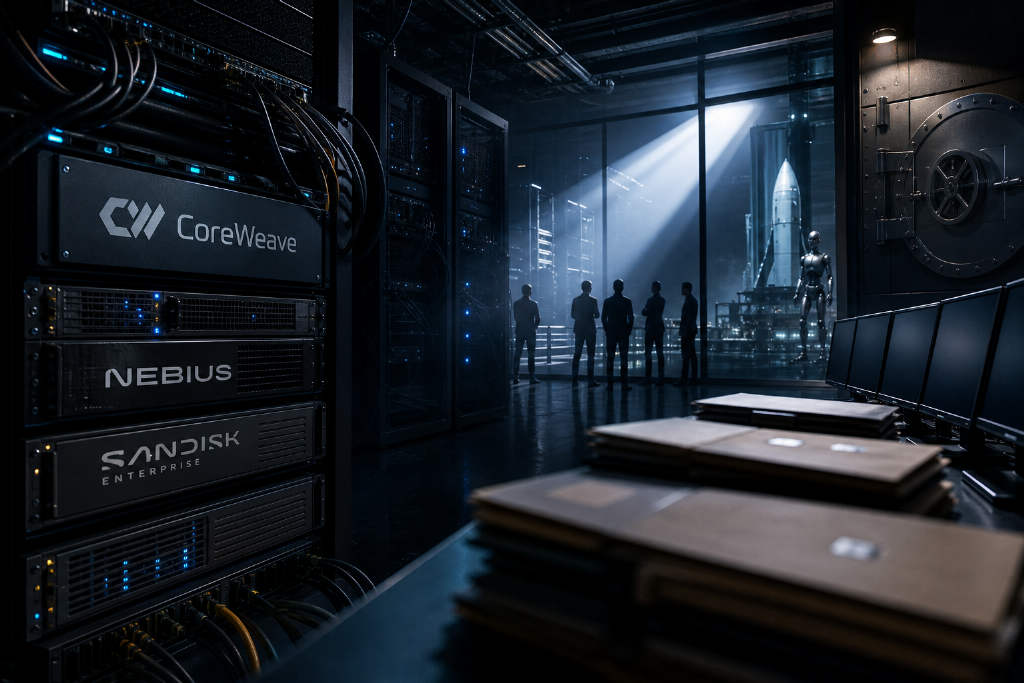
AI supply cha2026-08-16 05:01:46Serenity says the AI supply chain is still in a high-growth phase, with storage and packaging in focusSerenity, known online as the "white-haired stock god," said on X that the AI infrastructure buildout is still driving a long expansion cycle across several parts of the supply chain, including storage, advanced packaging, compute financing, optical communications, power systems, and electronic components. In the storage segment, Serenity cited a UBS forecast saying gross margin at traditional DRAM makers such as Micron could reach an unprecedented 95% by 2027, potentially topping margins seen in HBM products. Serenity also pointed to SanDisk, saying long-term agreements already cover about two-thirds of its 2028 capacity, with minimum contracted revenue of $93 billion, against a current market capitalization of about $239 billion. On cloud infrastructure, CoreWeave has signed an agreement to keep using Nvidia A100 GPUs through 2029, which Serenity said supports newer cloud companies such as Nebius and Iren while weakening bearish arguments around rapid depreciation of older GPUs. Serenity added that growth at frontier AI labs remains extremely fast, with market expectations that Anthropic could generate $190 billion to $200 billion in revenue by 2028. At the same time, advanced packaging and semiconductor infrastructure remain major bottlenecks, with a TSMC advanced packaging executive warning that the industry could face both memory shortages and tight ABF substrate supply in the coming years.1420
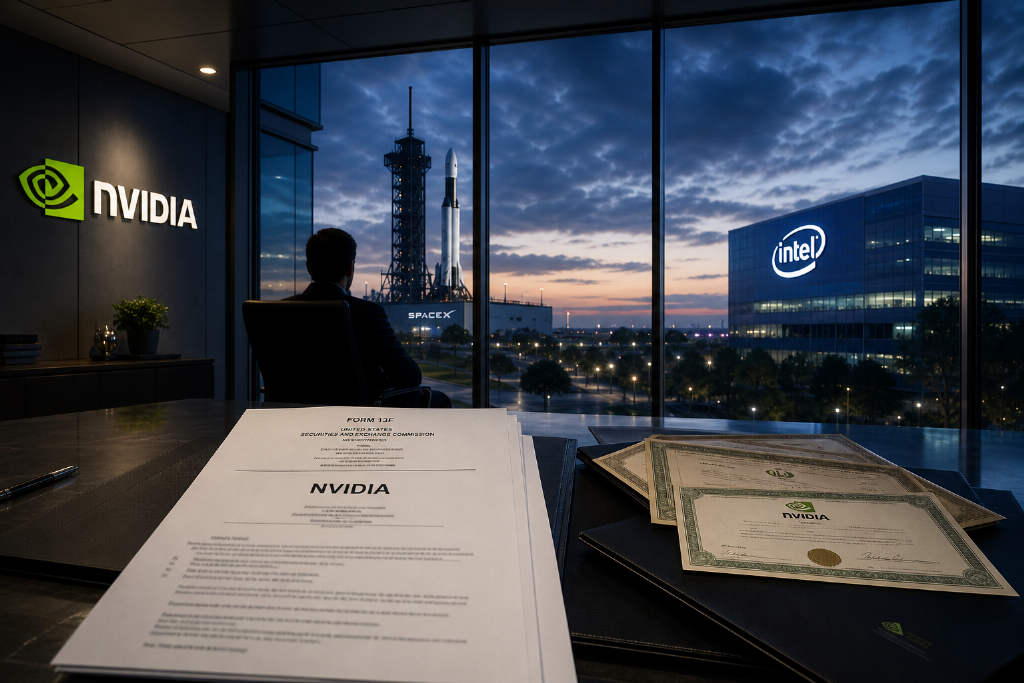
Nvidia2026-08-16 03:50:56Nvidia’s latest 13F shows SpaceX as a new No. 2 holding, while Intel stays on topNvidia’s latest Form 13F, covering holdings as of June 30, shows the chipmaker reporting eight U.S. stock positions with a total market value of about $63.44 billion, up roughly 245% from $18.37 billion at the end of the first quarter. Intel remained Nvidia’s largest disclosed holding at 215 million shares valued at about $29.99 billion, accounting for around 47.3% of the portfolio. SpaceX appeared in Nvidia’s 13F for the first time, with 123 million shares valued at about $20.98 billion, making it the second-largest position at roughly 33.1%. Together, Intel and SpaceX represented about 80.3% of the reported portfolio. The filing also listed positions in CoreWeave, Coherent, Nokia, Synopsys, Nebius, and Generate Biomedicines. Aside from SpaceX being added to the filing, the share counts of the other seven stocks were unchanged from the end of the first quarter. That means the sharp rise in the portfolio’s reported value came mainly from SpaceX being included in the filing and gains in the market value of existing holdings, rather than Nvidia buying about $45 billion of stocks in the secondary market during the second quarter.1500
Market Analys2026-08-14 11:46:03Top 5 stocks in focus this week: AI cloud names climb as SpaceX lockup and Unitree IPO draw attentionMarket attention this week stayed fixed on AI compute, cloud order visibility and embodied intelligence themes, according to BlockBeats. CoreWeave and Nebius led the list of the five most-watched stocks after posting strong quarterly numbers and improved order expectations. CoreWeave rose about 20.41% for the week as its second-quarter revenue reached $2.58 billion, nearly doubling year over year, while backlog expanded to $104 billion. Nebius gained about 34.20% after reporting $582.3 million in Q2 revenue, up 454% from a year earlier, and adjusted EBITDA of $236.2 million, alongside higher targets for AI cloud orders and power capacity. SanDisk also drew renewed investor interest after setting medium- to high-double-digit revenue growth targets for FY28 to FY30 and gross margin near 80% at its investor day, helping the stock rise about 16% in a single session. Outside the listed AI names, SpaceX remained in focus ahead of its second share unlock next week, while Unitree’s STAR Market IPO subscription results were released on Aug. 14, with fundraising of about 4.202 billion yuan and a valuation above 40 billion yuan.1370