Policy and Re2026-08-07 07:36:26AI tools are being used to flag sham token projects and on-chain pyramid schemesRegulators and security teams are increasingly using artificial intelligence to spot suspicious crypto projects before they scale. The article outlines how AI can scan white papers, marketing copy, team backgrounds, social media activity, fundraising claims, smart contract structures, and on-chain fund flows to detect patterns often linked to fake token offerings, multi-level referral schemes, and other illicit activity. It points to several concrete examples and policy signals. A June 2026 warning from Shenzhen’s financial regulator said bad actors were using labels such as “AI agents,” “AI quantitative investment,” and “Web3.0” to conduct illegal fundraising. The piece also cites the “Fun Coffee” virtual currency investment case in Hong Kong, which had drawn 225 reports involving HK$94 million as of early August 2026. Lawmaker Johnny Ng said the case involved a Ponzi scheme and a layered person-to-person recruitment structure. The article argues that AI can help by identifying templated white papers, fake community traction, fabricated investment claims, pyramid-style capital structures, rapid fund aggregation, abnormal rebate models, and wallet links to blacklists or mixers such as Tornado Cash. At the same time, it stresses that AI is not a final judge. False positives remain possible, decentralization does not equal illegality, and human review is still needed alongside data analysis and on-chain evidence.1830
MiCA2026-08-06 06:13:58EU Regulators Warn of Impersonation Scams as MiCA Licensing Transition UnfoldsEuropean Union regulators are warning of a rise in impersonation scams after the MiCA licensing rules took effect. Scammers are posing as financial regulators and crypto firms, targeting customers of crypto service providers that failed to obtain an EU license. The fraudsters use fake websites and forged documents to trick users into transferring assets. France's Financial Markets Authority (AMF) said scammers have impersonated its representatives and directed users to move funds through fraudulent websites, according to AMF official Stéphane Pontoizeau. The European Securities and Markets Authority (ESMA) said it has detected abuse of its identity and branding, including the use of forged documents. Under the Markets in Crypto-Assets Regulation (MiCA), crypto companies have needed authorization since July 1 to operate in the EU. Unauthorized firms must wind down or transfer their EU business. An ESMA list updated at the end of July shows only 323 licensed crypto companies so far. By comparison, data provider VASPnet previously estimated that more than 1,700 unlicensed companies would have to stop operations.1870
a16z crypto2026-08-06 04:29:26a16z crypto outlines three key elements of the CLARITY Acta16z crypto has published its reading of the CLARITY Act, highlighting three main pillars in the U.S. crypto bill now under review in Congress. According to the firm, the proposal would create a clearer compliant issuance path for crypto project developers, place exchanges and other intermediaries under a substantive regulatory framework, and strengthen consumer protection measures. The CLARITY Act, short for the Clarity for Digital Tokens Act, is designed to establish a clearer regulatory structure for digital assets in the United States. a16z crypto is the crypto investment arm of Andreessen Horowitz, focused on venture investing and policy research across blockchain and Web3.1700
Taiwan regula2026-08-04 12:33:32Taiwan plans phased crypto Travel Rule rollout with NT$30,000 threshold for added identity dataTaiwan’s Financial Supervisory Commission is preparing a phased rollout of the crypto Travel Rule that would require added identity details for transfers above NT$30,000 through domestic virtual asset service providers. According to Huang Chung-hao, deputy director-general of the FSC’s Securities and Futures Bureau, individual users would need to provide their date of birth and residential address, while legal entities would need to submit an official identification code and registered address. Receiving VASPs would also be required to verify the beneficiary information against their own customer records. The plan would be introduced in two stages. The first stage is scheduled for October 2026 and would apply only to transfers between domestic VASPs. A second stage, expected by the end of 2027, would extend the framework to transfers between domestic and overseas VASPs. The FSC said Taiwan’s NT$30,000 threshold was set with reference to the Financial Action Task Force’s de minimis standard of no more than $1,000 or €1,000. Transfers below that level would still require a reduced set of information, including names and wallet addresses or transaction identifiers. The draft amendment still needs to go through a 30-day public notice process before formal rulemaking proceeds.2200
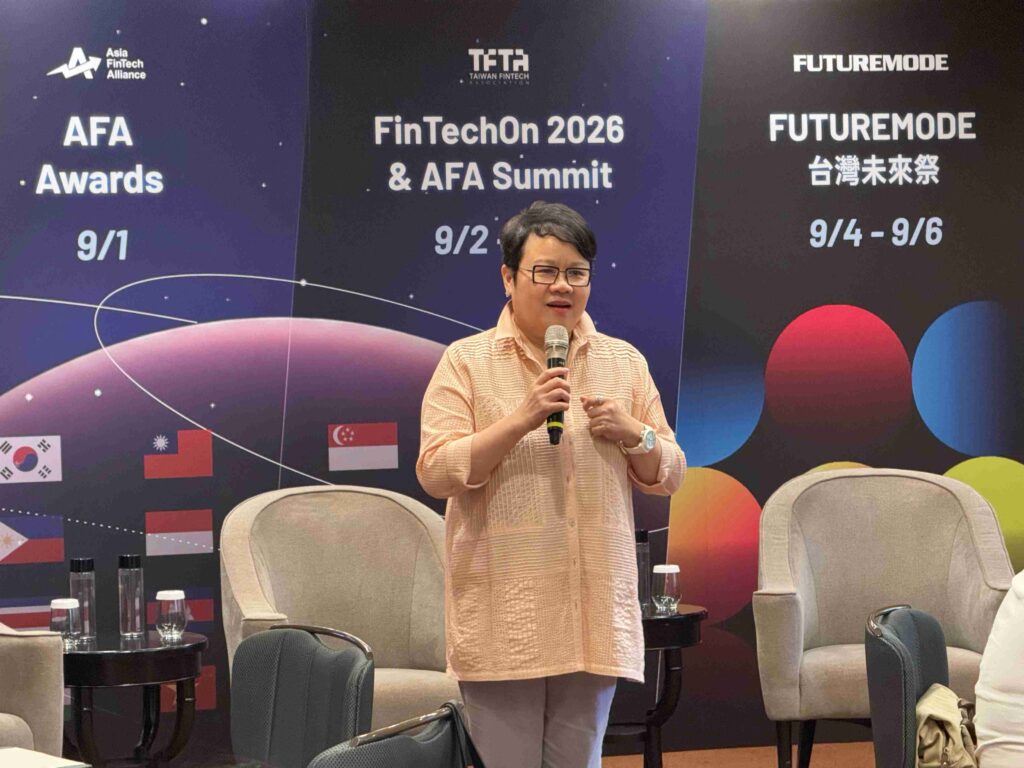
VASP2026-08-04 12:08:34Tsai Yu-ling says VASPs will be treated as financial institutions under Taiwan’s licensing regimeAt a media briefing for Taipei’s "Trendy Taipei 2026" tech event on Aug. 4, Asian FinTech Alliance (AFA) chair and honorary chair of the Taiwan FinTech Association Tsai Yu-ling said she had specifically checked with Taiwan’s Financial Supervisory Commission and was told that virtual asset service providers, or VASPs, will be classified as "financial institutions" under the new licensing framework rather than "quasi-financial institutions." Tsai said the change reflects how crypto assets, which were not legally defined assets last year, have now become legal and compliant assets after the passage of the dedicated law, and can be regarded as financial assets with FSC approval. She also pointed to the next issue for the market: how traditional financial institutions will work with VASP operators now that the law allows financial institutions to run such business lines concurrently. The event also outlined the first AFA Awards, which drew 88 nominations from 16 economies. Nine international judges are set to travel to Taipei for the Sept. 1 final and awards ceremony, where the Top 10 companies will pitch live and winners will be selected on site. FinTechOn 2026 and the second AFA Summit will follow on Sept. 2-3, with speakers including GBBC CEO Sandra Ro, Peter Kerstens, an Abu Dhabi regulator representative, and a JPMorgan managing director overseeing Asia-Pacific product for securities services.1940
South Korea2026-07-30 03:05:56South Korean lawmakers propose bill allowing payment suspensions on suspicious crypto accountsSouth Korean lawmakers from the ruling People Power Party have proposed an amendment to the Act on Reporting and Use of Certain Financial Transaction Information that would let financial authorities order payment suspensions on virtual asset accounts suspected of being used for illegal asset transfers. According to Digital Asset, the bill was submitted on July 28 by lawmaker Kim Sang-hoon and 15 others. The proposal defines an account as a unique identification number provided by an exchange to a user. Under the amendment, the Korea Financial Intelligence Unit could request a 30-day payment suspension when it determines an account is suspicious, with one possible extension. Entities that fail to comply could face fines of up to 100 million won. The bill would take effect six months after promulgation.1820
Changpeng Zha2026-07-28 23:19:40CZ backs ASEAN regulatory passport for crypto firmsBinance founder Changpeng Zhao said he supports the creation of an ASEAN-wide regulatory passport for crypto companies, a framework that would let a firm licensed in one jurisdiction expand more easily into other member states. The proposal is aimed at cutting repeated licensing applications across different countries and making cross-border compliance less cumbersome for businesses operating in the region. According to the report cited by Techub News, regulatory standards for crypto assets still vary across ASEAN countries. A unified passport mechanism could help connect those markets more closely and support the broader integration and development of the region’s digital asset sector. The item was attributed to Cointelegraph.1830
Japan FSA2026-07-25 09:07:05Japan FSA wraps up crypto AML information-sharing pilot led by Hitachi and 15 institutionsJapan’s Financial Services Agency said on July 24 that it had completed a proof-of-concept project on anti-money laundering information sharing for crypto assets and electronic payment instruments under its FinTech PoC Hub. The pilot, run from March to May 2026, was designed to test whether private-sector participants could exchange risk data across institutions, including suspicious blockchain addresses, transaction data, risk classifications, risk scores, and the basis for those assessments. The project was proposed and led by Hitachi, Ltd., with more than 15 organizations taking part. Participants included Aozora Bank, yen stablecoin issuer JPYC, GMO Coin, Chainalysis Japan, NEC, and Rakuten Wallet. According to the FSA, the trial covered three monitoring models: post-transaction reviews, real-time pre-transaction assessments, and token monitoring for issued electronic payment instruments. All three were found to be workable in practice. The agency said cross-institution information sharing could expose industry-wide risk patterns that a single exchange or company might miss on its own. It also said a combination of rule-based screening and machine learning helped identify known sanctioned entities as well as newly emerging suspicious patterns. At the same time, the FSA stressed that system alerts alone were not enough and that institutions must verify alerts themselves before restricting a transaction, while also putting data governance safeguards in place.1970