FCC

Policy Regula
2026-08-05 11:39:35

FCC draft on Chinese data-center optical modules puts focus on non-China suppliers and InP bottlenecks

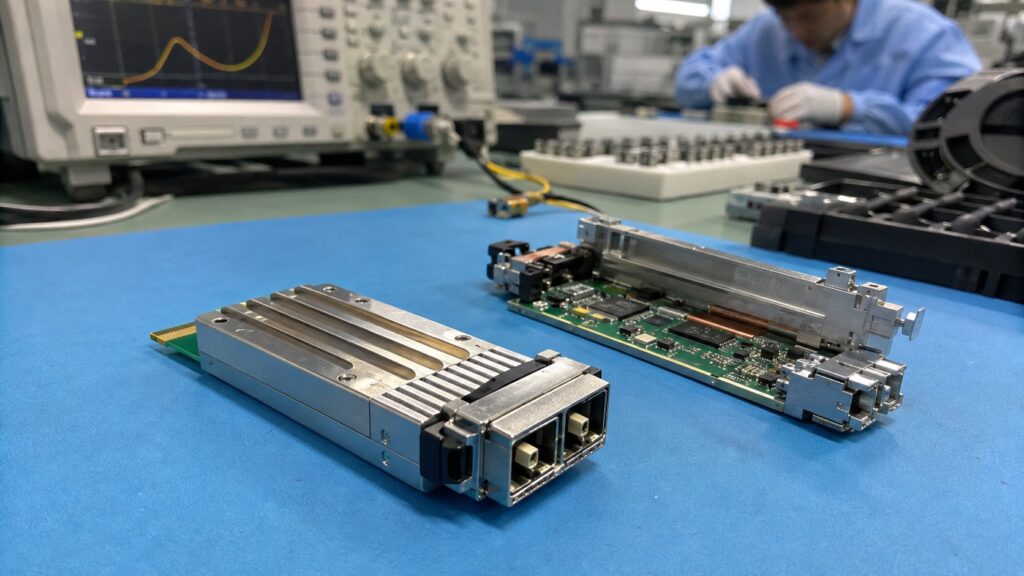
The U.S. Federal Communications Commission is considering restrictions on some new data-center optical modules made by Chinese vendors, but the proposal is still in draft form and several core definitions remain unsettled. The biggest open questions are whether the FCC will define "Chinese origin" by brand, manufacturing location, or component source, whether older models can still enter the U.S., and whether non-Chinese brands using Chinese-made substrates or lasers could still qualify for exemptions. For now, the market is trading the possibility that orders shift toward non-Chinese suppliers. WhiteLine Daily identified Coherent, Lumentum, and Applied Optoelectronics as the most direct potential beneficiaries if U.S. cloud companies continue building AI data centers while Chinese new-model supply faces limits. Marvell and Broadcom could benefit later, but only if demand passes through to DSP, driver-chip, and connectivity layers after module makers actually expand output. Over a longer horizon, the report says the more important constraint may not be module assembly capacity but the supply of indium phosphide, or InP, across substrates, epitaxial wafers, and lasers. AXT, IQE, and Sivers map to different parts of that chain, though each carries a different mix of policy risk and commercial visibility. The report argues that the real test will be the final FCC rule, confirmed customer orders, and whether non-China capacity can scale fast enough.

820
FCC draft on Chinese data-center optical modules puts focus on non-China suppliers and InP bottlenecks
Morgan Stanle
2026-08-05 06:33:27

Morgan Stanley says proposed U.S. curb on Chinese optical modules could open room for Coherent and peers

Morgan Stanley said in an Aug. 4 research note that a proposed U.S. restriction on new Chinese data-center components would benefit non-Chinese optical module suppliers, with Coherent seen as the biggest scaled winner and Lumentum positioned to gain indirectly through tighter EML laser supply. The bank’s argument, however, was not that market share can shift overnight. It said near-term execution would be difficult because non-Chinese suppliers still face capacity limits, certification constraints, and dependence on Chinese indium phosphide, or InP, substrates. According to Reuters, the Trump administration and the Federal Communications Commission are preparing measures that would restrict new Chinese data-center components from entering the U.S. market, with optical modules specifically mentioned. Morgan Stanley said Chinese vendors currently account for about half of the optical module market through companies such as Innolight and Eoptolink, so any ban would force demand toward alternative suppliers. Still, the bank said existing production capacity is not enough to fully replace that share in the short run. Morgan Stanley also flagged two bottlenecks that could shape the outcome: insufficient non-Chinese production capacity and the global supply chain’s reliance on China for InP substrates. If restrictions are implemented, the bank expects a short-term supply shock, while the longer-term structural benefit to non-Chinese suppliers may take more time to emerge.

550
Morgan Stanley says proposed U.S. curb on Chinese optical modules could open room for Coherent and peers
SpaceX
2026-08-05 02:41:00

SpaceX tops Q2 estimates, but shares fall 8% as investors focus on xAI weakness and lock-up expiry

SpaceX reported stronger-than-expected second-quarter results, with revenue reaching $7.814 billion, up 92% from a year earlier, and net loss narrowing to $541 million. Starlink subscribers doubled to 12 million, while the company’s AI segment posted a 247% revenue jump and positive adjusted EBITDA. Still, the stock fell 8% after earnings as investors looked past the headline beat and focused on structural concerns. Much of the AI revenue came from capacity leasing deals with Anthropic, Google and Reflection AI, while SpaceX’s own xAI business showed weak monetization. Grok had 117 million monthly active users in March, but only 1.9 million paid for SuperGrok. The company’s longer-term projects also remain under pressure: its space data center plan is still awaiting FCC approval, and delays tied to Starship have pushed the first crewed lunar landing to Artemis IV, targeted for early 2028. Attention is also turning to a major lock-up expiry on Aug. 6 involving about 911.5 million shares worth more than $100 billion.

480
SpaceX tops Q2 estimates, but shares fall 8% as investors focus on xAI weakness and lock-up expiry
United States
2026-08-05 01:01:23

US weighs ban on Chinese optical transceivers for data centers as AI supply chain scrutiny expands

The US government is drafting a new restriction that would bar imports of China-made next-generation optical transceivers used in data centers, according to a report cited by BlockBeats on Aug. 5. People familiar with the matter said the Federal Communications Commission is preparing the measure, with US officials aiming to announce and implement it during 2026. The proposal is still under discussion and could yet be revised or shelved. Optical transceivers are a core component within optical modules, converting electrical and optical signals and supporting high-speed data transmission in AI data centers. The report said a ban, if adopted, could ripple through the global optical module supply chain. It flagged Eoptolink as one of the companies that could come under pressure. Counterpoint Research data cited in the report shows Eoptolink holds about 27% of the global data-center optical transceiver module market. The report also said a previous study by the Information Technology and Innovation Foundation found US suppliers Coherent and Lumentum lack enough capacity to fully replace Chinese vendors. It added that the measure could raise costs for US cloud companies, with Amazon and other large cloud providers potentially needing to shift procurement to domestic suppliers as they expand AI data center infrastructure.

840
US weighs ban on Chinese optical transceivers for data centers as AI supply chain scrutiny expands
Policy Regula
2026-08-05 00:15:34

US moves toward curbs on Chinese optical transceivers as Taiwan suppliers draw attention

The Trump administration is working through the US Federal Communications Commission on a proposed ban targeting newly made optical transceivers from China, according to Reuters. The measure is framed as a national security step meant to guard against malware insertion, data theft, and network disruption risks tied to equipment used in AI infrastructure and data centers. Reuters said the FCC is considering adding the products to its Covered List, extending recent US restrictions that had already touched drones, inverters, and humanoid robots. The report put pressure on Chinese suppliers that hold a large share of the global data-center optical module market, including Zhongji Innolight and Eoptolink. Zhongji Innolight’s global market share was cited at about 27%. China’s embassy in Washington responded by urging the US to stop what it called baseless accusations and warned that it would take necessary countermeasures if Chinese interests were harmed. US optical and networking names rallied after the report. In Tuesday trading, Lumentum rose nearly 9%, Coherent jumped 12%, and Applied Optoelectronics gained more than 19%. The market reaction reflected expectations that large US cloud providers such as Amazon AWS, Microsoft, Google, and Meta may need to accelerate a shift toward non-Chinese or US-aligned suppliers. The report also pointed to Taiwan-based Enablence Technologies and LuxNet as companies that could benefit if orders are redirected.

480
US moves toward curbs on Chinese optical transceivers as Taiwan suppliers draw attention
Trump
2026-08-04 11:34:50

FCC said to target Chinese optical transceivers, lifting AAOI and other photonics stocks in premarket trade

Reuters, citing people familiar with the matter, reported that the Trump administration is drafting restrictions on imports of new Chinese-made data center components, with the U.S. Federal Communications Commission planning limits on Chinese optical transceivers and aiming to announce and put the measure into effect this year. The White House and the FCC did not comment on the report. The news sent U.S. optical networking and photonics names sharply higher in premarket trading. As of 6:47 p.m. Taipei time, Applied Optoelectronics rose 18.17% to $130.23, Coherent gained 14.23% to $329.15, and Lumentum advanced 11.33% to $868.27. Marvell, FOTO, Corning, Ciena, and Credo also posted sizable gains, while Nvidia was up 1.02% over the same period. The report also pointed to China’s position in high-speed optical modules. Innolight was described as holding more than 40% of the global 800G market and 50% to 70% of the 1.6T market, while Eoptolink was estimated at 25% to 30% in 800G. Together, the two companies account for roughly two-thirds of supply in the current mainstream 800G segment, according to the article.

1620
FCC said to target Chinese optical transceivers, lifting AAOI and other photonics stocks in premarket trade
Trump adminis
2026-08-04 11:17:34

Reuters: Trump administration drafts ban on new Chinese data center optical module imports

The Trump administration is drafting a rule that would block U.S. imports of new Chinese-made optical modules used in data centers, according to Reuters, which cited four people familiar with the matter. The measure is being prepared by the Federal Communications Commission and would cover new module models that transmit data through fiber-optic cables inside data centers. Officials want the ban published and put into effect within this year. Reuters said the proposal is meant to prevent Chinese companies from stealing data, inserting malware, or disrupting U.S. data center services. The draft could hit Eoptolink most directly. The report said the company holds a leading 27% share of the global data center optical module market and was added to the Pentagon’s list of Chinese military-linked companies in June this year. U.S. cloud providers including Amazon Web Services may have to shift to alternative suppliers such as Coherent and Lumentum, which could raise costs. China’s embassy in Washington said it would take all necessary measures in response to any action that harms Chinese interests. The draft can still be revised or shelved.

720
Reuters: Trump administration drafts ban on new Chinese data center optical module imports
FCC
2026-07-31 19:43:24

FCC import curbs on foreign robots extend beyond humanoids to Roombas and other connected devices

The U.S. Federal Communications Commission this week moved to block new imports and sales approvals for a broad class of foreign-made advanced robotic devices, with the policy aimed particularly at China. The decision adds advanced robotics and connected power inverters to the FCC’s Covered List after U.S. national security agencies said the products pose unacceptable risks. The measure reaches well beyond humanoid and quadruped robots. The FCC confirmed to The Verge that any new robotic device weighing more than 4.4 pounds, connected to the internet, and able to perceive its surroundings can fall under the restriction. That puts robot vacuum cleaners such as Roombas, robotic lawnmowers, delivery robots, and similar products in scope. The restrictions apply only to future models seeking new FCC equipment authorization. Devices already approved are unaffected, current owners can keep using them, and retailers may continue selling previously authorized models. Federal agency purchases and use are also unchanged. Manufacturers still have a path to approval if they first secure Conditional Approval from the Department of Defense, or from the Department of Homeland Security in the case of power inverters.

220
FCC import curbs on foreign robots extend beyond humanoids to Roombas and other connected devices