FDI

FDIC
2026-07-31 05:18:05

FDIC proposes public quarterly reporting for stablecoin issuers under a bank-style Call Report framework

The U.S. Federal Deposit Insurance Corporation has proposed a new quarterly filing, PS-02, for permitted payment stablecoin issuers, extending a reporting model that closely mirrors the banking sector’s Call Report structure. The proposal follows last week’s PS-01 weekly filing and would require issuers registered with the FDIC to submit a full set of financial disclosures within 30 days after each quarter ends through FDICconnect. Unlike PS-01, which is treated as confidential, PS-02 would be public in principle once accepted by the agency. The filing covers five schedules, including a balance sheet, income statement, off-balance-sheet items, and capital disclosures. It would classify outstanding redeemable stablecoins as liabilities, require issuers to separate reserve assets from non-reserve assets, and include crypto-specific items such as digital assets held for validator, miner, network, or gas fees. The proposal also imports bank-style capital concepts, including Common Equity Tier 1 and additional tier 1 capital under 12 CFR 350.8, while adding an operational buffer requirement based on the issuer’s total expenses over the prior 12 months. A memorandum section would ask how many branded stablecoins an issuer has outstanding, whether it met diversification and concentration rules each business day, and whether it holds any non-U.S. dollar assets or liabilities.


200
FDIC proposes public quarterly reporting for stablecoin issuers under a bank-style Call Report framework
FDIC
2026-07-31 04:38:40

FDIC proposal would require weekly stablecoin filings with top 100 wallet and reserve disclosures

The U.S. Federal Deposit Insurance Corporation has proposed a new reporting form, PS-01, that would require regulated payment stablecoin issuers to submit weekly disclosures covering issuance, redemptions, market activity, and reserve composition. Under the plan, each registered permitted payment stablecoin issuer would have to file a separate report for every stablecoin it issues, with submissions due by 5 p.m. every Wednesday through FDICconnect and data reported on a daily basis. The proposal stands out for how detailed it is. Issuers would need to list the top 100 wallet addresses by holdings and the top 100 by trading volume, including daily gross buys and sells, as well as the top 100 exchanges by trading activity across both centralized and decentralized venues. The form also asks for daily pricing metrics tied to the $1 peg, average redemption time in hours, the total amount of redemptions not initiated within 48 hours, and reserve breakdowns that extend to individual U.S. Treasury securities identified by CUSIP. The form remains at the proposal stage, and some definitions are still being developed.

210
FDIC proposal would require weekly stablecoin filings with top 100 wallet and reserve disclosures
SoFi
2026-07-30 07:20:08

SoFi posts $134.3 million in Q2 crypto trading revenue as SoFiUSD expands into business payments

SoFi said its crypto trading revenue reached $134.3 million in the second quarter, up 10% from the prior quarter, according to its latest earnings release. After subtracting $133.1 million in transaction-related costs, the business generated net revenue of $1.2 million, ahead of $850,000 in the first quarter. While crypto remains a small part of SoFi’s broader business, the company said it has kept building out its digital asset infrastructure since relaunching crypto trading and investing services at the end of 2025. The company also widened the use of its stablecoin, SoFiUSD. During the quarter, SoFi’s Big Business Banking platform began processing transactions through the SoFi Exchange Network, allowing commercial clients to move funds and make instant payments around the clock using SoFiUSD. In May, SoFi rolled out SoFiUSD in its financial app, where users can buy, hold, sell and redeem the dollar-backed token on Ethereum and Solana. SoFi also outlined plans for tokenized deposits backed by FDIC-insured bank deposits, cross-border remittances, and an integration with crypto exchange Bullish for institutional digital asset services.

1570
SoFi posts $134.3 million in Q2 crypto trading revenue as SoFiUSD expands into business payments
Neobanks
2026-07-29 00:54:15

Neobank census finds 368 live operators, with only 127 holding full banking licenses

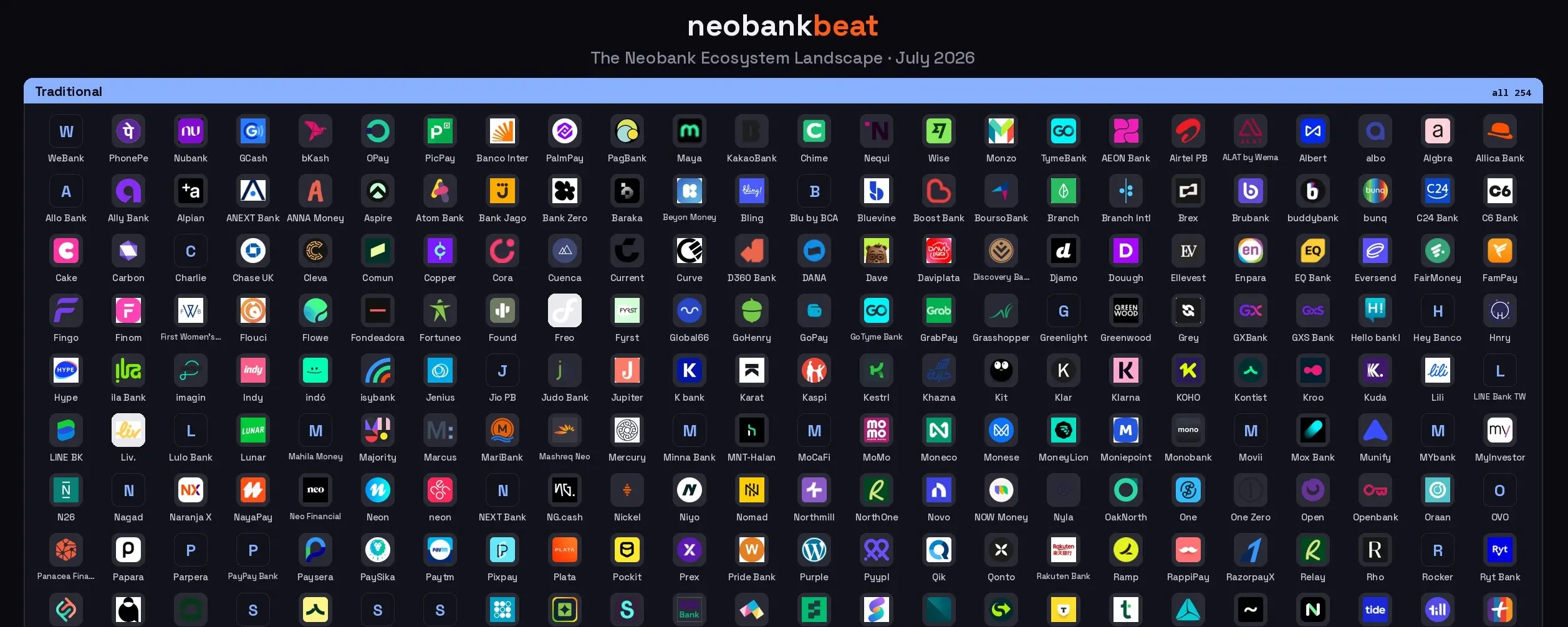
A new industry census by Francesco Andreoli, head of developer relations at Consensys and MetaMask, argues that the real story in neobanking is not how many companies have raised capital, but how many quietly disappear. His dataset, published on neobankbeat.com, identifies 368 verified neobanks still operating as of July 2026. Together, based on self-reported figures, they serve roughly 1.46 billion customers. The breakdown shows a business with very different models under one label: 254 traditional challenger banks, 58 hybrid fiat-crypto apps, and 56 web3-native apps. Andreoli says 30% of neobanks founded in the 2020s and still alive today are web3-native self-custody applications, compared with 4% among those launched in the 2010s. The sharper finding is regulatory. Only 127 of the 368 active companies hold full banking licenses. The rest rely on sponsor banks, e-money licenses, or card-issuing partners. Andreoli ties that dependence to past failures such as WaveCrest in 2018, Wirecard in 2020, Synapse in 2024, and Ready in 2026. His review also challenges widespread AI claims. After checking 368 firms against filings, regulatory disclosures, and production evidence, he says only 67 passed, or 18%. The report adds that 106 infrastructure providers support the 368 consumer-facing brands, highlighting concentration risk below the surface.

1030
Neobank census finds 368 live operators, with only 127 holding full banking licenses
Neobank
2026-07-28 14:05:06

Report says two-thirds of neobanks lack full banking licenses, with AI in production at just 18%

A report highlighted by Consensys and MetaMask developer relations lead Francesco Andreoli says the global neobank sector is far larger, and more fragile, than many users realize. Andreoli said he tracked and verified 368 active neobanks that together report 1.46 billion users worldwide. Yet only 127 of those firms hold full banking licenses, leaving roughly two-thirds dependent on sponsor banks, e-money permissions, or banking-as-a-service infrastructure. The data points to Asia as the dominant market with 817 million users, led by China’s WeBank at more than 400 million. Europe’s Revolut, while still one of the best-known names in the segment, was cited at more than 50 million users. Andreoli also said the industry mix is shifting, with 56 surviving neobanks founded in the 2020s classified as Web3-native self-custodial apps, and another 58 operating hybrid fiat-and-crypto models. The report also challenged claims around artificial intelligence adoption. Of the 368 firms reviewed, only 67 were said to have deployed AI in production, or about 18%. Andreoli added that many of the real-world AI lending use cases are appearing in emerging markets such as Nigeria, the Philippines, Mexico, and Bangladesh rather than in Western markets.

1090
Report says two-thirds of neobanks lack full banking licenses, with AI in production at just 18%
Neobanks
2026-07-28 11:55:14

368 neobanks, 1.46 billion users, and the hidden failure risk under the surface

Francesco Andreoli, head of developer relations at Consensys and MetaMask, says he verified 368 neobanks still operating as of July 2026 after spending six months tracking the sector. His dataset, published on neobankbeat.com, points to an industry with roughly 1.46 billion reported users, but also one with deep structural fragility. Asia accounts for 817 million of those users, with WeBank alone serving more than 400 million. Nubank has 131 million customers, while Revolut has more than 50 million. Andreoli also breaks the market into 254 traditional challenger banks, 58 fiat-crypto hybrid apps, and 56 web3-native apps, supported by 106 infrastructure providers and backed by 219 investors. The striking number in his analysis is not just the size of the sector, but how much of it sits on rented infrastructure. Of the 368 companies, only 127 hold full banking licenses. The rest depend on sponsor banks, e-money licenses, or card issuers. Andreoli points to WaveCrest in 2018, Wirecard in 2020, Synapse in 2024, and Ready in 2026 as reminders that when the infrastructure layer breaks, customers often face frozen funds and bankruptcy queues rather than direct deposit insurance protection. He also reviewed AI claims across the sector and found that only 67 companies, or 18%, had evidence in financial filings, regulatory disclosures, or live production deployments. In his view, the most effective AI lenders are often in emerging markets such as Nigeria, the Philippines, Mexico, and Bangladesh, where underwriting models fill gaps left by weak credit systems.

230
368 neobanks, 1.46 billion users, and the hidden failure risk under the surface
Cross River
2026-07-28 00:43:59

Cross River to provide banking infrastructure for X Money

Cross River, a crypto-friendly banking-as-a-service provider, will supply the banking infrastructure behind X Money, according to Cointelegraph. The setup will support peer-to-peer payments, FDIC-insured interest-bearing accounts, and Visa debit card services. Cross River’s banking platform and payment rails are also intended to back X’s broader “super app” push, with room to add more financial products over time. X Money entered limited testing in May 2025 and expanded to external testing in March 2026. X has also secured money transmitter licenses in more than 40 U.S. states and registered with the Financial Crimes Enforcement Network, or FinCEN, to support peer-to-peer payments on the platform. The announcement did not mention support for cryptocurrencies or stablecoins.

1070
Cross River to provide banking infrastructure for X Money
DTCC
2026-07-27 09:34:19

Crypto shifts from challenging Wall Street to rebuilding its settlement rails

A major change is taking shape in global finance: legacy institutions are starting to use crypto infrastructure not as a consumer-facing replacement for banks and brokers, but as back-end plumbing for settlement, collateral movement and cross-border money flows. The article argues that the appeal is straightforward. Old financial rails still lock up capital for hours or days, force banks to prefund accounts across jurisdictions, and leave margin idle when markets are closed. That cost is no longer trivial. DTCC, which processed $4.7 quadrillion in securities settlement last year, has now turned on blockchain technology for related transactions and on July 15 completed its first live trades in tokenized securities, including tokenized equities, U.S. Treasuries and ETFs. JPMorgan tokenized Invesco QQQ Trust and posted it as collateral to CME, while more than 30 institutions including Goldman Sachs, BlackRock, Vanguard and the New York Stock Exchange took part in the test. The same pattern is spreading elsewhere. SWIFT is preparing a tokenized deposit pilot with 17 banks from six continents. Visa has launched a platform for banks to issue, move and redeem stablecoins inside existing treasury systems. Mastercard is expanding regulated stablecoin settlement options across multiple chains. In this model, crypto firms such as Chainlink, Digital Asset, Fireblocks, BitGo, Circle, Ondo and Securitize are no longer positioning themselves as Wall Street’s replacements. They are becoming its infrastructure vendors.

1160
Crypto shifts from challenging Wall Street to rebuilding its settlement rails