Ignas2026-09-29 13:15:29Ignas says tokenomics innovation is returning as crypto projects try to give tokens real valueDeFi researcher Ignas said in a post on X that he had been concerned tokenomics innovation had stalled, but now sees signs that the sector is experimenting again. After a cycle dominated by low-float, high fully diluted valuation token launches, he said crypto projects are testing new structures aimed at making tokens more than fundraising instruments. Ignas pointed to several examples. ZCAT uses a 3% transfer tax to provide ZEC rewards to holders. BUN/Mosh uses a "Bundle Launch" model that lets capital backers share trading fees while preventing LP withdrawals. STONK directs fee revenue to buy back and burn the top 15 compliant tokens on a market-cap-weighted basis. VVV/DIEM allows users to stake VVV to mint DIEM, then stake DIEM to receive daily AI credits. ORBIO converts trading fees into AI credits for stakers. BP requires staking for at least one year to qualify for future IPO equity conversion rights, with token supply unlocks tied to project growth milestones. Even so, Ignas said many of these mechanisms still depend on continued speculative trading, and that speculation remains the dominant force in the crypto market.180
Jumper2026-09-28 07:10:00Jumper splits from LI.FI and launches JUMP sale at a $75 million FDVJumper, the cross-chain aggregation app originally incubated by LI.FI, is moving into independent operations and plans to raise capital through a token sale rather than equity. The JUMP public sale is scheduled for Sept. 29 at 21:00 on Legion, with a $75 million fully diluted valuation, a $2 million fundraising target, and a $3 million hard cap. After the split, Marko Jurina will serve as CEO, while the product will continue to run on LI.FI’s technology stack. The separation is presented as a way to cleanly divide incentives between LI.FI’s enterprise routing business and Jumper’s retail-facing frontend. LI.FI has expanded its client base to wallets, exchanges, neobanks, and AI agents, while Jumper built its own user base through XP points and fee-free trading. The article argues that keeping both under the same roof made LI.FI’s claim of neutrality harder to defend, especially when many of its customers compete for the same end users. The report also examines JUMP’s tokenomics, lock-up schedule, and valuation. Public sale buyers will receive 50% at TGE and the rest over four months, but community emissions, fee-sharing mechanics, and post-fee user retention remain unclear. Based on projected fee income, the $75 million FDV implies a valuation roughly in line with comparable projects, though the article says the setup leaves limited margin for error and exposes buyers to market, liquidity, and execution risk.250
Binance2026-09-27 07:49:44IOSG says Binance delistings are accelerating, with FDV and OI emerging as key survival metricsAn IOSG report says Binance has removed 42 spot tokens and 28 USDT-margined perpetual contracts so far in 2026, already pushing spot delistings above any full year since 2022. The report, based on Binance announcements, exchange data and CoinGecko, argues that the exchange is pruning older assets from spot while cutting much newer listings from derivatives. Median survival time for delisted spot tokens rose from 4.1 years in 2022 to 5.1 years in 2026, while the same figure for contracts fell from 1.3 years to 0.8 years. IOSG also says a token’s fully diluted valuation on spot and open interest on perps explain delisting risk better than headline trading volume. In its sample, 49% of spot tokens with FDV below $10 million were delisted in 2026, while none above $100 million were. On derivatives, contracts with OI below $1 million had a 31% delisting rate, compared with 0% for those above $20 million. The report adds that Binance’s own issuance channels did not guarantee protection: 63% of delisted contracts came from Binance Alpha Spotlight, and 11 of the 42 delisted spot tokens had come through Launchpool or Launchpad.260
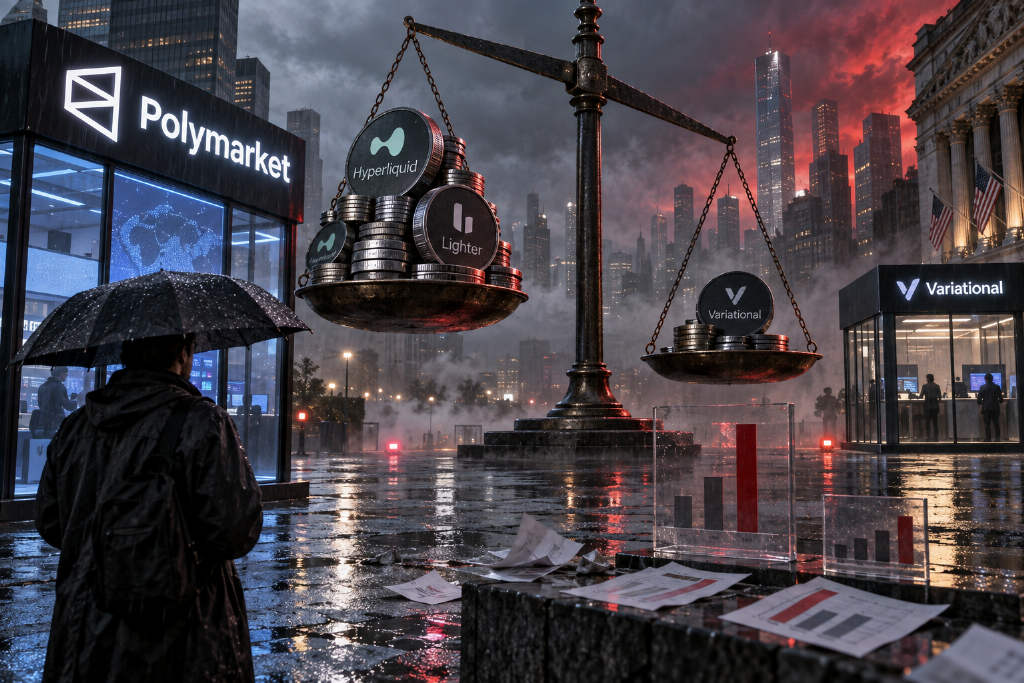
Variational2026-09-27 03:00:04Analyst says Variational’s $1.5 billion FDV looks too optimisticBlockworks analyst Shaunda Devens said in a post on X that Polymarket’s current pricing for Variational, which implies a fully diluted valuation of about $1.5 billion, appears overly optimistic. In her view, the market is applying valuation-to-revenue multiples seen in projects such as Hyperliquid and Lighter to a platform that still relies on points-based subsidies. She compared that pricing with recently launched perpetual DEX tokens, where the median first-day FDV-to-annualized-revenue multiple was 6.3x, versus roughly 57x for Variational at current levels. Devens also noted that median trading volume for such projects drops 54% in the first month after TGE. Using a conservative historical benchmark of 6.3x, she estimated Variational’s fair valuation at about $167 million, implying a points price of $4.8 to $5.4. Even under the highest recent comparable, Lighter at about 21.1x, the valuation would be around $558 million, with points priced at $16 to $18. She added that she does not expect Variational to trade down to that extremely conservative range at TGE, given the market’s current risk-on appetite, and said the comparison was meant to show that current pre-market OTC pricing may be too optimistic.270
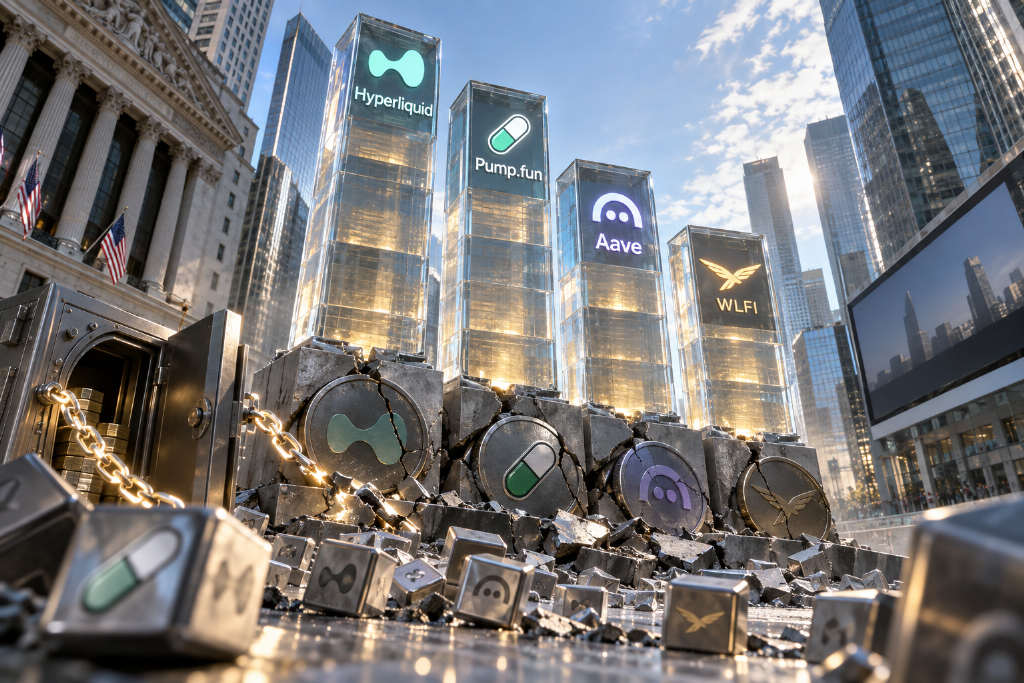
crypto market2026-09-22 03:51:07Crypto Protocols Are Making Money, but Many Tokens Still Fall as 2026 Revenue Rankings Expose Valuation GapsCoinGecko’s 2026 revenue ranking shows that crypto issuers outside stablecoins generated $3.4 billion in revenue over the first eight and a half months of the year, with the top 15 accounting for 56% of the total. The headline figures are striking, but the token market tells a different story. Hyperliquid and Pump.fun led the list with $429 million and $322 million in revenue, while trading terminals Axiom Pro and GMGN also ranked near the top, highlighting how user traffic and trading interfaces are capturing a growing share of fees. At the same time, several high-revenue names either have no token tied to that cash flow or generate income through structures that do not accrue to token holders. The divergence is also visible in market performance: HYPE rose about 218% and PUMP gained about 83.6% year to date, while Sky was up just 0.8%, Aave fell 17.8%, and WLFI dropped more than 61%. The article argues that revenue alone is a weak shortcut for valuation unless investors also examine how that revenue is earned, where it flows, whether token holders share in it, and how dilution from high fully diluted valuations and token unlocks affects the market.460
Binance2026-09-21 13:59:13Binance’s altcoin elimination cycle: 294 delistings point to a survival rule built on FDV and OIA study by IOSG author Ethan argues that Binance’s delisting pace has accelerated sharply in 2026, with 42 spot tokens and 28 USD-margined perpetual contracts removed by Aug. 11. Using data from Binance announcements, Binance market data and CoinGecko, the report covers 144 historical spot delisting events and 150 contract delisting events from Feb. 17, 2022 to Aug. 11, 2026. The paper says spot and derivatives are being cleaned up in very different ways. Spot removals are skewing older, with the median survival time of delisted spot assets rising from 4.1 years in 2022 to 5.1 years in 2026. Contract removals are moving the other way, with median survival dropping from 1.3 years to 0.8 years, and all 28 contract delistings in 2026 tied to listings launched after 2024. Its central claim is that fully diluted valuation, or FDV, and open interest, or OI, matter more than trading volume. Spot tokens with FDV below $10 million saw a 49% delisting rate in 2026, while none above $100 million were removed. For contracts, pairs with OI below $1 million had a 31% delisting rate, while those above $20 million had 0%. The report also says Binance’s own distribution channels offered no lasting shield, with 63% of delisted contracts coming from Binance Alpha Spotlight and 11 of the 42 delisted spot tokens tied to Launchpool or Launchpad.410
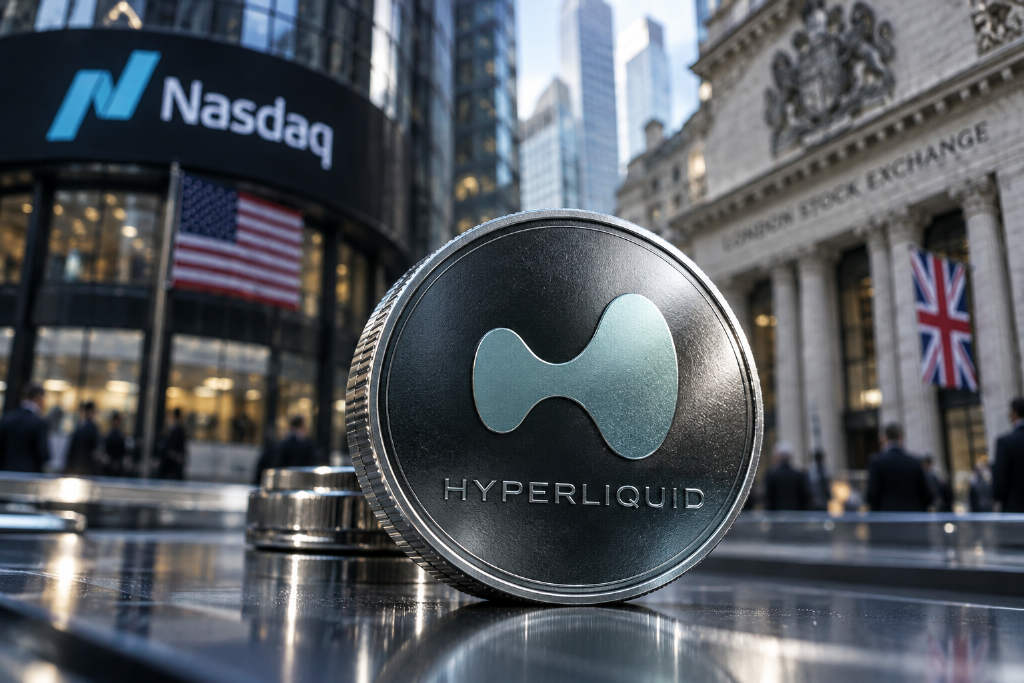
Hyperliquid2026-09-21 11:35:39Hyperliquid FDV Tops Nasdaq and London Stock Exchange, BlockBeats SaysBlockBeats reported on Sept. 21, citing market data from BIT (bit.com), that Hyperliquid’s fully diluted valuation, or FDV, has moved above that of Nasdaq and the London Stock Exchange. The brief did not provide the specific valuation figures behind the comparison. It also did not spell out the methodology, calculation basis, or the exact timing used for the side-by-side measure. As presented in the source item, the update was limited to the headline comparison and attribution to BIT market data, with no added breakdown of how Hyperliquid’s FDV was derived or which listed entities were used in the exchange comparison.290
GSR2026-09-20 13:49:16GSR says low-float, high-FDV token listings have repeatedly led to weak post-launch returnsGSR analyzed more than 2,300 token listings across major exchanges since 2013 and found a consistent pattern: the lower the initial circulating supply and the higher the fully diluted valuation, the worse the token’s subsequent performance tended to be. The report says median initial circulation fell sharply from 38% in 2017 to about 13% in 2020, recovering only partially in later years. It also found a strong link between listing valuation and float. Tokens listed below a $10 million FDV had a median initial circulation of 97%, while those above $1 billion had a median of 13%. Performance data in the study was similarly weak. On a median basis, tokens fell below their listing price within three days and were down 50% within 90 days. Among tokens listed above a $1 billion FDV, $1 invested was worth just $0.19 after 360 days, equal to a median one-year return of -81%. Tokens with less than 20% initial circulation retained only about $0.23 to $0.26 per $1 after a year, while those with 30% to 50% initial circulation held about $0.55. GSR argues this is not only a crypto issue and points to similar dynamics in the IPO market. The firm also outlines three areas for improvement: pricing public buyers in a way that leaves upside, releasing enough supply for real price discovery, and widening access so more participants can enter earlier.380