GLM-5

Jia Yangqing
2026-08-02 14:52:31

Jia Yangqing launches Intent Lab and unveils autonomous agent team Fleet

Jia Yangqing, former vice president of technology at Alibaba and founder of Lepton AI, has announced a new company, Intent Lab, along with an autonomous agent team called Fleet. According to ChainCatcher, the project is designed to turn users’ natural-language development requests directly into software systems that can run in production environments. Intent Lab said users only need to describe their development intent, and Fleet can handle the full workflow, including system architecture design, code development, infrastructure deployment, testing, quality verification, and performance optimization. The stated goal is not simply to generate code, but to deliver production-grade software that is ready to run. The company has also presented several early results, including the GLM-5.2 inference engine, one-shot database creation, and an agent file system that has completed full validation.


1770
Jia Yangqing launches Intent Lab and unveils autonomous agent team Fleet
CXMT
2026-07-28 02:03:46

July 28 crypto and tech roundup: CXMT’s blockbuster debut, domestic DUV production, and a packed day for AI and regulation

July 28 brought a dense mix of crypto market moves, semiconductor headlines, AI developments, and regulatory updates. In equities tied to China’s chip sector, CXMT posted a 465.82% gain on its first trading day, with turnover topping RMB 140 billion and market capitalization reaching RMB 3.28 trillion. Separate reporting cited by The Information said a Shanghai state-backed company has started mass production of self-developed DUV lithography manufacturing equipment, with output planned at around five units in 2026 and about 20 in 2027; SMIC, Hua Hong Semiconductor, and CXMT were named as intended customers. In crypto, most of the highest-volume CEX tokens were down over the past 24 hours, while AEON led the OKX gainers list with an 84.28% rise. Hyperliquid data around the CXMT IPO drew attention after Allium said pre-listing volume reached $17.8 million and that 96% of smart-money accounts had established profitable shorts before the open. Elsewhere, Strategy disclosed its first buyback of Stretch STRC shares under its digital credit securities repurchase plan, and Triple-A’s reported exploit losses expanded to $11.8 million. On policy, BlackRock backed the CLARITY Act, but the U.S. Senate temporarily set the bill aside, while lawmakers in Japan called for easing the country’s 2x crypto leverage cap.

1470
July 28 crypto and tech roundup: CXMT’s blockbuster debut, domestic DUV production, and a packed day for AI and regulation
Moonshot AI
2026-07-27 06:12:11

Moonshot AI to release Kimi K3 weights as Chinese open-weight models reach 68% of token usage

Moonshot AI, a Chinese AI startup, plans to release the model weights for Kimi K3, allowing developers to download the model, modify it for different uses, and run it in their own data centers or cloud environments. The company said Kimi K3 has 2.8 trillion parameters and a 1 million-token context window, enabling it to process large document sets and codebases in a single run. Moonshot AI also plans to publish a technical report covering the model architecture, training methods, and performance evaluation results. After Kimi K3 launched, Moonshot AI’s daily revenue reportedly increased by at least sixfold. The company is also pursuing a new funding round at a $50 billion valuation and is considering a Hong Kong listing as early as this year. According to Bloomberg Intelligence, the release of Kimi K3 and Z.AI’s GLM-5.2 pushed Chinese open-weight models to 68% of overall token usage. AWS Bedrock, Microsoft Azure Foundry, and Google Vertex AI do not yet offer Kimi K3, GLM-5.2, or similar Chinese open-weight models.

1030
Moonshot AI to release Kimi K3 weights as Chinese open-weight models reach 68% of token usage
China AI
2026-07-23 06:45:23

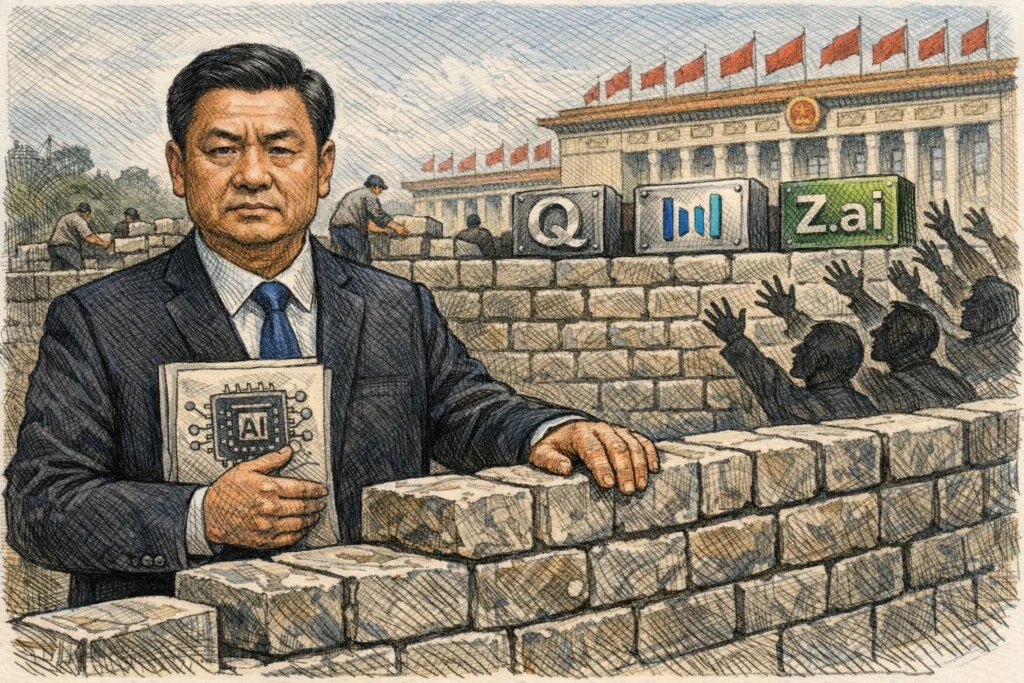
China weighs export curbs on AI models and chips, with Qwen, Doubao and Z.ai named in report

China’s Ministry of Commerce is considering tighter export rules for AI models and chip-related products and has discussed possible limits on overseas access to flagship systems from Alibaba, ByteDance and startup Z.ai, according to the Financial Times. The report says the talks involve Alibaba’s Qwen, ByteDance’s Doubao and Z.ai’s GLM-5.2, with options under review including changes to export control lists, clearer licensing standards and stricter checks on end users. Nothing has been finalized. The ministry has not published a formal proposal or timeline, and the three companies named in the report have not publicly confirmed the discussions. The report also says some officials have suggested any restrictions may apply only to future-generation models rather than older versions that are already widely distributed. The discussion comes as Chinese open-source models have gained wide adoption. The report cites Hugging Face data showing more than 113,000 derivative models in the Qwen family, more than 200,000 Qwen-tagged models overall, and about 942 million cumulative downloads for Qwen, compared with roughly 476 million for Meta’s Llama.

1030
China weighs export curbs on AI models and chips, with Qwen, Doubao and Z.ai named in report
JPMorgan
2026-07-21 08:07:19

JPMorgan says Zhipu selloff went too far, keeps Overweight after Kimi K3 repricing

JPMorgan said Kimi K3 has reset the valuation framework for China’s frontier model companies, but argued that the market reaction in Zhipu has gone too far. In its latest China AI sector report, the bank said investors cut valuation multiples for companies such as Zhipu and MiniMax after K3 raised doubts about their long-term lead. It lowered the benchmark from roughly 30x 2030 estimated P/ARR to 20x. Even so, JPMorgan said Zhipu’s share-price decline of more than 50% already reflects that pressure in excess. The bank kept an Overweight rating on Zhipu while reducing its target price to HK$1,600 from HK$2,400. It maintained a Neutral rating on MiniMax and cut its target price to HK$160 from HK$240. The report said Kimi K3 shortened the lead window for GLM-5.2, but did not push Zhipu out of China’s frontier-model group. JPMorgan added that China’s model commercialization market is still at an early stage, with Zhipu’s indicative ARR at about $1 billion, DeepSeek at $500 million, and MiniMax and Kimi at about $300 million each, versus roughly $69 billion for Anthropic. It also said K3’s higher API pricing points to a possible shift from low-price competition toward capability-based pricing.

1040
JPMorgan says Zhipu selloff went too far, keeps Overweight after Kimi K3 repricing