GPs

Solana
2026-08-27 15:22:53

SOL jumps more than 8% as Solana’s first binding on-chain governance vote nears result

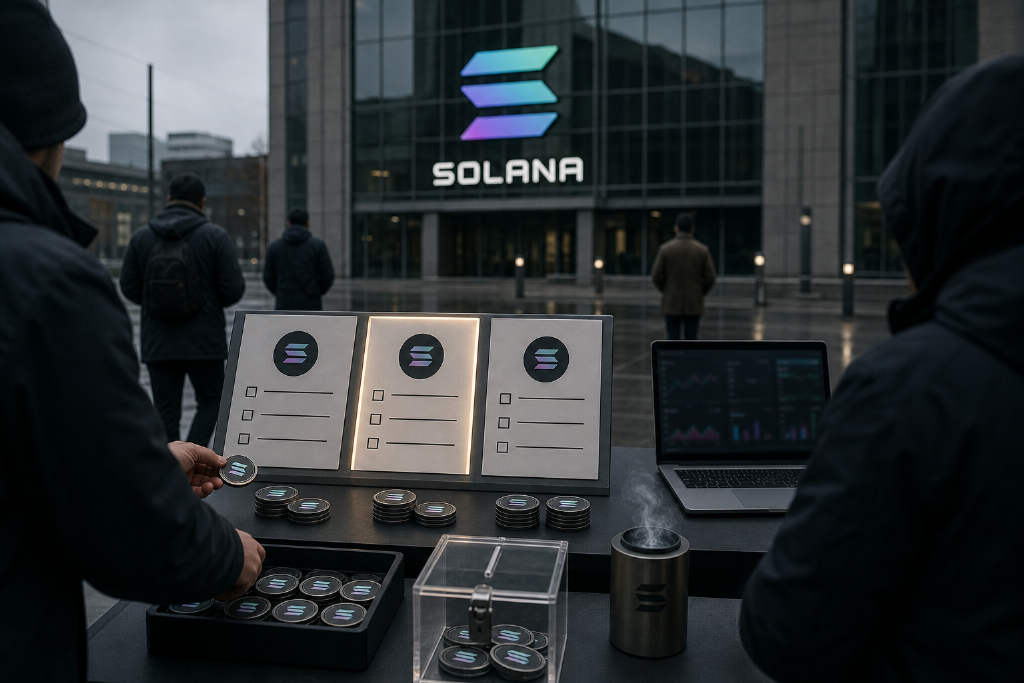
SOL rose more than 8% over the past 24 hours and is up about 44% for the month, marking its strongest monthly performance of 2024 so far, with the token climbing back above $105. The move came as Solana’s first binding on-chain governance vote entered its closing stage, with traders this week pricing in expectations of tighter future supply. The vote includes three Solana Governance Proposals, or SGPs: SGP-1 to approve a Solana constitution and formally establish future on-chain voting procedures; SGP-2, also known as SIMD-550, proposed by a Helius engineer, to double the disinflation rate from 15% to 30%, bringing the inflation schedule to its 1.5% floor by 2029 and cutting roughly 18.9 million SOL in issuance over the next six years; and SGP-3, or SIMD-553, proposed by Temporal, to split transaction fees into a base inclusion fee and a resource fee, with the latter burned directly. The two economic proposals each require a two-thirds absolute majority of participating stake weight to pass.

970
SOL jumps more than 8% as Solana’s first binding on-chain governance vote nears result
Solana
2026-08-27 15:12:18

SOL Jumps as Solana Validators Near Final Call on Inflation and Burn Proposals

Solana’s native token SOL rose more than 8% over the past 24 hours and was on track for its strongest month since 2024, up roughly 44% since the start of August and back above $105 for the first time since January. The move came as Solana validators approached the end of a major governance vote that could change how the network manages token supply. The vote, set to close around 15:30 UTC at the end of epoch 1023, covers three Solana Governance Proposals, or SGPs, under a new on-chain system that gives validators and SOL delegators binding, stake-weighted voting rights for the first time. One proposal would ratify a Solana Constitution. The other two, SIMD-550 and SIMD-553, focus on token issuance and burn mechanics. SIMD-550 would double Solana’s disinflation rate from 15% to 30%, bringing the network to its 1.5% inflation floor by 2029 instead of 2032 and reducing issuance by about 18.9 million SOL over six years. SIMD-553 would split transaction fees into an inclusion fee paid to validators and a resource fee that would be burned, potentially lifting daily burn from about 650 SOL to as much as 9,000 SOL. Both proposals require a two-thirds supermajority of participating stake, and results are expected within hours after voting ends.

380
SOL Jumps as Solana Validators Near Final Call on Inflation and Burn Proposals
Odin
2026-07-27 09:58:42

Odin survey says micro-fund plus SPV model may outperform a single large VC fund

A new survey from Odin argues that the classic 10-year blind-pool venture fund is under structural pressure, especially for smaller managers. Based on responses from 56 general partners, the report says 84% have already used special purpose vehicles, or SPVs, or plan to do so. Follow-on capital is the dominant use case, with 39 of the 47 respondents who use or expect to use SPVs citing that purpose. The report lays out a case for a hybrid approach: a small fund for early, high-uncertainty bets, paired with deal-by-deal SPVs for selective follow-on rounds. Odin says this setup can lower blended fee drag for limited partners and create tighter alignment between GPs and investment outcomes. In a hypothetical comparison, a $10 million micro-fund backed by SPVs is presented as superior on DPI to a $38.3 million fund making the same investments internally, assuming both portfolios return 4x. Survey data also points to emerging market norms around SPV economics. Management fees of 0%-0.5% were the most common, carry of 16%-20% was the most frequently cited range, and two-thirds of managers said setup and administration costs are passed through to LPs at cost. Odin also proposes a template for aligned SPV terms, including GP commitment of at least 2%, zero management fee, and 10%-20% carry.

620
Odin survey says micro-fund plus SPV model may outperform a single large VC fund
Venture Capit
2026-07-27 07:03:55

Microfunds and SPVs Gain Ground as Traditional Blind-Pool VC Funds Face Pressure

A new research note from Shoal Research and Odin argues that the traditional 10-year blind-pool venture fund is losing its grip as smaller managers increasingly combine microfunds with deal-by-deal special purpose vehicles, or SPVs. The premise is straightforward: use a small fund to capture the hardest early-stage bets, then bring in co-invest capital later when a company has clearer traction, stronger metrics, or a more established market position. The article says this hybrid structure can lower blended fee loads for limited partners while keeping general partners focused on the earliest part of the market. It also claims the model aligns incentives better than a single larger fund. In one example, the authors compare a $10 million microfund backed by SPVs with a $38.3 million fund that executes the same strategy internally, and conclude the smaller fund structure can produce better DPI if portfolio outcomes are identical. Odin also surveyed 56 GPs earlier this year. Of those, 39 already use SPVs and another 8 plan to do so, bringing current and prospective adoption to 84%. Follow-on financing was the dominant use case. The piece argues that co-investment is moving toward a standard feature of venture capital, but says both GPs and LPs still need clearer norms on fees, GP commitments, transparency, and allocation priorities.

510
Microfunds and SPVs Gain Ground as Traditional Blind-Pool VC Funds Face Pressure
listed compan
2026-07-24 09:56:09

261 Listed Companies Committed RMB 50.644 Billion to Funds in H1, With Most Making Just One Bet

Data from Touzhong Jiachuan CVSource shows that 261 listed company limited partners, or LPs, made 331 fund commitments in the first half of the year, with disclosed subscribed capital totaling RMB 50.644 billion. Excluding financial firms, 254 non-financial listed companies made 307 commitments worth RMB 25.103 billion. The figures point to a segment that draws close attention as a proxy for market-oriented capital, even if its share of the broader LP market remains small. The report says non-financial listed company LPs accounted for 4.0% of all LP commitments by deal count and 2.5% by committed capital, based on 7,616 LP commitments and RMB 989.161 billion across the wider market in the same period. More than 80% of listed company LPs made only one commitment in H1. JHET and Bojun Technology led by frequency with four commitments each, while Mixue Group ranked first by disclosed commitment amount at RMB 1.5 billion. At the manager level, Jinding Capital received commitments from nine listed companies, the highest by investor count. By disclosed capital, Kaibo Capital ranked first with RMB 1.523 billion, followed by Xingwang Investment at RMB 1.5 billion and Heyi Capital at RMB 1.05 billion. Semiconductor led all sub-sectors with 39 commitments involving 32 listed companies, while battery and energy storage stood out on total disclosed capital.

170
261 Listed Companies Committed RMB 50.644 Billion to Funds in H1, With Most Making Just One Bet