Glide

SEC
2026-09-21 03:03:50

SEC tokenized securities relief draws scrutiny as Glider co-founder says scope is far narrower than markets assumed

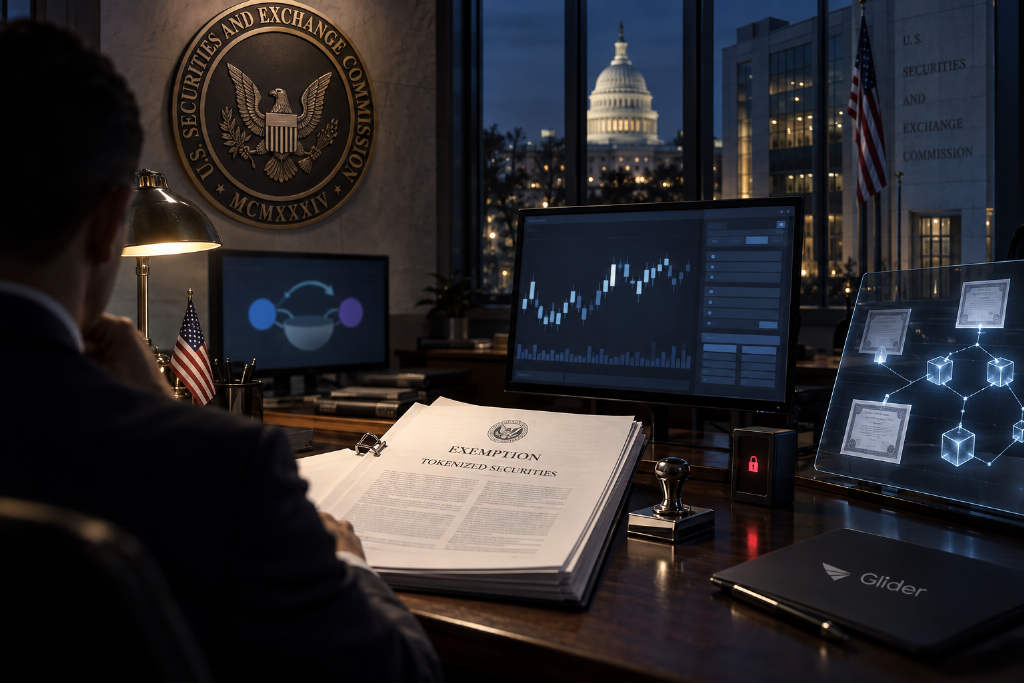
The U.S. Securities and Exchange Commission’s Sept. 18 relief document on tokenized securities was quickly read by the market as a green light for onchain equities, helping lift sentiment across crypto and fueling bets that names tied to tokenization infrastructure could benefit. Brian Huang, co-founder of DeFi protocol Glider, argued in a Sept. 22 post on X that the market reaction ran ahead of what the 60-page document actually permits. After reading the filing in full, Huang said the exemption is tightly limited to permissioned participants, requires tokenized National Market System stocks to be registered with the SEC, and does not cover the permissionless stock-linked tokens already available from platforms including Robinhood, Coinbase, Binance, Ondo and xStocks. He also said the framework centers on automated market maker venues rather than central limit order book models such as Hyperliquid, even though the SEC itself acknowledges best-execution concerns under AMM-based trading. Huang described the proposal as lacking clear market demand and argued that no existing institution fully meets the requirements. He pointed to a long compliance checklist, issuer veto power over tokenized listings, equal shareholder-rights requirements, and a trading-volume cap of 0.25% of the prior month’s average daily volume in the underlying NMS stock. He said Glider expects to submit a formal comment letter to the SEC seeking broader exemptive relief.
120
SEC tokenized securities relief draws scrutiny as Glider co-founder says scope is far narrower than markets assumed
Tokenized Sto
2026-09-05 15:13:15

AMC Token Dispute Expands Into a Broader Fight Over Which Tokenized Stock Structure Should Prevail

A public clash between AMC Entertainment CEO Adam Aron and Robinhood over tokenized AMC shares has widened into a much larger industry debate over how tokenized stocks should be built. At the center of the dispute are three competing structures: Robinhood’s offshore debt-style stock tokens that give users economic exposure but no claim on the referenced issuer; custodial 1:1 models used by firms such as Ondo, xStocks and Dinari, where regulated intermediaries hold the underlying shares; and issuer-native designs from Securitize and Superstate, where a company’s own registered shares are recorded onchain. The SEC’s Division of Corporation Finance outlined these categories in a Jan. 28 statement, and the choice of structure affects both the securities rules that apply and what investors may be able to claim if an intermediary fails. The argument intensified Friday as Dinari co-founder Gabriel Otte criticized synthetic products, Uniswap founder Hayden Adams defended programmability and 24/7 access, and Securitize CEO Carlos Domingo backed issuer-controlled tokenization. The fight is unfolding as tokenized stocks reach $2.91 billion across 2.67 million holders, according to rwa.xyz, with Ondo leading the sector and Robinhood gaining trading traction through activity on Robinhood Chain. Lawyers, transfer agents and market structure participants have also entered the discussion, turning what began as an AMC controversy into a live test of investor rights, execution quality, supply mechanics and regulatory design for onchain equities.

880
AMC Token Dispute Expands Into a Broader Fight Over Which Tokenized Stock Structure Should Prevail
RWA
2026-08-28 09:52:10

RWA Weekly: Four Banks Move on a Global Stablecoin Alliance as Coinbase Brings Tokenized Stocks to Base

Real-world asset markets kept expanding during the Aug. 21 to Aug. 27 tracking window, with on-chain RWA market capitalization reaching $38.7 billion and total holders climbing to 2.952 million, according to the figures cited in the report. Stablecoins also grew in scale, with total market capitalization rebounding to $303.04 billion and monthly transfer volume rising 20.33% from a month earlier to $6.49 trillion, even as monthly active addresses slipped 1.24% to 52.87 million. The report described that split as a market where larger holders are rebalancing frequently while smaller users are staying on the sidelines. Regulatory developments came from three major jurisdictions. In the U.S., the Financial Accounting Standards Board proposed guidance on when some digital assets, including stablecoins, may qualify as cash equivalents under GAAP, with comments due by Nov. 19, 2026. In the U.K., the government is moving to give the Bank of England a secondary legal objective to support innovation in digital currency and payments. In Japan, regulators are preparing to ease limits on large-value stablecoin payments, potentially allowing single transactions above 1 million yen. On the corporate and product side, The Wall Street Journal reported that JPMorgan Chase, Bank of America, Wells Fargo and Santander are working toward a global stablecoin alliance. Coinbase has launched tokenized stocks natively on Base under its B20 standard, while Franklin Templeton, Bitwise, Bitfinex Securities, Revolut, Fasset and Entropy.io also posted fresh RWA and stablecoin developments.

1230
RWA Weekly: Four Banks Move on a Global Stablecoin Alliance as Coinbase Brings Tokenized Stocks to Base
Bitwise
2026-08-25 19:17:25

Bitwise rolls out self-custodied tokenized stock portfolios on Base, with only Mag7X live at launch

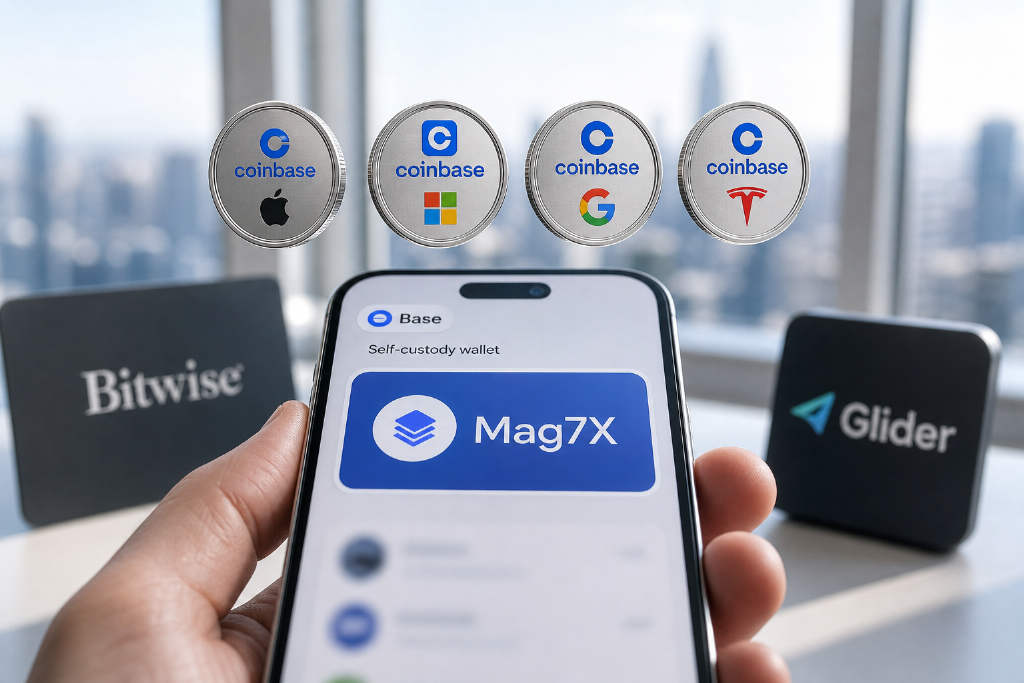
Bitwise on Tuesday launched Automated Token Portfolios, a new product that lets eligible investors outside the United States hold Coinbase-issued tokenized stocks directly in their own wallets on Base. The offering builds on Coinbase’s tokenized-stock infrastructure, which went live a day earlier with four technology names, and packages those assets into rules-based portfolio strategies. Bitwise said it selects the portfolio constituents and target allocations, while Glider executes trades and handles rebalancing. The firms said they do not take custody of user tokens during that process. Although Bitwise announced three portfolio models, only Mag7X is currently active on Glider’s platform, while Robotics and AI Leaders are listed as coming soon. Mag7X is intended to equally weight Apple, Microsoft, Nvidia, Alphabet, Amazon, Meta, Tesla, and SpaceX. At launch, though, the live strategy only holds the four tokenized stocks Coinbase currently offers — Apple, Alphabet, Meta, and Nvidia — each at 25%. Glider lists a 0.15% fee and says Coinbase is also providing an extra 10% incentive to the strategy. Access is limited to non-U.S. persons in eligible jurisdictions under Regulation S, and the tokens are issued by a Coinbase entity licensed in Abu Dhabi Global Market.

880
Bitwise rolls out self-custodied tokenized stock portfolios on Base, with only Mag7X live at launch
US Treasury
2026-08-26 02:41:00

US Treasury launches quantum-readiness group as Grayscale lists Zcash ETF and BlackRock lowers in-kind Bitcoin ETF threshold

A dense stretch of crypto and adjacent market developments unfolded between Aug. 25 and Aug. 26. The US Treasury said it is launching a Quantum Readiness Working Group, a public-private effort meant to help the financial sector migrate toward quantum-resistant technology in an orderly and operationally resilient way. One of its three workstreams is focused on digital assets and emerging technology risks. In Thailand, the securities regulator opened a public consultation on draft rules for crypto ETFs, with Bitcoin and Ether set as the only eligible assets at the initial stage and comments accepted through Sept. 20. Product launches and market-structure changes also stood out. Grayscale converted its Zcash Trust into the Zcash ETF, ticker ZCSH, and listed it on NYSE Arca, calling it the first ETF to provide direct Zcash exposure. The fund charges a 2.5% fee, and Grayscale said the revenue generated from that fee will flow back to the Zcash ecosystem. BlackRock, meanwhile, cut the minimum trade size for investors using in-kind Bitcoin subscriptions to create ETF shares from $25 million to $1 million in July. Robbie Mitchnick, BlackRock’s head of digital assets, said IBIT has now processed more than $5 billion of those conversions. Elsewhere, Kraken said some customer accounts were temporarily inaccessible after receiving tiny token transfers tied to a wallet associated with sanctioned rival HTX, while LayerZero outlined plans for an institutional onchain exchange called ATLAS. Several funding rounds, whale-position updates, tokenized-equity products, and ETF flow data rounded out the latest batch of market-moving items.

1360
US Treasury launches quantum-readiness group as Grayscale lists Zcash ETF and BlackRock lowers in-kind Bitcoin ETF threshold
Bitwise
2026-08-25 13:22:38

Bitwise to launch automated tokenized stock portfolios for qualified non-U.S. investors

Bitwise Asset Management said it will roll out an automated token portfolio product for qualified investors outside the United States, giving them a way to hold baskets of tokenized equities directly in self-custody wallets. The offering will use Coinbase’s tokenized U.S. stocks, while Glider will provide the technology that supports the product’s operation. Portfolio allocations will be automatically rebalanced based on weightings set by Bitwise. The first portfolios are set to focus on three themes: the Magnificent Seven, artificial intelligence, and robotics. Bitwise said the assets will not be pooled into a separate investment vehicle. Instead, they will remain in each investor’s own wallet, which sets the structure apart from a traditional fund format. The firm plans to charge a 0.15% methodology access fee for the product. Launch is expected in the coming weeks, according to the announcement carried by Odaily.

730
Bitwise to launch automated tokenized stock portfolios for qualified non-U.S. investors
Uniswap
2026-08-18 21:55:04

Hayden Adams says correlated-pair AMMs can win major markets as former XTX trader argues they will go to zero

Uniswap founder Hayden Adams has reignited debate over automated market makers with his first blog post since 2019, arguing that AMMs can take over the world’s biggest markets once tokenized assets trade against each other instead of directly against dollars. His thesis centers on correlated pairs: if two assets move together, liquidity providers face less risk, making passive onchain liquidity more competitive with professional market makers. Adams compares that shift to the rise of index investing, citing the growth of passive funds and the concentration of trading power at firms such as Citadel Securities. The argument met immediate resistance. Brian Huang, co-founder of onchain portfolio app Glider and a former XTX Markets trader, said AMMs are structurally unsuited for traditional market making, pointing to execution, latency, gas costs, order-flow segmentation and impermanent loss. Other market participants pushed on different parts of the thesis. Bebop CEO Katia Banina questioned whether traders would actually want pairs like SPY/NVDA instead of dollar pairs, while InvestaX CEO Julian Kwan said regulated tokenized assets introduce issuer-controlled permissioning that limits who can provide liquidity. The debate widened to include Uniswap v4 hooks, routing economics, capital efficiency and the current share of DEX spot volume relative to centralized venues. Supporters framed AMMs as programmable market infrastructure; skeptics argued the model may remain useful in niche routing and arbitrage roles without displacing professional market makers.

1400
Hayden Adams says correlated-pair AMMs can win major markets as former XTX trader argues they will go to zero
MoonPay
2026-08-18 13:00:00

MoonPay adds Cash App Pay for crypto purchases by US customers

MoonPay has added Cash App Pay as a payment option for crypto purchases, giving eligible US customers another way to fund transactions with balances already held in the mobile payments app. The integration is available through MoonPay’s own checkout and selected partners, including Trust Wallet, MetaMask, Ledger, Uniswap and others. MoonPay said the move lets users buy crypto without switching apps or logging in again. The company now supports Cash App, PayPal and Venmo, after adding PayPal in 2024 and later expanding to Venmo. Cash App, operated by Block, already lets users buy and sell Bitcoin in-app and had 59 million active users in June, according to Block’s second-quarter shareholder report. MoonPay co-founder and CEO Ivan Soto-Wright said the integration gives tens of millions of Americans access to the digital asset ecosystem through an app they already know and trust. The company also noted its New York and EU regulatory authorizations, while continuing to expand beyond fiat-to-crypto onramps through acquisitions in 2026.

630
MoonPay adds Cash App Pay for crypto purchases by US customers