IFM

IFM
2026-09-03 14:54:17

Abu Dhabi’s IFM open-sources six K2 Horizon models spanning 0.9B to 375B

The Institute of Foundation Models, or IFM, under the UAE’s Mohamed bin Zayed University of Artificial Intelligence (MBZUAI), has released K2 Horizon and open-sourced six models in one batch: 0.9B, 3.7B, 7B, 32B, 36B-A4B, and 375B-A23B. IFM said the 0.9B version is aimed at edge devices such as watches and smart glasses, while the 7B model can run on phones. The largest model, 375B-A23B, uses a mixture-of-experts architecture and activates about 23B parameters per generated token. According to the institute, the 0.9B, 3.7B, and 7B variants set new benchmark results within their respective size classes. Beyond final weights, IFM said it will also release training code, data or data-construction recipes, intermediate checkpoints, training logs, and evaluation records. Some datasets cannot be redistributed directly because of licensing limits, though the team said it will disclose sources, construction methods, and mixture ratios. The models and code are released under Apache 2.0. Artificial Analysis gave the 375B-A23B model an Intelligence Index score of 47, close to MiniMax-M3’s 45, and said it performs better on agent tasks while showing weaker results in knowledge and hard reasoning.


20
Abu Dhabi’s IFM open-sources six K2 Horizon models spanning 0.9B to 375B
Bitcoin
2026-08-25 06:33:15

Saylor says Bitcoin should integrate with banks, governments and fiat, not fight them

Michael Saylor argues that Bitcoin has moved past its cypherpunk phase and now functions as a global capital network used by individuals, hedge funds, public companies, banks, custodians and even sovereign governments. In his view, parts of Bitcoin’s early survival culture have hardened into dogma, especially strict readings of Satoshi Nakamoto, the white paper, self-custody and hostility toward banks and governments. He says that framework no longer fits Bitcoin’s current role. Saylor’s core argument is that Bitcoin should be understood less as everyday electronic cash and more as a form of digital capital: a scarce, portable, non-sovereign reserve asset that can support securities, credit, debt, derivatives and even machine-driven economic activity. He rejects the idea that custody, exchange-traded products or other financial wrappers are inherently fraudulent, and says financialization is a normal way capital adapts to different user needs. The article also points to the failure of BIP-110, which was marked closed on August 9, 2026 after facing rejection from the economic network, as evidence that ideological enforcement cannot override market consensus. Saylor’s broader point is that fiat systems and Bitcoin can coexist, with fiat continuing to serve taxation, wages and commerce while Bitcoin develops alongside it as digital capital.

280
Saylor says Bitcoin should integrate with banks, governments and fiat, not fight them
SEC
2026-08-20 02:08:38

SEC Crypto Assets Proposal Would Ease Registration, Not Oversight

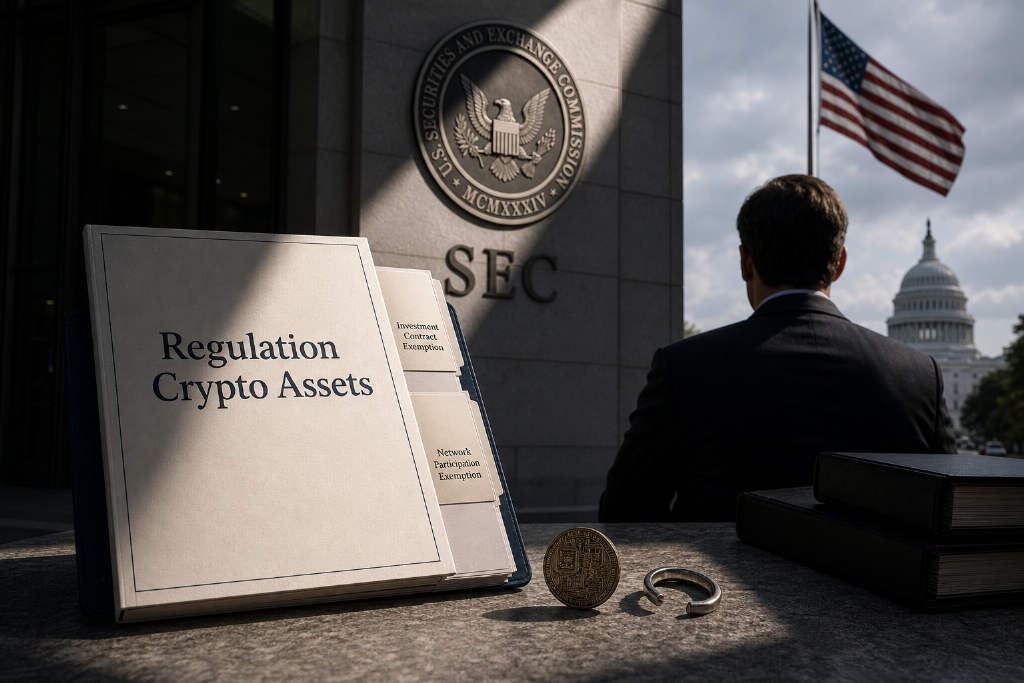
The U.S. Securities and Exchange Commission’s Aug. 18 Regulation Crypto Assets proposal has triggered a wave of excitement in crypto circles, with some reading it as a green light for token issuers to raise money in the U.S. without dealing with securities regulation. That is only partly correct. The proposal creates a tailored exemption framework for crypto asset offerings inside the existing U.S. securities regime, but it does not remove SEC oversight or anti-fraud enforcement. At the center of the draft are two fundraising exemptions, a safe harbor that could let a token stop being treated as a security once core development work is completed or permanently halted, and federal preemption over state-level registration requirements. The proposal sets a $5 million cap over four years for an early-stage exemption and a $75 million cap in a 12-month period for a larger fundraising exemption that comes with audited financials and ongoing reporting. The rule is still only a proposal. Its fate will depend on a 60-day public comment period, a procedural Senate vote on the CLARITY Act scheduled for Sept. 15, 2026, and the possibility of legal challenges from Wall Street groups such as SIFMA. For crypto projects, the draft offers a clearer path than the current case-by-case uncertainty, but it also comes with legal, audit and compliance costs that the source estimates could run from hundreds of thousands of dollars to more than $1 million.

390
SEC Crypto Assets Proposal Would Ease Registration, Not Oversight
Robinhood
2026-08-18 21:01:11

Tenev Urges U.S. to Open the Door to Tokenized Stock Trading

Robinhood CEO Vlad Tenev said U.S. securities rules need to be modernized so tokenized stocks can trade in America, calling the lack of U.S. Stock Tokens a key gap in the company’s tokenization push. His post came five days after the SEC pulled a planned discussion of its “innovation exemption.” Tenev argued that onchain settlement, 24/7 trading and portability would make tokenized equities more useful. He also said Robinhood’s Stock Tokens now cover more than 190 U.S. equities across more than 120 countries, though the product still represents a small share of the broader tokenized equity market.

510
Tenev Urges U.S. to Open the Door to Tokenized Stock Trading
Pump.fun
2026-08-18 12:37:02

PUMP posts first golden cross as Pump.fun revenue climbs to a seven-month high

Decrypt’s Morning Minute said Pump.fun’s PUMP token is showing its first golden cross since launch, with the 50-day EMA moving above the 200-day EMA after a prolonged downturn. The token fell to $0.001491 in July, traded as high as $0.003 intraday on Monday, and later changed hands near $0.002733. The report tied the move to improving business performance rather than price action alone. According to DefiLlama data cited in the piece, Pump.fun generated $11.52 million in revenue over the past seven days, ranking fourth among all crypto protocols behind Tether, Circle, and Canton. The newsletter also said annualized revenue stands at $458 million against a $1.09 billion market cap, while August 10 to 16 fees reached $10.74 million, up 7% week over week. Pump said Tuesday’s $1.73 million marked its strongest single revenue day since January 30. The article also highlighted Pump.fun’s buyback-and-burn structure, recent product changes including Callout Rewards and lower trading fees, plus broader market, macro, ETF, memecoin, token, and NFT developments covered in the daily roundup.

680
PUMP posts first golden cross as Pump.fun revenue climbs to a seven-month high
SEC
2026-08-14 01:32:36

SEC Delays Innovation Exemption Again as White House and Wall Street Push Back

The U.S. Securities and Exchange Commission has again delayed its closely watched "innovation exemption" plan for tokenized securities, after pressure from both the White House and Wall Street. According to CoinDesk, citing three people familiar with the matter, the SEC had planned to release parts of the exemption at a public meeting on Friday, only to cancel the move late Thursday. The White House was concerned that a broad SEC exemption could disrupt ongoing congressional negotiations over the Digital Asset Market Clarity Act, or the CLARITY Act. One person familiar with the discussions said the industry had already received signals that the plan may have to wait until lawmakers decide the bill’s fate. At the same time, the Securities Industry and Financial Markets Association, or SIFMA, argued in a June 30 letter that major market structure changes should be handled through open legislative processes rather than exemptions or no-action relief. Its concerns center on how on-chain trading would meet best-execution obligations under Regulation NMS. The delay also reflects internal SEC questions over legal authority, economic analysis, and procedure, even as tokenization efforts from Nasdaq, NYSE, DTCC, and Citi continue to move ahead.

890
SEC Delays Innovation Exemption Again as White House and Wall Street Push Back
SEC
2026-08-12 19:30:12

SEC moves ahead with tokenized-securities exemption that may open the door to 24/7 stock-token trading

The U.S. Securities and Exchange Commission is moving toward an "innovation exemption" for tokenized listed securities, according to public remarks by Chair Paul Atkins and a Bloomberg report published on Aug. 11. Atkins has said the framework is meant to give market participants a limited path to begin facilitating compliant onchain trading while the agency works on longer-term rules. Bloomberg said the measure could also help clear the way for continuous, 24/7 trading of stock tokens on blockchains. What is not clear is just as important as what has been said. Atkins' April and May remarks described the initiative in broad terms, but they did not spell out the exemption's legal form, effective date, binding conditions, or which existing requirements it would modify. Both speeches also carried disclaimers stating that he was speaking for himself, not for the Commission or fellow commissioners. The SEC's published agenda for Friday does not list the tokenized-securities exemption. Its only item concerns a separate proposal on a tailored offering regime for certain investment contracts involving crypto assets. Earlier SEC staff guidance and statements from Commissioner Hester Peirce have also stressed that tokenized securities remain securities under federal law, meaning the same legal framework still applies unless a specific exemption is available.

840
SEC moves ahead with tokenized-securities exemption that may open the door to 24/7 stock-token trading