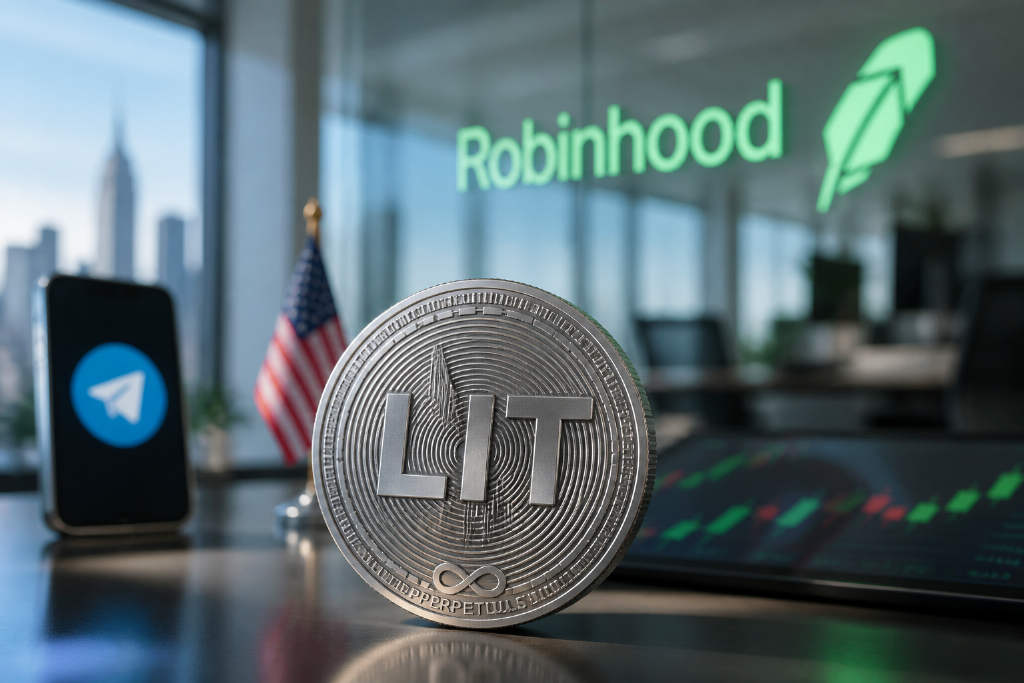
LIT2026-08-31 08:43:20LIT jumps nearly 5x in five months as Lighter’s Robinhood ties come into focusLIT has been one of the strongest-performing crypto tokens this year, rising from a low of $0.7794 in late March to as high as $3.79 five months later. The token was up 75% over the past 30 days and 24% over the past seven days, lifting its market capitalization to $865 million and placing it 76th globally by crypto market value, according to the source article. The report argues that the rally cannot be explained by broader market strength alone. It points to Lighter’s position as a U.S.-based perpetual DEX project, its role in powering perpetual products for Telegram Wallet and Robinhood Chain, and the growing visibility of its founder Vladimir in U.S. regulatory discussions. On Aug. 20, Vladimir attended the first meeting of the Commodity Futures Trading Commission’s newly formed innovation advisory committee, where participants discussed what a decentralized exchange would need to look like to operate legally in the United States. The article also traces the personal history behind Lighter’s relationship with Robinhood, saying Vladimir and Robinhood co-founder Vlad Tenev were high school classmates at Thomas Jefferson High School for Science and Technology and that Vladimir later served as an early adviser to what became Robinhood.500
Chainlink2026-08-29 01:50:35Lighter Expands Chainlink Integration to Cover More Than 125 Cross-Category MarketsLighter, a ZK Rollup-based decentralized exchange built on Ethereum Layer 2, has broadened its integration with Chainlink to cover more than 125 markets spanning multiple asset categories. The expansion introduces Chainlink's 24/5 US Equities Streams, allowing perpetual futures traders to obtain low-latency stock pricing data even while traditional US equity markets are closed. Chainlink price feeds currently support liquidations, margin calculations, and conditional orders that depend on real-time prices. Lighter, which uses a verifiable order book to prevent front-running, first partnered with Chainlink in November 2025, naming Chainlink Data Streams as its official oracle solution for real-world asset (RWA) derivatives. With this expansion, Lighter can now facilitate on-chain perpetual contracts across commodities, equities, and foreign exchange. The news was reported by Techub News, citing Crypto Briefing.970
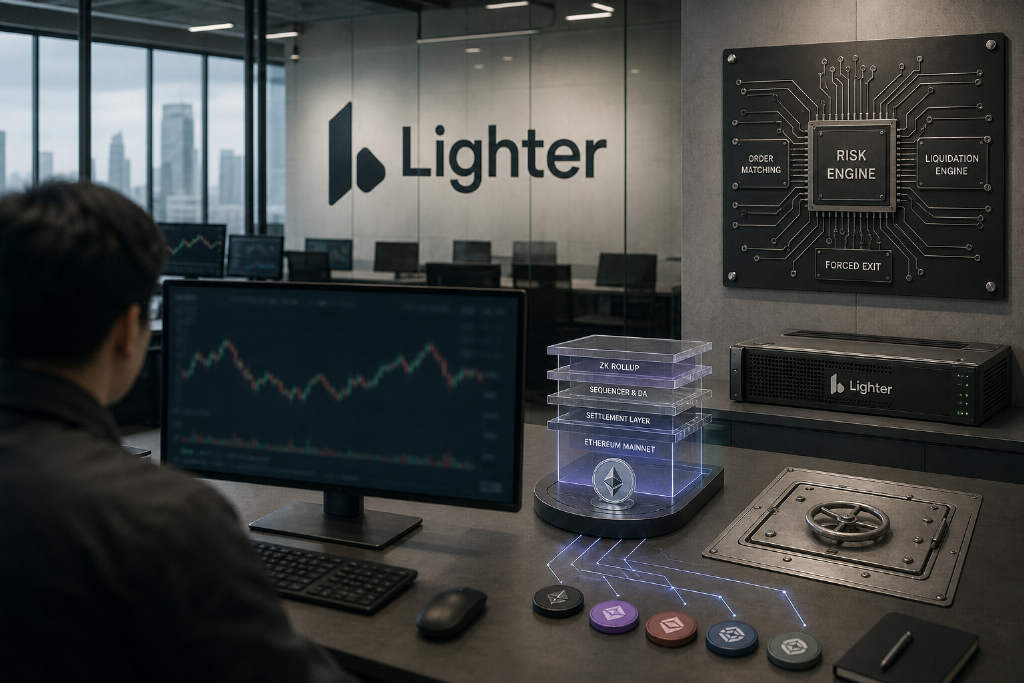
Lighter2026-08-27 02:02:27Why LIT Keeps Hitting Highs as Lighter Bets on a Different Perp DEX ArchitectureLighter’s token, LIT, has continued to set fresh highs since Aug. 20, reaching as much as $3.8 on Aug. 26 after bottoming near $0.78 on March 30, according to Foresight News. The report argues that the rally is not only tied to business-side factors such as token buybacks and a partnership with Robinhood, but also to Lighter’s underlying market structure and chain design. Only about 25% of LIT is currently in circulation, while team and investor allocations remain locked until Dec. 30, 2026. Current sell pressure mainly comes from staking rewards, and official dashboard data shows 17.3 million LIT has already been bought back, equal to 1.73% of total supply and 6.92% of circulating supply. Foresight News says Lighter has taken a path distinct from general-purpose Layer 2s and standalone Layer 1 trading chains. Instead of relying on a generic stack, Lighter built a purpose-built ZK Rollup for trading and encoded exchange rules directly into zk constraints. That design, combined with Ethereum-based custody, forced exit guarantees, and direct access to liquidity from Ethereum, Arbitrum, Base and Solana, is presented as the core reason the market has assigned a premium to the protocol and its token.730
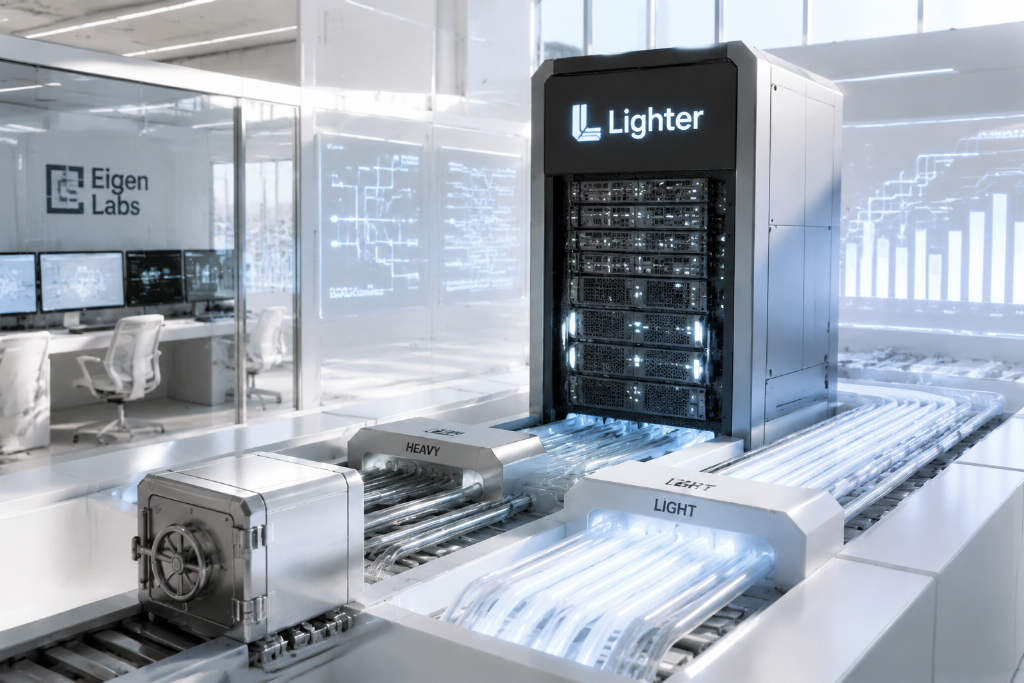
Lighter2026-08-26 05:45:02Lighter says block verification is about 5x faster, with withdrawal delay floor cut to 16-17 minutesDecentralized exchange Lighter said it has made fresh progress on its validation system, bringing its average block verification time down from about 5.3 minutes to roughly 1 minute over the past month. The company attributed the change to two separate upgrades. The first, which it called a "heavy/light decomposition," splits validation circuits by trade complexity so that simple trades, which account for more than 98% of volume, incur a lower verification cost. Lighter said that change alone halved verification time. The second came from a prover optimization competition run jointly with Eigen Labs. That effort focused on infrastructure-level improvements to the Plonky2 prover, and the first batch of results went live on Aug. 23, cutting verification time by more than half again. Lighter also said its main validation setup relies on a cluster of Apple Silicon Mac mini machines, backed by an elastic cloud overflow layer. As throughput improved, the cloud overflow layer dropped from running for several hours a day to nearly zero usage, while the baseline time tied to withdrawal finality fell from about 21-22 minutes to around 16-17 minutes.940
Lighter2026-08-26 00:24:08Lighter says average block proving time fell from 5.3 minutes to about 1 minuteDecentralized perpetuals protocol Lighter said its average block proving time dropped from about 5.3 minutes to roughly 1 minute over the past month, following two separate optimizations introduced on July 23 and Aug. 23. According to the protocol, the changes allow blocks to be verified faster, lifting throughput, lowering infrastructure costs, and leaving more room for future scaling. The first upgrade, described as a Heavy/Light decomposition, split transaction circuits into lightweight and heavyweight paths so that simple quote updates, which make up the bulk of transactions, only incur light constraints. Lighter said that cut proving time in half. A second set of gains came from Prover backend work tied to a proving competition run with Eigen Labs, which reduced proving time by more than half again under the same circuit conditions. Lighter also said that on Aug. 10 it batched all Schnorr signature checks into a single Plonky3 proof per block, delivering an additional 20% improvement. The protocol added that withdrawal finality fell from about 21–22 minutes to around 16–17 minutes, while sustained processing capacity now exceeds its historical peak load.980
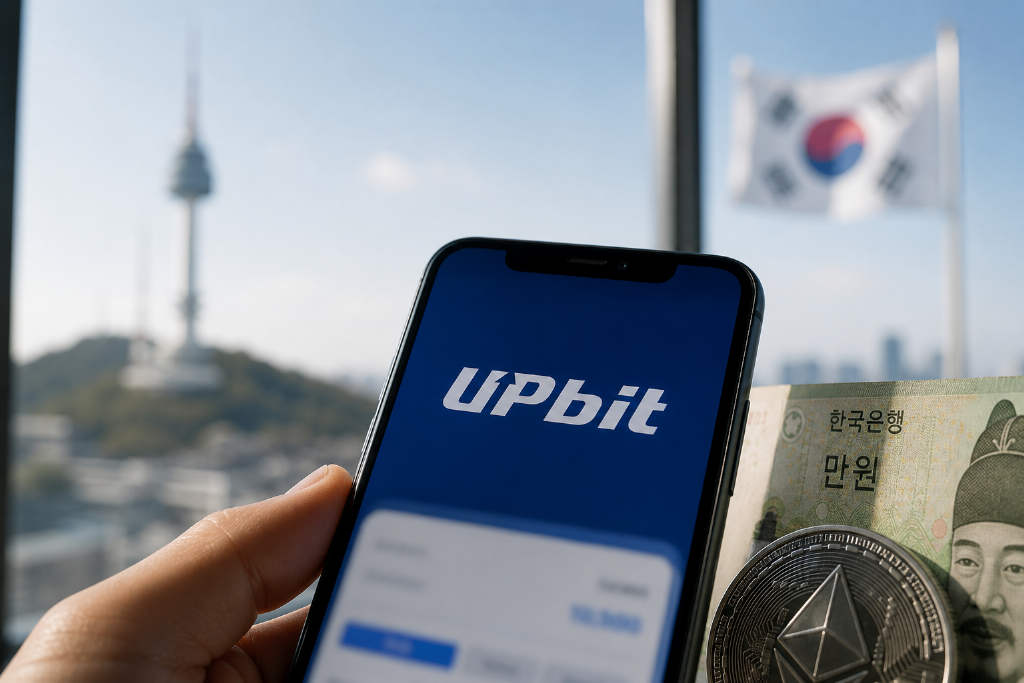
UPBIT2026-08-24 02:35:40UPBIT to list Lighter (LIT) on Aug. 24 and open KRW tradingChainCatcher said UPBIT will list Lighter (LIT) at 13:00 on Aug. 24 and support KRW trading. LIT is an Ethereum-based utility token, and it is mainly used for staking and liquidity participation in the Lighter protocol.1000
LIT2026-08-24 01:58:42Eric Conner says LIT may be heading into a short squeeze as 6 million tokens sit in the liquidation zoneFormer Ethereum core developer and angel investor Eric Conner said on X that Lighter (LIT) may be entering a short squeeze, describing the setup as potentially devastating for short sellers. According to his post, short liquidations totaling as much as 6 million LIT are concentrated in the $3.43 to $4.10 price range. Odaily noted that LIT was trading at $3.66 at the time. Based on the figures cited in the post, that liquidation cluster equals 2.5% of the token’s circulating supply. The comment points to a narrow band above the current price where short positions could face pressure if LIT continues moving higher.1080
Lighter2026-08-21 01:51:18Lighter CEO says DeFi should not be treated as a regulatory adversary, sees AI widening access to financeLighter CEO Vladimir Novakovski said at the first meeting of the U.S. Commodity Futures Trading Commission’s Innovation Advisory Committee that decentralized finance has long been misunderstood and should not be treated as being at odds with regulators. He said DeFi transactions are recorded on on-chain ledgers in a verifiable way, which can help regulators with transparency, consumer protection, and market fairness. Novakovski also said decentralized, verifiable finance could become an important part of future U.S. financial infrastructure, especially in cybersecurity and operational resilience. In his view, the industry should push more technology toward open-source, verifiable stacks. On artificial intelligence, he said AI could help democratize finance by allowing users to build bundled trading or investment strategies based on their own views on macroeconomics and specific industries. He noted that such capabilities were previously aimed mainly at high-net-worth individuals and professional money managers. At the same time, he identified consumer protection as the main risk for AI in finance, including cases where users do not understand what an AI model actually does or where its capabilities are marketed in a misleading way. Before AI models are rolled out to consumers at scale, he said, sandbox mechanisms should be put in place and models should be tested for effectiveness and formal verifiability.1070