MPC

Sui
2026-08-18 09:36:09

Sui’s Hashi testnet processed more than 1.1 million Bitcoin deposits in three weeks

Sui’s Hashi Bitcoin lending protocol has processed more than 1.1 million Bitcoin deposits and 165,000 withdrawals within three weeks of its testnet launch on July 22. As of last week, more than 25 institutions had joined stress testing for the system, according to Bitcoin.com News. Participants named in the report include digital asset custodian BitGo, trading firm Cumberland, as well as Swissborg, Fluid and Ledger, spanning trading, custody infrastructure and wealth management platforms. Hashi lets users deposit native Bitcoin and receive hBTC after Sui validators confirm the transaction, with the minted asset used for on-chain lending and stablecoin borrowing. For security, deposits use a 2-of-2 multisignature setup backed by MPC validator signatures, while withdrawals are subject to review through the Guardian Layer. The project plans to move toward a 2026 mainnet launch after that security layer completes its security review.


110
Sui’s Hashi testnet processed more than 1.1 million Bitcoin deposits in three weeks
Mysten Labs
2026-08-12 02:56:16

Mysten Labs Unveils Tessera, a B2B Settlement Prototype With Private Amounts on Sui

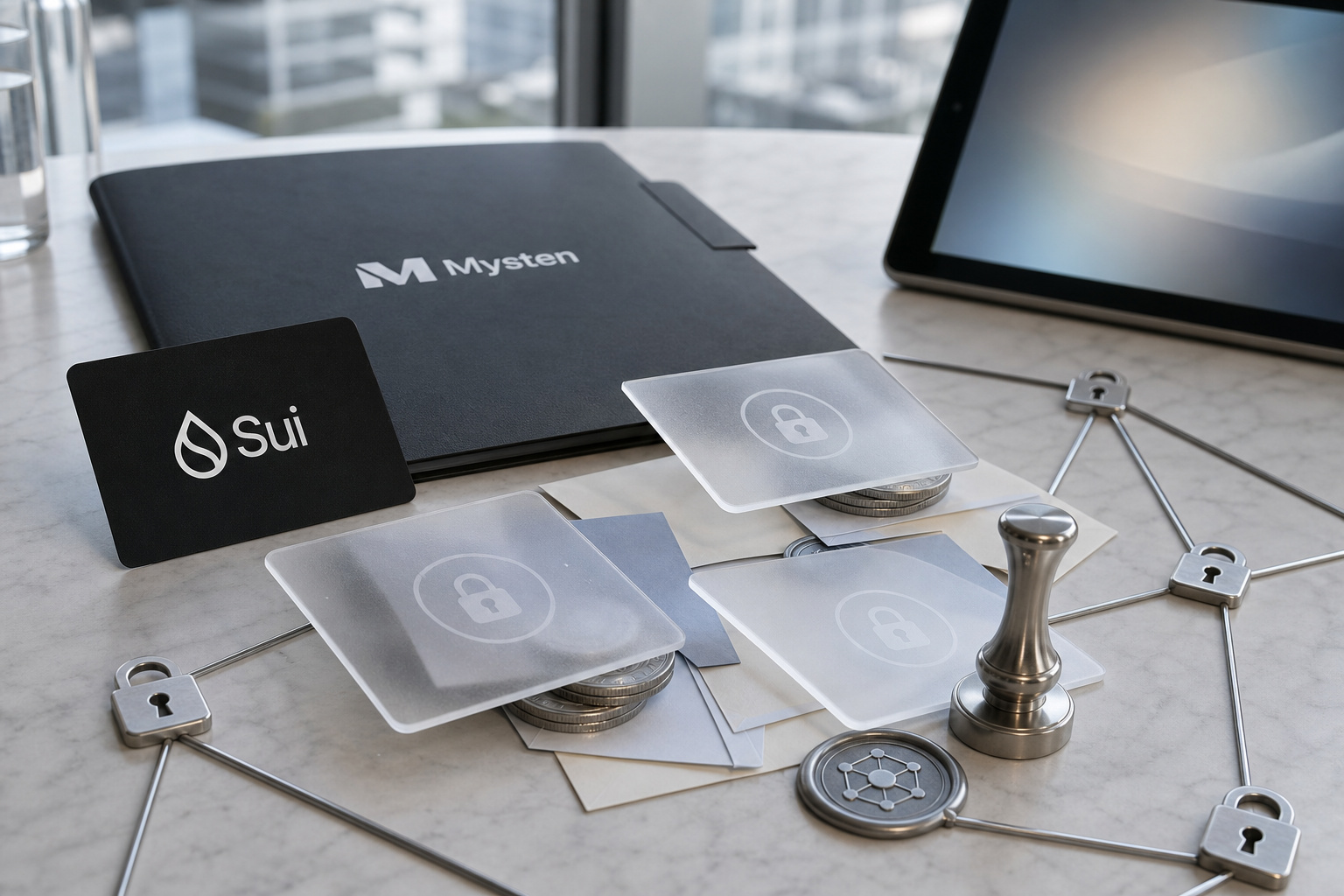
In a recent update, Sui announced that Mysten Labs has introduced Tessera, an enterprise-facing B2B settlement prototype. The project is built on a combination of Seal MPC and Sui's private transfer technology. Its stated goal is to solve a problem that has long kept business settlements off-chain: most blockchains make transaction amounts visible to everyone. Tessera operates through an internal corporate network, and only members that have completed KYC verification can join. Within this network, participants settle invoices using a privacy-enabled stablecoin. The system records the payer, payee, and payment time on-chain, but the actual transaction amount remains hidden. In addition, the level of detail available to each viewer is not the same; the two parties to a transaction, competitors, and regulators are given different access ranges, depending on the viewer's relationship to the transaction. The relevant code has been open-sourced. Since Tessera is still a prototype, it is not yet a production-ready settlement service. The open-source release provides an early look at how Sui-based private settlement between companies might work in practice. The original announcement was shared by Sui.

630
Mysten Labs Unveils Tessera, a B2B Settlement Prototype With Private Amounts on Sui
Mysten
2026-08-10 17:17:03

Mysten Unveils Amount Privacy Prototype Built on Seal MPC and Confidential Transfers

Mysten has introduced a prototype designed to tackle amount privacy on blockchain, built on Seal MPC and confidential transfers. In a post on X, Sui said institutions will not settle on infrastructure where competitors can see pricing and trading volume, and that public amounts on most blockchains have been an obstacle to real-world commercial settlement.

580
Mysten Unveils Amount Privacy Prototype Built on Seal MPC and Confidential Transfers
Sui
2026-08-10 17:17:50

Sui Says Institutions Won't Settle on Transparent Chains; Mysten Unveils Privacy Prototype

In a post on X, Sui said institutions won't choose to settle on infrastructure where competitors can see pricing and trading volumes. The project argued that public amounts on most blockchains have been a persistent obstacle to real commercial settlement. Mysten has introduced a new prototype aimed at solving the amount-privacy concern, built on Seal MPC and confidential transfers, according to the announcement. ChainCatcher reported the update. The post did not disclose further implementation details or a deployment timeline.

560
Sui Says Institutions Won't Settle on Transparent Chains; Mysten Unveils Privacy Prototype
Bitcoin
2026-08-06 06:29:41

Hashi’s 25-Plus Institution Stress Test Puts Focus on Where Bitcoin Programmability Should Live

Hashi’s testnet on Sui has drawn participation from more than 25 institutions in a push to let Bitcoin take part in DeFi without leaving the Bitcoin network. The article argues that the market debate has shifted: the question is no longer whether BTC should be programmable, but where that programmability should sit. Hashi keeps the underlying BTC in 2-of-2 multisig Bitcoin addresses while execution happens on Sui, a setup the author says improves asset safety but still leaves users relying on two systems at once. Against that backdrop, TuringBitChain, or TBC, is presented as a different route. Rather than splitting assets and contract logic across chains, it says it writes Turing-complete smart contracts directly into the UTXO model at Layer 1. The piece contrasts the two approaches across trust assumptions, architecture, performance claims, developer trade-offs, and institutional readiness, framing the broader contest around whether programmable BTC finance will be built through external execution layers or within UTXO itself.

600
Hashi’s 25-Plus Institution Stress Test Puts Focus on Where Bitcoin Programmability Should Live
Cregis
2026-08-06 02:03:01

Cregis founder Shawn Yan says long-term value matters more than chasing every crypto cycle

In an interview with TechFlow, Cregis founder and CEO Shawn Yan laid out the thinking behind more than a decade of entrepreneurship, from WeChat merchant SaaS and FinTech to enterprise digital asset infrastructure. Yan said he lived through the 2017 ICO frenzy, saw opportunities to make fast money, and chose not to pursue them. Instead, he said his team stayed focused on building transaction systems, enterprise wallets and capital operation tools tied to real business demand rather than market hype. He also shared his view on Bitcoin, stablecoins and tokenized gold as settlement tools, arguing that the three point to very different directions. In his account, stablecoins fit on-chain payment and settlement better today, while Bitcoin functions more as a store-of-value anchor than a daily payment rail. On the company side, Yan described Cregis as a three-part platform built around WAAS, Rails and Custody, with WAAS still serving as the core layer. The interview also covered licensing, compliance, customer demand from traditional financial institutions, product development shaped by repeated client pain points, and Cregis’ global expansion from Hong Kong into the Middle East, Europe, Latin America, Africa and the US. Yan said the company now serves more than 4,000 enterprise clients, and that trust in digital asset infrastructure is earned over time rather than through marketing.

330
Cregis founder Shawn Yan says long-term value matters more than chasing every crypto cycle
Policy and Re
2026-08-05 02:29:42

ChainFeeds roundup tracks on-chain privacy, Uniswap’s Robinhood Chain launchpad clues, and Cloudflare’s AI wallet push

ChainFeeds’ Aug. 5 research roundup brought together five separate crypto narratives that now sit close to the center of the market. One piece from IOSG Ventures framed blockchain privacy around a basic question — where the secret is kept — and compared Zcash, Monero, and Canton as three different answers. Another post argued that pools.trade appears to be Uniswap’s own user-facing launchpad on Robinhood Chain, with on-chain infrastructure already live even though the product has not formally opened. A third report said Strategy’s recent BTC sale and MSTR issuance were not used to add to its bitcoin holdings, but to support STRC, repay obligations tied to preferred stock, and expand dollar reserves. A fourth essay from imToken linked stablecoins, tokenized real-world assets, prediction markets, and agentic payments as parts of a broader financial stack that is finally connecting. The fifth piece focused on Cloudflare Wallets, which is built for AI agents rather than retail crypto users, using stablecoins, x402, and wallet-linked identity to let software pay for data, APIs, and online services under preset rules.

1130
ChainFeeds roundup tracks on-chain privacy, Uniswap’s Robinhood Chain launchpad clues, and Cloudflare’s AI wallet push
crypto exchan
2026-08-05 06:52:53

Four Public Metrics Users Can Check Before Choosing a Crypto Exchange

A BlockTempo market analysis says users can do far more due diligence on crypto exchanges before opening an account than many assume. The report argues that recent exchange liquidations have made pre-trade risk checks more urgent, pointing to BitMart’s late-July announcement of an “orderly liquidation” as a fresh reminder. BitMart halted new registrations, deposits and new orders immediately, is set to end all trading services on Aug. 26, and plans to shut down fully on Jan. 31, 2027. Yet on-chain data showed severe withdrawal congestion, including an eight-hour stretch in which no withdrawal requests were processed, while some users said funds were stuck. Using derivatives exchange Toobit as an example, the article lays out four common and free-to-check indicators: proof of reserves, third-party security ratings and infrastructure, regulatory registrations, and liquidity plus market depth. It cites a May 2026 Hacken proof-of-reserves audit showing Toobit at 106% reserves for BTC, ETH and USDT, and 102% for USDC. The report also says Toobit received a AAA rating from CER.live in May 2026, holds ISO 27001 certification, runs a $40 million Shield Fund, and uses cold storage, multi-signature controls and Fireblocks MPC custody. On the compliance side, the exchange is described as holding a VASP license from Poland’s KNF, MSB registrations in the U.S. and Canada, and DCE registration with Australia’s AUSTRAC. CoinGecko data cited in the piece puts Toobit’s 24-hour futures volume at about $17.5 billion across more than 750 trading pairs.

810
Four Public Metrics Users Can Check Before Choosing a Crypto Exchange