MPC

DeFi
2026-08-05 01:26:20

Ground COO says DeFi is losing its way in a subsidy-driven yield race

Ground COO Stephanie Vaughan argued that DeFi is drifting into a “yield war” centered on access to fintech distribution rather than solving end-user problems. In her view, companies such as Robinhood, Coinbase, Revolut, and Kraken are competing for customer funds, while protocols including Aave, Morpho, and Ethena are trying to become the infrastructure layer for lending strategies. Vault providers and risk management firms, she said, are also competing around fintech platforms rather than building direct user relationships for DeFi itself. Vaughan said this setup sends a clear market signal: pricing power for DeFi products is nearing zero. She argued that much of the yield on offer comes from subsidies provided by platforms, vault services, strategy providers, or underlying protocols, instead of real demand created by the product itself. She described that dynamic as closer to paying “shelf fees” than gaining genuine distribution. She also pointed to weaknesses in some multi-strategy vaults, including idle capital, waiting periods before deployment, and slow governance processes, which can leave actual user returns below advertised APY. By contrast, she said, traditional financial products such as money market funds can put capital to work immediately. As L2 costs fall and cross-chain infrastructure matures, Vaughan said the chain itself is no longer the main competitive edge, and future DeFi products should be built around user needs and move toward infrastructure such as MPC wallets that let users keep control over strategy while platforms handle execution and simplification.


500
Ground COO says DeFi is losing its way in a subsidy-driven yield race
Visa
2026-08-04 10:01:04

Visa launches VSP to bring stablecoin treasury, bank infrastructure and AI-era payments onto one platform

Visa has moved its stablecoin push beyond settlement pilots with the launch of Visa Stablecoin Platform, or VSP, now in limited testing. Announced on July 16, 2026, the platform is designed for commercial banks, fintechs and treasury teams, offering lifecycle management for stablecoins including minting, redemption, custody support and transfers. Visa positions the product as enterprise infrastructure rather than a simple settlement rail. The initial release supports two operating models: Wallet-as-a-Service for institutions that want Visa-provided key management technology, and Bring Your Own Wallet for firms already using external custodians such as Fireblocks, BitGo or Fystack. In beta, VSP natively supports only Open USD, or OUSD, and only on Ethereum, Solana and Tempo. The platform also ties into Visa Direct for cross-border payout conversion and is being linked with Pismo to support tokenized deposits alongside third-party stablecoins. The report argues that VSP’s launch matters not only because of its product design, but because of the economics around OUSD. The token is described as part of an Open Standard consortium backed by Visa, Mastercard, Stripe, BlackRock, Coinbase and more than 140 financial and technology companies. Its reserve income-sharing structure, according to the article, could pressure the legacy float-based model used by incumbent stablecoin issuers. The piece also highlights VSP’s relevance to agentic commerce, while noting several current constraints: restricted onboarding, limited asset and chain support, incomplete API availability and undisclosed pricing.

680
Visa launches VSP to bring stablecoin treasury, bank infrastructure and AI-era payments onto one platform
Coldcard
2026-08-03 11:21:11

Coldcard flaw linked to 1,755 BTC theft as wallet trust comes under pressure

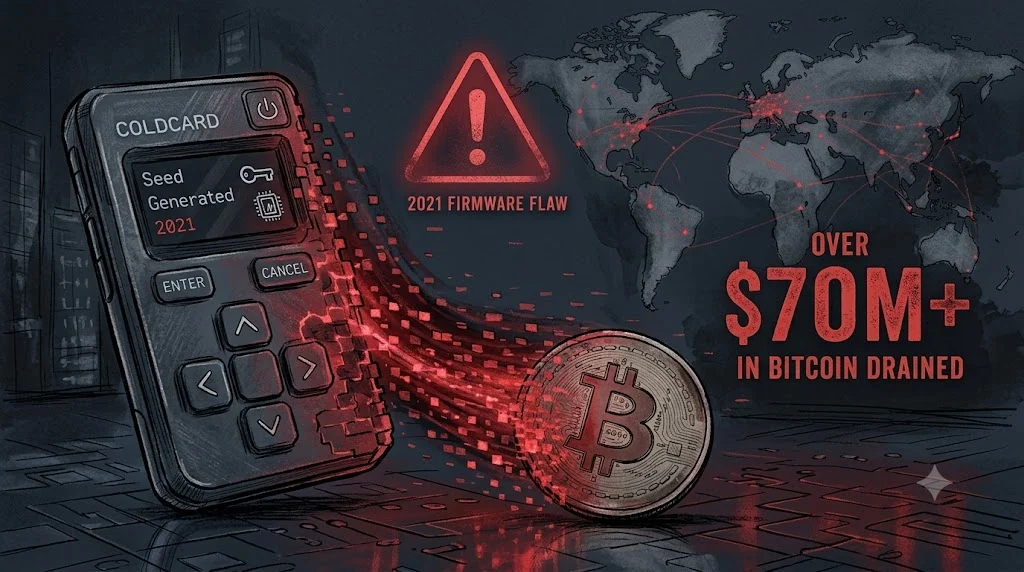
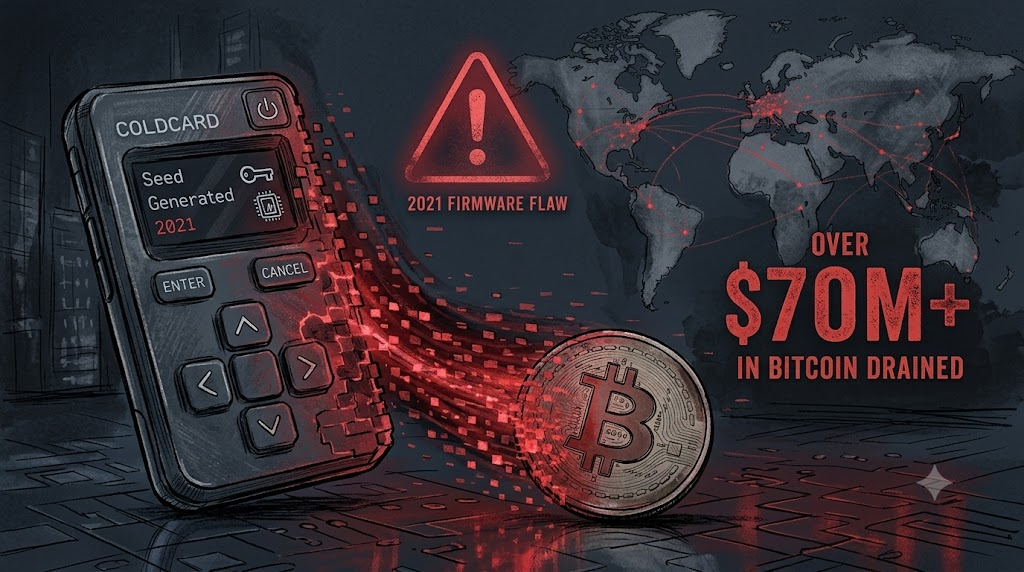
Coldcard’s hardware wallet security crisis has shaken confidence in Bitcoin self-custody after a flaw tied to its March 2021 v4.0.1 firmware update was linked to the theft of 1,755.95 BTC, worth more than $110 million at market prices. The issue stemmed from the use of a pseudo-random number generator instead of a true hardware random number generator during private-key creation, leaving affected wallets exposed to brute-force reconstruction for years. According to Galaxy Research, attackers emptied 1,196 victim addresses in just 41 minutes during the first two waves and moved more than $70 million before Coldcard issued its warning, with the main transfers completed about 30 hours earlier. In a later wave, the attacker used Replace-By-Fee transactions at a pace of as many as 13.8 transfers per block to push transactions through quickly. The fallout spread across the Bitcoin network. CryptoQuant said daily active addresses jumped from 645,000 on July 30 to nearly 1 million on July 31, while transfers below 1 BTC reached the highest level since November 2022, close to the spike seen after FTX filed for bankruptcy. The case also highlighted AI’s dual role in crypto security: attackers were described as using AI at scale, while community developers used Claude Code, Zhipu GLM 5.2 and Kimi K3 to identify and verify the flaw, with one scan reportedly taking just eight minutes.

540
Coldcard flaw linked to 1,755 BTC theft as wallet trust comes under pressure
NEAR Protocol
2026-08-04 05:44:15

NEAR co-founder proposes protocol sovereign fund to reshape token economics

NEAR Protocol co-founder Illia Polosukhin has proposed creating a protocol sovereign fund in the project’s governance forum, according to ChainCatcher. The proposal is framed as a way to improve the long-term sustainability of NEAR’s token economics. Under the plan, the fund would be built from the current protocol treasury, future treasury allocations, and protocol revenue. It would hold NEAR tokens and generate yield, with part of that income used to cover ecosystem public goods costs, including security, validator support programs, and MPC service providers. Polosukhin said using ecosystem revenue to buy NEAR and then funding public goods from the resulting yield is better aligned over the long run than simply burning tokens. The proposal puts the protocol treasury’s initial size at about 30 million NEAR, or roughly $53 million. Over time, governance could direct more revenue and emissions into the fund, with the stated aim of gradually reducing effective inflation and potentially moving toward a fixed supply. The proposal is open for discussion for two weeks and is not mandatory at this stage.

10500
NEAR co-founder proposes protocol sovereign fund to reshape token economics
BitGo
2026-08-04 02:56:49

BitGo CEO Mike Belshe Dares Anthropic to Take 100 BTC From a Public Wallet

BitGo co-founder and CEO Mike Belshe has publicly challenged Anthropic by depositing 100 BTC into a BitGo wallet and posting the address on X, saying the company should try to take the funds if Claude is truly capable of breaking into systems. The stash was described as being worth about $6.3 million at the time. Belshe’s post directly mocked claims around a supposed “hacking monster,” arguing that if Anthropic’s technology is as formidable as suggested, it should prove it on a real target rather than in controlled demonstrations. The funds, however, were not placed in a simple wallet. According to the source, they sit inside BitGo’s institutional custody platform using a multisignature or MPC setup, meaning any successful theft would require breaching layered key management, approval policies, hardware protections and operational controls. Public on-chain data currently shows both spent_txo_count and spent_txo_sum at zero for the address, with no unconfirmed transactions in the mempool. Anthropic has not publicly responded so far, while online reactions have also framed the exchange as a form of marketing theater.

640
BitGo CEO Mike Belshe Dares Anthropic to Take 100 BTC From a Public Wallet
Coldcard
2026-08-03 08:45:00

Coldcard flaw sparks fresh doubts over Bitcoin self-custody as $110 million in BTC is drained

A long-hidden flaw in Coldcard firmware has triggered one of the most jarring security shocks for Bitcoin self-custody users in recent years. According to PANews, 1,755.95 BTC, worth more than $110 million at market prices, was quietly drained from thousands of addresses on July 30, with most of the funds moved roughly 30 hours before an official warning was issued. The issue traces back to Coldcard’s v4.0.1 firmware released in March 2021, when the wallet reportedly used a pseudo-random number generator instead of a true hardware random source during private key generation. Galaxy Research said the first two waves of attacks emptied 1,196 victim addresses in just 41 minutes and moved more than $70 million before users were broadly alerted. CryptoQuant data showed a sharp jump in on-chain activity after the incident, with Bitcoin active addresses rising from 645,000 on July 30 to nearly 1 million on July 31, while sub-1 BTC transfers climbed to their highest level since November 2022. The episode has pushed market participants to reassess concentration risk in single-wallet setups and renewed discussion around multisig, MPC, social recovery wallets, exchange custody, and spot Bitcoin ETFs as alternatives or complements to pure hardware-wallet storage.

570
Coldcard flaw sparks fresh doubts over Bitcoin self-custody as $110 million in BTC is drained
MoonPay
2026-07-29 19:31:03

MoonPay launches PayBox, putting a crypto wallet and payments inside Claude and ChatGPT

MoonPay has launched PayBox, a payment vault that connects to Claude and ChatGPT and lets AI agents complete transactions after user approval. The system stores crypto wallets and payment cards in a secure vault, lines up transactions inside the chat flow, and uses a passkey on the user’s device to authorize payment. At launch, PayBox supports restaurant reservations, flight bookings, shopping across major online retailers, token swaps, cross-chain fund transfers, and routing assets into DeFi protocols such as Aave. It starts with support for Solana and seven Ethereum-compatible chains: Ethereum, Hyperliquid, Tempo, Base, Robinhood Chain, Arbitrum, and Polygon. MoonPay also said PayBox works with x402, the open payments protocol developed by Coinbase and later donated to the Linux Foundation, now supported by Visa, Mastercard, Stripe, Shopify, AWS, and Anthropic. The infrastructure comes from Sodot, the Israeli key management startup MoonPay acquired in April for roughly $100 million in an all-stock deal. According to MoonPay, wallet keys are split with MPC and stored across TEEs so no single party, including MoonPay or the AI agent, can access a full key or sign on its own.

230
MoonPay launches PayBox, putting a crypto wallet and payments inside Claude and ChatGPT
Bitcoin
2026-07-30 12:36:31

Hashi launches on Sui testnet to put idle Bitcoin capital to work

Hashi has gone live on Sui testnet in July, opening a live environment for developers, custodians, financial institutions and ecosystem partners to build, integrate and stress-test Bitcoin-backed financial applications before mainnet. The launch is framed around a striking imbalance in the Bitcoin economy: while BTC’s market capitalization stands at roughly $1.31 trillion, only about $4.3 billion is currently deployed in DeFi, according to DefiLlama, or less than 0.33% of the total. In other words, more than 99.6% of Bitcoin remains largely idle in wallets rather than being used in lending, collateralized finance or yield-bearing products. Hashi introduced its Guardian Layer alongside the testnet, adding an independent verification layer on top of its existing threshold-signature model. Under the design described in the article, BTC collateral sits behind a 2/2 multisig structure that requires both MPC signatures from Hashi validators and a Guardian signature before release. The project also said the testnet ecosystem includes more than 25 partners spanning custody, wallets, lending, liquidity, asset management, insurance, oracle services and smart contract auditing.

690
Hashi launches on Sui testnet to put idle Bitcoin capital to work