
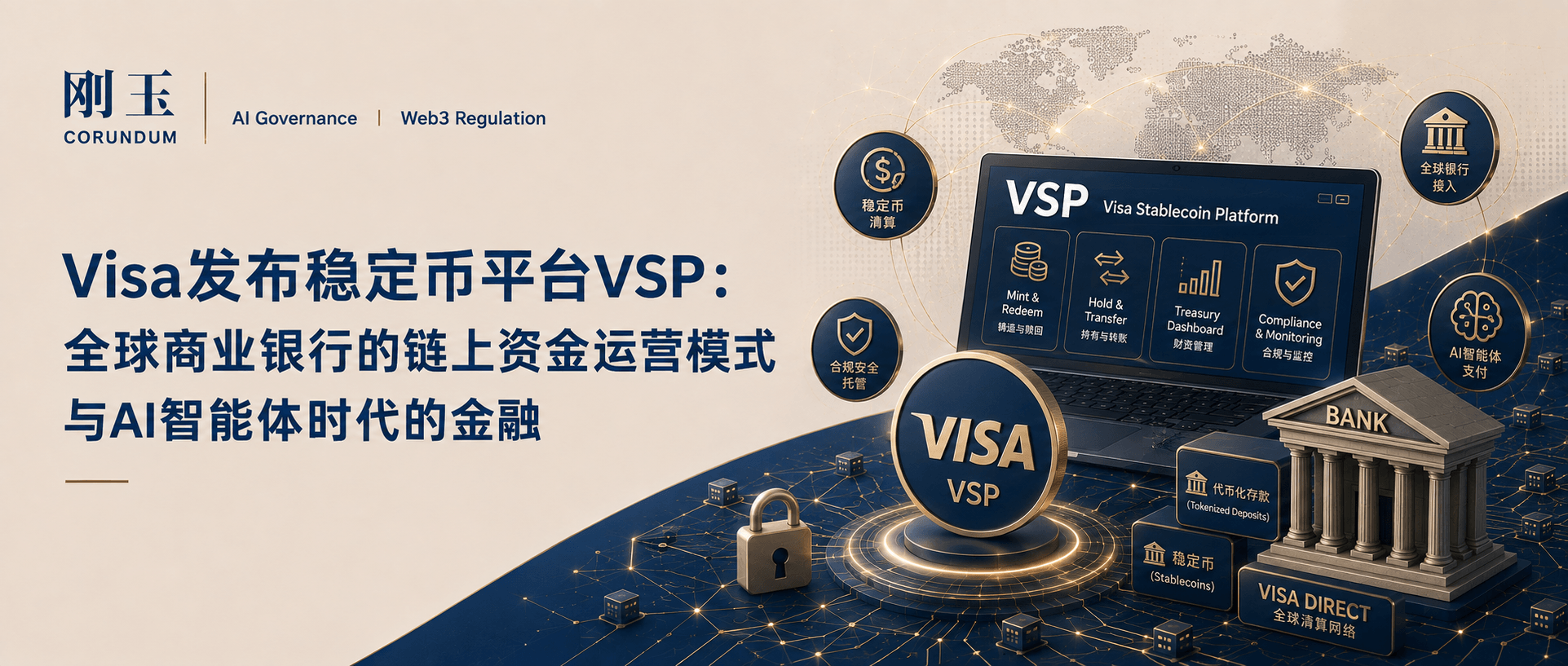
Visa has formally launched the Visa Stablecoin Platform, or VSP, shifting its stablecoin strategy from isolated settlement experiments toward a broader piece of enterprise infrastructure.
The company began exploring public-blockchain stablecoin settlement in 2021. After early clearing pilots and prefunding tests on Ethereum and Solana, the article says the annualized settlement volume of Visa’s stablecoin pilot program had reached $7 billion by April 2026, with 50% quarter-over-quarter growth and clearing rails extended to nine major blockchain networks.
On July 16, 2026, Visa announced VSP and said the product had entered a limited testing phase. The platform is aimed at commercial banks, fintech companies and treasury departments, with services covering the full stablecoin lifecycle, including minting, redemption, holding and transfers. In the framing used by the original report, Visa is trying to move beyond its long-standing role as a transaction processor and become an infrastructure operator for programmable money.
A two-track product structure: WaaS and BYOW
For regulated financial institutions, the hard part of bringing crypto assets into core operations is not theory. It is the underlying engineering and day-to-day operating burden. The report notes that banks trying to build blockchain capabilities on their own would need to maintain validator nodes, manage hot-wallet keys, audit complex smart contracts and reconcile distributed-ledger data with their core banking ledgers.
VSP is designed to abstract those tasks into modular services. The platform integrates four core technical functions:
- Onchain Minting & Redemption Routing, allowing institutions to send instructions directly to supported smart contracts through VSP to issue or destroy tokens;
- Centralized Treasury Dashboard, a single interface for monitoring cross-chain and cross-asset balances, transaction speed and fund flows;
- Enterprise Compliance & Fraud Monitoring, tied to Visa’s existing global risk controls for abnormal onchain activity detection and automated screening;
- Turnkey Interoperability, which connects onchain virtual accounts with ACH and wire channels through APIs so fiat and digital assets can move between systems.
Visa has also built two parallel wallet operating models around different compliance preferences.
Wallet-as-a-Service
Under Wallet-as-a-Service, or WaaS, institutions do not need to build their own key-management environment. The report describes this as a cloud-based setup in which a third-party provider supplies wallet development, management, interfaces and security controls without requiring the customer to run complex nodes or its own cryptographic ledger stack.
In VSP’s WaaS design, Visa provides secure key-management technology, but the client remains the custodian of its own assets from a legal and operational perspective. According to the article, that structure helps Visa avoid the compliance burden and balance-sheet risk that would come with acting as the direct custodian.
At the security layer, VSP uses both Multi-Party Computation, or MPC, and Hardware Security Modules, or HSMs. MPC is used so no single party or machine holds a complete private key, reducing single-point compromise risk. HSMs provide dedicated hardware for key generation and key storage, making direct key extraction far more difficult even if systems are attacked.
The WaaS model also includes several internal-control features intended for Tier 1 institutions:
- Maker/Checker approval flows, where one operator initiates a sensitive action and another authorized person must approve it;
- device-bound passkey signing, replacing shared-password workflows with local authorization using biometrics or physical security keys;
- allowlists and audit logging, restricting transfers to preapproved wallet addresses and preserving tamper-resistant records for compliance review.
Bring Your Own Wallet
The second model is Bring Your Own Wallet, or BYOW. For institutions that already run their own key-security environments through outside custodians such as Fireblocks, BitGo or Fystack, VSP offers a way to connect without handing over signing or custody operations to Visa.
In that setup, Visa does not participate in key signing or routine custody workflows. VSP acts primarily as a fiat-to-stablecoin gateway, while also providing compliance configuration, virtual account inflow and outflow routing, and integration with Visa’s existing global card-payment and settlement systems.
Even though the long-term roadmap is described as multi-asset and multi-chain, the current testing version has clear limits. VSP natively supports only Open USD, or OUSD, and only on Ethereum, Solana and Tempo.
Tying VSP into Visa Direct and Pismo
The article argues that VSP’s commercial value does not sit in wallet tooling or token issuance alone. A central piece is how it connects onchain stablecoins with Visa Direct, Visa’s existing real-time money movement network.
In traditional cross-border B2B payments and treasury management, firms often rely on prefunding. That means a company or fintech has to place large amounts of fiat in destination-country bank accounts ahead of time to ensure local payments can be made instantly. The report describes this as a drag on liquidity because capital becomes trapped across multiple corridors.
With VSP, a company can hold stablecoins directly in a Visa-hosted wallet. When it needs to pay an overseas supplier or merchant, the firm’s finance system sends a payment instruction to VSP. The platform then evaluates the best route in the background and uses Visa Direct’s real-time settlement network to convert the stablecoin balance into local fiat, such as Mexican pesos or Philippine pesos, within seconds and push the funds to a bank account or card.
That structure, in the report’s telling, lets multinational firms consolidate working capital into a single onchain treasury account instead of scattering fiat reserves across many local balances.
The second major integration path involves Pismo, the cloud banking software company Visa acquired outright in 2024. Visa plans to use Pismo’s bank-core connectivity to make VSP support not only third-party stablecoins, but also tokenized deposits issued and managed by commercial banks themselves.
The article stresses that stablecoins and tokenized deposits may look similar at the technical layer but differ sharply in financial, legal and risk terms. Stablecoins are generally off-balance-sheet money equivalents issued outside the banking system, with no passthrough deposit insurance and with legislative limits that make direct interest distribution difficult. Tokenized deposits, by contrast, would let banks keep deposits on their own balance sheets while still gaining the 24/7 settlement and programmability benefits of blockchain infrastructure.
Visa CEO Ryan McInerney is quoted as saying Visa’s role is not to predict in advance which token form will ultimately dominate. Instead, VSP is meant to support both stablecoins and tokenized deposits in parallel. In the article’s interpretation, that multi-token, multi-chain strategy helps Visa preserve its place in value transfer regardless of which model institutions adopt.
Why OUSD matters in the VSP rollout
The stablecoin that anchors the first version of VSP is Open USD. The report presents that choice as more than a launch detail. It sees OUSD as a direct challenge to the legacy profit model of traditional stablecoin issuers.
For years, issuers such as Tether with USDT and Circle with USDC have relied heavily on reserve income, described in the piece as float-capture economics. OUSD was introduced by the Open Standard consortium, whose founding members include Visa, Mastercard, Stripe, BlackRock, Coinbase and more than 140 financial and technology companies worldwide.
Its reserves, the article says, are fully backed by highly liquid short-term U.S. Treasury money market funds managed by asset-management leaders including BlackRock.
What makes OUSD different in the report is its yield-sharing model. Because U.S. stablecoin legislation, including proposals such as the GENIUS Act, is described as sharply limiting the ability of issuers to pay interest directly to retail holders, OUSD does not distribute reserve yield to end users. Instead, interest generated by the short-term Treasury reserves is shared back, based on transaction and holding proportions, with financial institutions, businesses and distribution partners involved in distribution, redemption and operations.
That becomes more significant when combined with Visa’s distribution reach. The article says Visa plans to promote VSP and OUSD across its global base of 15,000 financial institution members. For banks and fintech companies, connecting to OUSD through VSP would mean turning working capital that was previously tied up without return into an asset that can generate compliant yield.
The market reaction cited in the article was immediate. On July 16, 2026, the same day VSP beta launched with OUSD, Circle shares fell about 5%. The bearish case outlined by the report is that the VSP-plus-OUSD channel alliance could compress Circle’s existing float economics by redirecting reserve income back to distribution channels, pushing the stablecoin market from a model of issuer-centered arbitrage toward one of infrastructure-driven revenue sharing.
How the industry is framing Visa’s strategy
Global payments and fintech expert Tom Noyes used a simple comparison in the report: “VSP is to stablecoins what Visa DPS is to debit cards.”
The point of that analogy is structural. Visa DPS, or Debit Processing Service, handles back-end processing, validation and accounting for a large number of banks, allowing them to avoid building vast transaction and communications infrastructure in-house. In Noyes’s framing, Visa is trying to reproduce that operating model for onchain finance. The rails change from card-message networks to distributed ledgers. Account management shifts from PAN administration to crypto wallets and multisig custody. Batch reconciliation gives way to onchain mint-and-burn accounting.
The article contrasts that approach with the paths taken by Mastercard and Stripe.
Visa: neutral enablement and ecosystem tolls
Visa is described as pursuing a neutral operating system rather than picking one token and issuing it itself. Through VSP, it works with an Open Standard consortium that includes Mastercard, Stripe, BlackRock, Coinbase and more than 140 other companies to promote OUSD. Visa avoids direct reserve-management exposure and token-issuance compliance risk, while focusing on wallets, fiat ramps, routing and card-network settlement that generate transaction and value-added fees.
Mastercard: ownership and central control
Mastercard, by contrast, is portrayed as taking a heavier, ownership-driven path. The report says Mastercard spent $1.8 billion in April 2026 to acquire B2B stablecoin payment processor BVNK outright, aiming to build a proprietary stablecoin payments and treasury stack under direct control. That approach could give Mastercard tighter command over product direction and economics, including transaction fees and FX spreads, but it also concentrates operating risk and integration complexity.
Stripe: merchant-focused API verticalization
Stripe’s route is described as a merchant closed loop built around vertical APIs. According to the article, Stripe acquired stablecoin platform Bridge at a premium to create a smoother and lower-cost settlement channel for developers and merchants, with the goal of helping merchants avoid the higher costs associated with traditional card rails.
Tom Noyes argues that Visa may hold a long-term advantage because it does not need to build and maintain every local off-ramp itself. Instead, it can distribute that work across partners. The article gives examples: Stripe focuses on developer APIs, Tempo handles machine payments, and regional fintech firms tackle domestic fiat clearing in their local markets. Those partners invest, localize and handle compliance, while the stablecoin transaction flows they create ultimately run through Visa’s network.
Visa executives have made similar points publicly. On an earnings call, Ryan McInerney said Visa would maintain an open stance toward multiple tokens and multiple chains, adding that the company’s role is not to predict a single winner while stablecoins remain in an early phase of real-world commercial adoption. Chief Product and Strategy Officer Jack Forestell said the bottleneck around stablecoins has never been the big idea of programmable money itself, but the operational detail required to make it work. VSP, in that view, is meant to hide the blockchain plumbing behind familiar Visa interfaces.
VSP and the rise of agentic commerce
The report also places VSP in the context of agentic commerce, where AI systems act as the transacting entity rather than a human buyer.
Traditional card systems were built around people: lower transaction frequency, larger ticket sizes, and dependence on chargeback windows and credit authorization controls. AI agents change those assumptions. If software needs to pay tiny amounts for a single data query or for each API call, the fixed starting fee embedded in traditional payment rails can exceed the value of the payment itself by orders of magnitude.
The article also says that machine-led commerce will involve constant, high-frequency, around-the-clock transactions, something legacy bank back ends built around daily batch reconciliation and weekend downtime are not designed to handle.
This is where the report introduces M2M micro-commerce, meaning real-time, high-frequency, machine-to-machine payments for very small digital services such as bursts of compute or individual data labels. It says those flows can reach tens of thousands of transactions per second, with single payments worth less than one cent.
Visa’s front-end answer, according to the article, is Intelligent Commerce Connect, an AI payments front-end protocol, combined with the x402 machine-payments standard and related machine-payment protocols developed with industry partners. The system is described as issuing secure credentials for each AI agent, complete with budget limits, credit assessment and protections against systemic deadlock loops.
VSP is the back-end support layer. Because it runs on high-throughput public-chain infrastructure, the article says machine-to-machine micro-settlement can push individual blockchain transfer costs below a cent, removing the fee bottleneck. It also states that most machine-initiated transfers already default to public-chain stablecoin settlement.
Current limits and rollout risks
For all of the ambition behind VSP, the article is clear that the product remains early and comes with several practical constraints for institutions evaluating adoption.
1. Access is still closed
VSP is not yet an open public cloud platform. To join testing, an institution must go through Visa’s existing enterprise channels and obtain a Visa Access ID plus a Business Identification Number, or BID. That means the current rollout is effectively a closed-loop upgrade for banks and financial institutions already inside Visa’s network, while startups and newer Web3 builders without those relationships remain outside the first wave.
2. Asset and chain support is narrow
While Visa has supported other assets such as USDC from Circle and USDG from Paxos in separate digital-asset work, the unified VSP environment currently supports only OUSD. Chain support is also limited to Ethereum, Solana and Tempo. Institutions that need mixed treasury operations across several chains and several assets, such as moving USDC and EURC between Ethereum, Avalanche and Base, cannot yet do that natively through the present version of VSP.
3. APIs and SDKs are not fully live
For neobanks and cross-border settlement providers that want deep automation, system-level code integration is essential. Yet the article says VSP remains portal-driven for now. Administrators still need to use the graphical interface to handle inflows, outflows, minting, redemption and approval settings manually.
Visa’s product roadmap includes a REST API suite and SDKs, and documentation previews have already been opened to partners. But true programmatic interaction is still labeled “Coming Soon.” Without a mature sandbox and production-ready API stack, the platform is hard to deploy as a highly automated, high-throughput back end.
4. Captive stack versus neutral orchestration
The article classifies VSP as a captive stack, a tightly integrated system in which wallets, custody tooling, FX paths and on/off-ramp settlement are all controlled by Visa, and supported chains and stablecoins are subject to Visa approval.
That creates clear integration benefits. A bank can work with one supplier and receive a combined offering that includes WaaS, compliance tooling and Pismo’s cloud-core banking support. But the report says major commercial banks that care deeply about payments sovereignty and cross-border arbitrage may still prefer a neutral orchestration layer. For those firms, VSP would be one route among many rather than the sole foundation of their architecture.
The article gives a practical example: a bank might switch dynamically between VSP using OUSD, where it can capture interest-sharing economics, and public-chain routes using USDC on high-speed Base, depending on the economics of each payment corridor.
5. Pricing is still undisclosed
The final issue is cost transparency. Visa has not publicly disclosed VSP’s pricing details, including licensing, per-transaction processing fees for minting, redemption and transfers, or interface fees under the BYOW model.
Without that information, finance teams at banks and enterprises cannot yet make a clean return-on-investment assessment for a VSP integration.
What comes next
Based on the report, VSP is more than another stablecoin pilot. It combines wallets, compliance, cross-border routing, tokenized deposit support and an AI-commerce back end under one framework.
Even so, the platform is still at an early testing stage. It depends heavily on Visa’s existing network relationships, supports only one native asset in beta, lacks fully deployed APIs and does not yet offer a transparent commercial model. The article says the real test through late 2026 and into 2027 will be whether VSP can move from a portal-led product to full API delivery, expand to broader multi-asset interoperability and prove its economics in the market.
For institutions considering adoption, the choice is not only whether to use stablecoins. It is also whether to build around Visa’s integrated stack or place VSP inside a broader neutral orchestration model that preserves more control over routes, assets and infrastructure strategy.