MVRV

Bitcoin
2026-08-15 02:02:52

Bitcoin Stays Range-Bound as Stocks and Gold Rally, While Bottom Signals Remain Incomplete

Bitcoin has yet to join the rebound seen in U.S. equities and gold, even as spot Bitcoin ETF flows in the United States have turned positive again and several long-term on-chain indicators have moved closer to historically depressed levels. Since peaking at about $126,000 in October last year, Bitcoin has remained in a prolonged correction and has spent the past 30 days trading sideways between $62,000 and $66,000, according to CoinGecko. Over the past 90 days, Glassnode said the S&P 500 rose about 5% while Bitcoin fell 20%, underscoring a sharp divergence in performance. The report, written by Nancy for PANews and republished by Blockcast, points to a mix of countervailing forces. On one side, Santiment Intelligence data showed 2.27 million new BTC wallets and 751,000 active wallets over the past week, while SoSoValue recorded five straight trading days of net inflows into U.S. spot Bitcoin ETFs, totaling $854 million, the strongest weekly result since April 17. On the other side, miner selling, liquidity needs at crypto DAT companies, and weak U.S. spot demand continue to weigh on price action. CryptoQuant said miner-linked OTC balances have dropped from about 500,000 BTC in November 2021 to 139,700 BTC, while Coinglass showed the Coinbase Bitcoin Premium Index has stayed negative for 80 consecutive days. PAData’s bottom-fishing dashboard shows only 4 of 12 core indicators in the hit zone, suggesting some bottoming signs are in place but a full cyclical low has not yet been confirmed.


1490
Bitcoin Stays Range-Bound as Stocks and Gold Rally, While Bottom Signals Remain Incomplete
Bitcoin
2026-08-12 08:52:09

Bitcoin Lags as Stocks and Gold Rally, With Only Partial Bottom Signals Emerging

Bitcoin has yet to join the rebound seen in U.S. equities and gold, even as some market conditions begin to improve. After peaking at about $126,000 in October last year, the asset has stayed in a prolonged correction and has recently traded sideways between $62,000 and $66,000 over the past 30 days, according to CoinGecko. PANews, in a report by Nancy cited by MarsBit, said the disconnect has persisted despite renewed inflows into U.S. spot Bitcoin ETFs and a pickup in several long-term valuation and cycle indicators. Data cited in the report showed U.S. spot Bitcoin ETFs posted net inflows for five straight trading days last week, totaling $854 million, the strongest weekly performance since April 17, according to SoSoValue. At the same time, Santiment Intelligence recorded 2.27 million new BTC wallets over the past week and 751,000 active wallets, though the jump in activity was linked in part to security concerns triggered by the Coldcard wallet incident rather than outright risk appetite. The report argued that persistent selling from miners and crypto DAT companies, along with weak U.S. spot demand reflected in an 80-day negative Coinbase Bitcoin Premium Index streak, has capped price recovery. PAData’s bottom-fishing dashboard showed 4 of 12 core indicators have entered hit zones, but broader metrics tied to valuation, sentiment, profitability, liquidity, and on-chain activity have not yet reached the extreme levels that have historically marked a confirmed cycle bottom.

600
Bitcoin Lags as Stocks and Gold Rally, With Only Partial Bottom Signals Emerging
ChainFeeds
2026-08-11 02:26:40

ChainFeeds roundup tracks Bitcoin’s BIP-110 split, Pump-FOMO rivalry, and Robinhood Chain’s meme-led launch

ChainFeeds’ Aug. 11 research roundup brought together five separate market and policy discussions that are shaping current crypto debate. The package led with the fallout from Bitcoin’s BIP-110, where nodes enforcing the proposal began rejecting blocks without bit 4 signaling even though support in the prior 2,016-block window was only 51 blocks, or 2.53%. The result was a chain split, with the higher-work main chain moving ahead while the BIP-110 branch lagged. The report also reviewed the competitive battle between Pump and FOMO over the social trading interface, arguing that the real contest is not token issuance alone but control over discovery, amplification, distribution, and execution. A separate Bitcoin market note focused on ETF flows, hash rate, node distribution, MVRV, the 200-week moving average, and three portfolio approaches ranging from dollar-cost averaging to options hedging. On Ethereum, ChainFeeds highlighted a debate around EIP-8363 and whether staking rewards should eventually rely only on execution-layer revenue once network staking surpasses 50%. The final section examined Robinhood Chain, which generated $3.6 million in REV in July and out-earned several established Layer 2 networks, though early activity was dominated by meme coin trading rather than RWA usage.

650
ChainFeeds roundup tracks Bitcoin’s BIP-110 split, Pump-FOMO rivalry, and Robinhood Chain’s meme-led launch
Bitcoin
2026-08-09 11:55:25

Will Clemente says Bitcoin is trading near the low end of its historical value range

Bitcoin on-chain analyst Will Clemente argues that Bitcoin now looks "cheap" on a historical basis even though the asset may still see another leg lower later this year. In a long-form market note translated and published by ChainCatcher, Clemente said the past year has been frustrating for Bitcoin holders: spot Bitcoin ETFs hold about $50 billion in assets, access for both retail and institutional buyers is now widely available, yet Bitcoin ETF products still saw $5 billion in net outflows over the past year while DRAM-related products pulled in $10 billion in a single month. Clemente said the Bitcoin network remains structurally healthy despite a decline in total hash rate and a growing shift by listed miners toward AI and high-performance computing. He pointed to broad global node distribution, the network’s difficulty adjustment mechanism, and the fact that hash rate has only fallen back to mid-last-year levels even as many public miners pivot away from core mining. On valuation, he highlighted Bitcoin’s position near its 2021 prior high, slightly below the 200-week EMA, bullish RSI divergence from oversold conditions, and MVRV readings that place the asset near the lower end of its historical valuation band. He also said long-term holders have resumed accumulation after distributing in the second half of 2025. Clemente identified two major overhangs — digital asset treasury companies and quantum computing risk — but said both are starting to show signs of repair. His base case is not that Bitcoin needs a dramatic new catalyst, but that seller exhaustion and steady institutional allocation could matter more over the next several months.

570
Will Clemente says Bitcoin is trading near the low end of its historical value range
Ethereum
2026-08-06 09:24:16

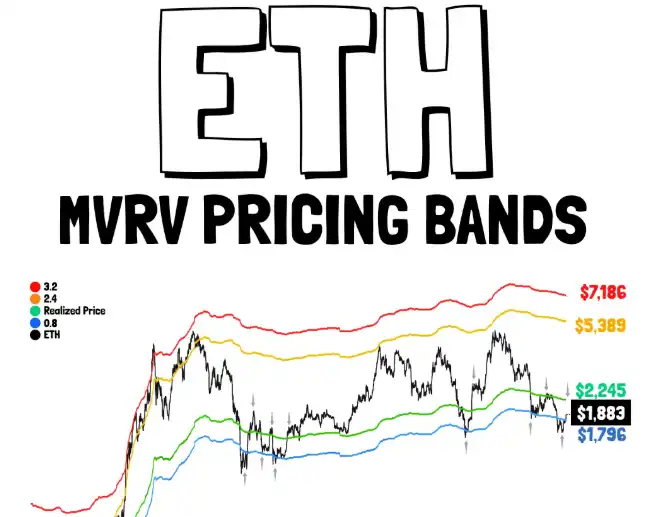
Analyst says Ethereum has flashed an MVRV momentum golden cross, with four prior cases leading to 50% to 166% gains

BlockBeats reported on Aug. 6 that crypto analyst alicharts pointed to an MVRV momentum golden cross in Ethereum. Based on ETH price action over the past six years, alicharts said the asset has often found support after reclaiming the MVRV 0.8 level and then moved toward its realized price, which he put at about $2,300. He added that the current setup matches four earlier MVRV momentum golden cross signals, which were followed by gains ranging from 50% to 166%. Albeit constructive in his historical comparison, alicharts also flagged $3,000 as a key resistance zone, saying more than 10 million ETH have historical transaction records around that area. The comments were cited by BlockBeats in a short market analysis update.

580
Analyst says Ethereum has flashed an MVRV momentum golden cross, with four prior cases leading to 50% to 166% gains
Ethereum
2026-08-06 09:25:05

alicharts: ETH's MVRV 0.8 Support Points to $2,300 Run, $3,000 Resistance

Crypto analyst alicharts points to Ethereum's near-six-year price history as evidence that ETH typically finds support at the MVRV 0.8 level, then pushes higher toward its realized price of roughly $2,300. The current signal mirrors four previous MVRV momentum golden crosses from prior cycles, which were followed by gains between 50% and 166%, according to the analyst. Beyond the support setup, alicharts flags $3,000 as a key resistance zone, noting that more than 10 million ETH have historical transaction records around that price level. The call was carried by ChainCatcher's market analysis desk on August 6, 2026. Within the six-year sample the analyst cites, each prior golden cross preceded a double-digit rally, and the MVRV 0.8 retest served as the consistent setup for those moves. The $3,000 zone, by contrast, sits where a heavy concentration of on-chain transaction history has been recorded, marking it as the level the analyst expects to cap upside.

570
alicharts: ETH's MVRV 0.8 Support Points to $2,300 Run, $3,000 Resistance
Bitcoin
2026-07-30 02:33:03

Bear Market Playbook: Stablecoin Yield and Accumulation Plans Over Bottom Calling

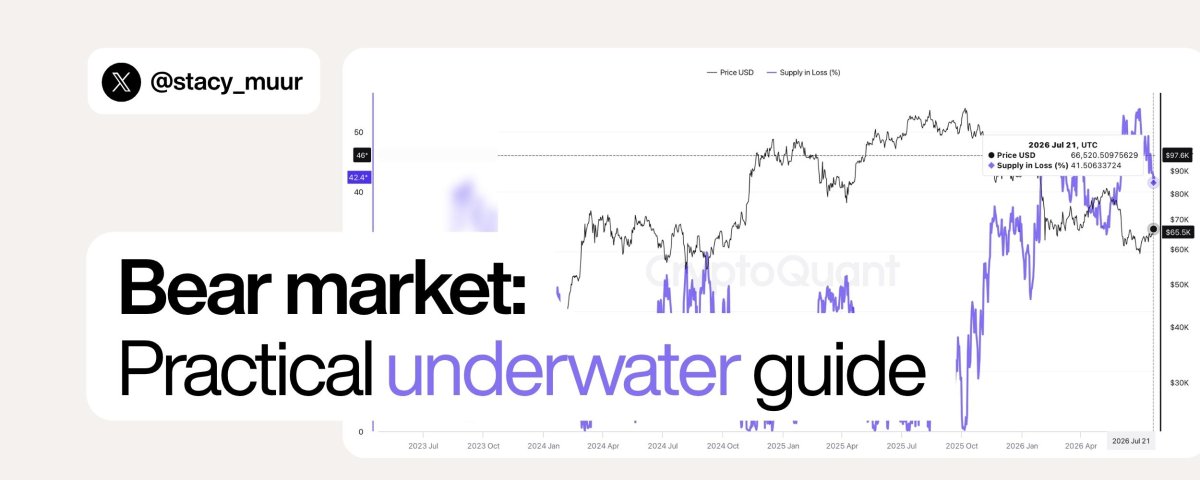
A market analysis published by TechFlowPost lays out a practical framework for navigating the 2025–26 crypto bear market without relying on aggressive leverage or all-in bottom calls. Citing past cycles, the piece compares Bitcoin’s drawdowns in 2018, 2022 and the current downturn, arguing that while the present cycle has seen a shallower peak-to-trough decline than prior bear markets, on-chain data still points to broad investor pain and a market that may not have fully completed its capitulation phase. The article’s proposed approach centers on preserving liquidity, earning yield on stablecoins, and using a rules-based accumulation process rather than trying to time the exact bottom. It points to stablecoin lending yields of roughly 5% to 10% APY and Bitcoin liquid staking yields of around 4.5% to 5.5%, while also arguing for diversified yield sources instead of dependence on a single trade. The framework combines recurring dollar-cost averaging with an “accumulator” allocation reserved for deeper drawdowns. The piece also stresses risk control. It warns against leverage for investors who do not fully understand liquidation risk, recommends keeping core exposure below 2x leverage if leverage is used at all, and highlights MVRV Z-Score, supply in loss, short-term holder cost basis and ETF flows as signals for changing deployment speed. The core message is straightforward: in a bear market, process and capital preservation matter more than heroic bottom calls.

740
Bear Market Playbook: Stablecoin Yield and Accumulation Plans Over Bottom Calling
Bitcoin
2026-07-30 00:53:18

Bear market playbook: protect capital first, then scale in with yield and on-chain signals

MarsBit published a market analysis piece arguing that the harshest part of a bear market is not the drawdown itself, but the way it exposes weak strategy and leverage. Citing past Bitcoin cycles, the article contrasts 2018, 2022 and the 2025–26 downturn, saying the current cycle has seen a smaller peak-to-trough decline than prior bear markets, even as a large share of supply remains under water. The author’s view is that structural risk now looks lower than it did during the 2022 contagion phase, though a capitulation stage may still lie ahead. The article lays out a practical framework rather than a price call. It favors parking “dry powder” in yield-bearing stablecoin positions, using systematic dollar-cost averaging plus separate accumulation windows for deeper drawdowns, and relying on diversified yield strategies instead of a single source of return. It also warns against leverage unless liquidation risk is fully understood. On timing, the piece says investors should watch on-chain indicators such as MVRV Z-Score, supply in loss, short-term holder cost basis and ETF flows, then increase deployment only when those signals begin to align. The central argument is simple: preserve liquidity, compound cautiously and let process—not hope—drive entries during a bear market.

750
Bear market playbook: protect capital first, then scale in with yield and on-chain signals