OPS

AMD
2026-07-22 07:32:58

AMD Helios rack is reportedly priced about 40% above Nvidia Vera Rubin, with Microsoft Azure as first buyer

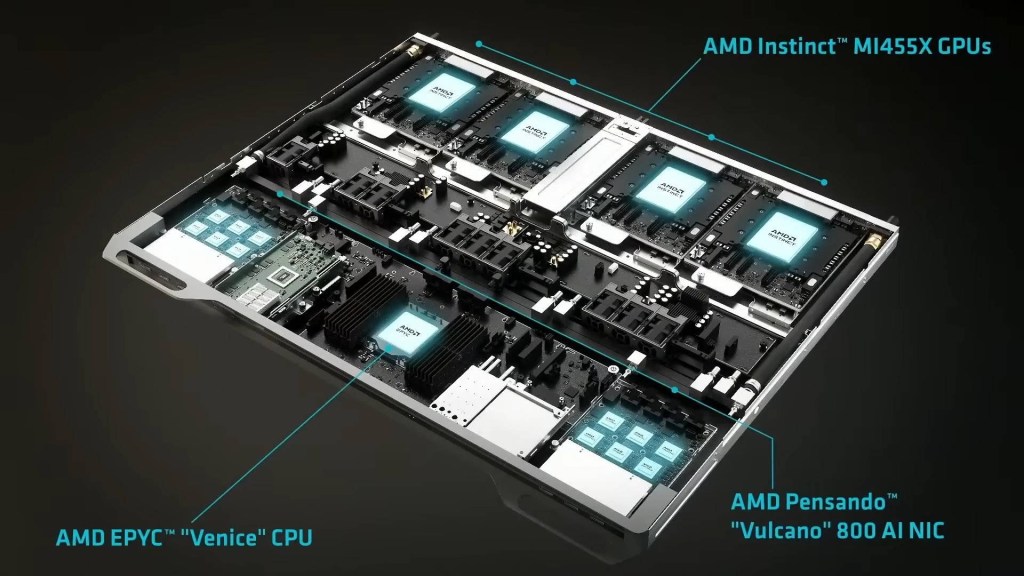
Advanced Micro Devices is no longer being framed as the low-cost alternative in AI infrastructure. Citing a new report from research firm Futurum, Wccftech said AMD’s Helios AI rack is expected to sell for $5 million to $5.5 million per rack, compared with an estimated $3.5 million to $4 million for Nvidia’s second-generation Vera Rubin rack. That puts Helios roughly 40% higher on price, though the figure is based on bill-of-materials analysis rather than an official AMD quote. Helios is AMD’s first rack-scale, full-stack system built for AI workloads. It combines the Instinct MI455X GPU, sixth-generation EPYC Venice CPUs, Pensando Vulcano 800 AI NICs, Salina DPUs, Infinity Fabric interconnect and the ROCm software platform in one architecture. On specs, Nvidia’s Vera Rubin leads in FP4 compute and HBM4 bandwidth, while AMD leads in FP8 compute and memory capacity, with 432 GB of HBM4 versus Rubin’s 288 GB. Microsoft has confirmed it will deploy Helios in Azure AI services. OpenAI, Meta, Oracle, Celestica, Nutanix and the U.S. Department of Energy were also listed as customers, giving AMD an early roster across cloud, enterprise IT and government.

1210
AMD Helios rack is reportedly priced about 40% above Nvidia Vera Rubin, with Microsoft Azure as first buyer
Hong Kong
2026-07-19 10:04:29

Hong Kong could offer about 180,000 PFLOPS of computing power by 2032, Paul Chan says

Hong Kong Financial Secretary Paul Chan said the city’s artificial intelligence buildout has moved into a more coordinated phase, with planning now covering research and innovation, data flow and security, computing infrastructure, use cases, talent training and capital deployment. In his weekly blog, Chan said AI is expanding across different layers of application, including a shift from chatbot-style interaction toward embodied intelligence in the physical world, as it moves from the digital sphere into real-world settings and daily life. On computing capacity, Chan said Hong Kong could provide about 180,000 PFLOPS by 2032. He said that figure would be 36 times the city’s current total computing power. He also said 56% of the funds deployed by Hong Kong Investment Corporation across projects last year went to hard-tech areas including AI, while the company also pushed forward the ecosystem development of the open-source RISC-V architecture.

1250
Hong Kong could offer about 180,000 PFLOPS of computing power by 2032, Paul Chan says
darknet marke
2026-07-08 23:00:14

Why Darknet Markets Keep Growing After Dread’s Sudden Disappearance

Dread’s unexplained outage and the reported disappearance of admin Hugbunter triggered security fears across the darknet community. Yet the broader market appears resilient, with users migrating to alternative forums and crypto-fueled trade continuing.

170
Why Darknet Markets Keep Growing After Dread’s Sudden Disappearance