optical modul2026-08-05 11:43:08US plan to restrict Chinese optical modules puts a key AI supply chain under pressureReports carried by Chinese media citing overseas outlets said the US Federal Communications Commission is drafting a rule that could ban imports of new Chinese optical transceiver modules, with officials reportedly aiming to publish and enforce the measure in 2026, while still leaving room for revisions or a delay. The report immediately rippled through equity markets: US optical-module names strengthened at one point, while major A-share suppliers opened lower before trimming losses, with Tianfu Communication ending higher. Industry data cited in the report points to a deeper issue for any forced separation. LightCounting said Chinese vendors now account for more than 60% of the global optical module market and hold an even larger share in 800G and 1.6T segments. Demand from Meta, Google, Microsoft, Amazon and Nvidia alone is described as running into tens of millions of high-speed modules, while US domestic output remains far below that level. Revenue disclosures from Chinese manufacturers also show a heavy concentration of overseas, especially US, customers, highlighting the mutual dependence built into the current supply chain.3430
Policy Regula2026-08-05 11:39:35FCC draft on Chinese data-center optical modules puts focus on non-China suppliers and InP bottlenecksThe U.S. Federal Communications Commission is considering restrictions on some new data-center optical modules made by Chinese vendors, but the proposal is still in draft form and several core definitions remain unsettled. The biggest open questions are whether the FCC will define "Chinese origin" by brand, manufacturing location, or component source, whether older models can still enter the U.S., and whether non-Chinese brands using Chinese-made substrates or lasers could still qualify for exemptions. For now, the market is trading the possibility that orders shift toward non-Chinese suppliers. WhiteLine Daily identified Coherent, Lumentum, and Applied Optoelectronics as the most direct potential beneficiaries if U.S. cloud companies continue building AI data centers while Chinese new-model supply faces limits. Marvell and Broadcom could benefit later, but only if demand passes through to DSP, driver-chip, and connectivity layers after module makers actually expand output. Over a longer horizon, the report says the more important constraint may not be module assembly capacity but the supply of indium phosphide, or InP, across substrates, epitaxial wafers, and lasers. AXT, IQE, and Sivers map to different parts of that chain, though each carries a different mix of policy risk and commercial visibility. The report argues that the real test will be the final FCC rule, confirmed customer orders, and whether non-China capacity can scale fast enough.2520
Morgan Stanle2026-08-05 06:33:27Morgan Stanley says proposed U.S. curb on Chinese optical modules could open room for Coherent and peersMorgan Stanley said in an Aug. 4 research note that a proposed U.S. restriction on new Chinese data-center components would benefit non-Chinese optical module suppliers, with Coherent seen as the biggest scaled winner and Lumentum positioned to gain indirectly through tighter EML laser supply. The bank’s argument, however, was not that market share can shift overnight. It said near-term execution would be difficult because non-Chinese suppliers still face capacity limits, certification constraints, and dependence on Chinese indium phosphide, or InP, substrates. According to Reuters, the Trump administration and the Federal Communications Commission are preparing measures that would restrict new Chinese data-center components from entering the U.S. market, with optical modules specifically mentioned. Morgan Stanley said Chinese vendors currently account for about half of the optical module market through companies such as Innolight and Eoptolink, so any ban would force demand toward alternative suppliers. Still, the bank said existing production capacity is not enough to fully replace that share in the short run. Morgan Stanley also flagged two bottlenecks that could shape the outcome: insufficient non-Chinese production capacity and the global supply chain’s reliance on China for InP substrates. If restrictions are implemented, the bank expects a short-term supply shock, while the longer-term structural benefit to non-Chinese suppliers may take more time to emerge.1880
Policy Regula2026-08-05 03:53:02Wall Street splits on proposed U.S. curbs on Chinese optical modules for AI data centersA proposed U.S. move to restrict imports of Chinese optical components used in AI data centers has quickly become a new trading theme for the optical module sector. U.S. optical communications names including Marvell, Coherent, Lumentum, Applied Optoelectronics and Corning rose overnight as capital rotated into the domestic supply chain, while related A-share names tied to North America’s AI buildout came under pressure. Wall Street’s early read is not uniform. Morgan Stanley argued that if Chinese optical transceivers are ultimately restricted from the AI data center supply chain, non-Chinese vendors could gain share, with Coherent seen as the clearest beneficiary and AAOI and Fabrinet also positioned to capture incremental demand. At the same time, the bank said implementation would be difficult because non-Chinese capacity is not enough to meet AI capex demand and key upstream materials such as InP substrates still involve Chinese suppliers. Citi took a more cautious line, saying any ban would be hard to turn into a simple rule. It noted that seven of the world’s top 10 optical transceiver companies are Chinese and that they supply more than 50% of high-speed optical modules to major U.S. cloud providers. Citi expects exemptions are likely under real supply-demand constraints and said investors are now watching whether final rules hit third-country capacity, whether North American cloud firms reallocate orders, and whether overseas factories run by Chinese suppliers can continue to serve as a buffer.1810
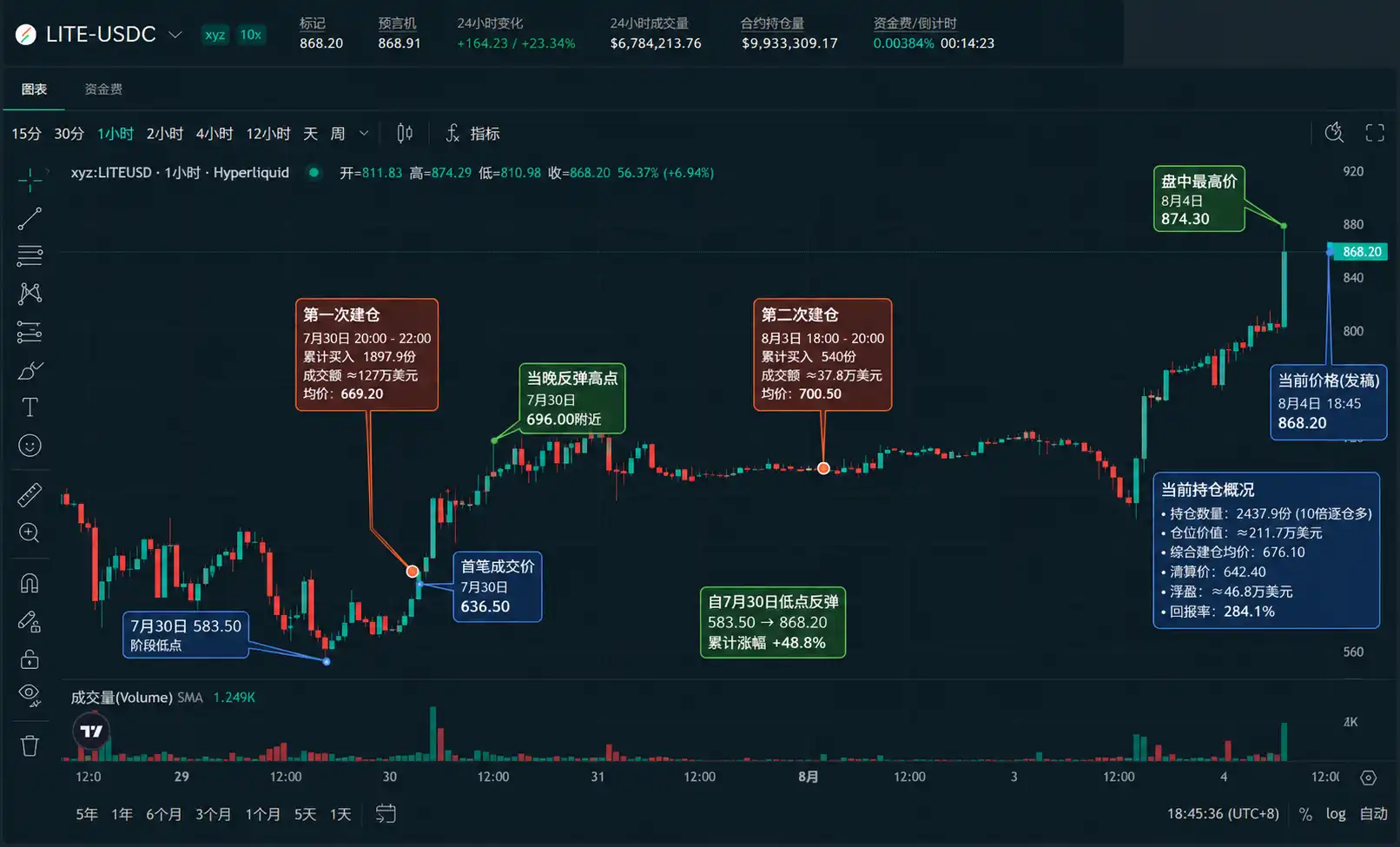
Whale Movemen2026-08-04 11:03:42Whale built LITE long position before both sharp moves, with unrealized profit reaching about $468,000TradingBeats, formerly Hyperinsight, said a whale wallet beginning with 0xaa53 bought Lumentum (LITE) twice just before the token accelerated higher. Before the market saw a potential industry tailwind cited later by Reuters, the trader had already finished a second round of accumulation, bringing total purchases to about $1.648 million. At press time, the whale was holding a 10x isolated long worth about $2.117 million, with an average entry of $676.1 and a liquidation price of $642.4. Unrealized profit had widened to roughly $468,000, while the reported return climbed to 284.1%. Trading records cited by BlockBeats showed 139 buy executions in LITE, with no sales, no take-profit order and no scale-down order during the period. The first entry came on the evening of July 30, when the whale bought 1,897.9 LITE in roughly two hours for about $1.27 million at an average of $669.2. A second purchase followed between the late afternoon and evening of Aug. 3, when the trader added 540 LITE at an average of $700.5 for about $378,000. LITE later touched an intraday high of $874.3 and was last quoted at $868.2, up 23.3% over 24 hours.2040
Trump adminis2026-08-04 11:17:34Reuters: Trump administration drafts ban on new Chinese data center optical module importsThe Trump administration is drafting a rule that would block U.S. imports of new Chinese-made optical modules used in data centers, according to Reuters, which cited four people familiar with the matter. The measure is being prepared by the Federal Communications Commission and would cover new module models that transmit data through fiber-optic cables inside data centers. Officials want the ban published and put into effect within this year. Reuters said the proposal is meant to prevent Chinese companies from stealing data, inserting malware, or disrupting U.S. data center services. The draft could hit Eoptolink most directly. The report said the company holds a leading 27% share of the global data center optical module market and was added to the Pentagon’s list of Chinese military-linked companies in June this year. U.S. cloud providers including Amazon Web Services may have to shift to alternative suppliers such as Coherent and Lumentum, which could raise costs. China’s embassy in Washington said it would take all necessary measures in response to any action that harms Chinese interests. The draft can still be revised or shelved.2310
U.S. stocks2026-07-22 08:30:27Premarket pullback hits optical module and memory stocks after prior-session rallyU.S. stocks tied to optical modules and memory traded lower in premarket action on July 22 after posting strong gains in the previous session, according to market data cited by BlockBeats from BIT (Bit.com). The moves pointed to early profit-taking after a sharp run-up across both segments. In optical names, Coherent (COHR), Lumentum Holdings (LITE), Applied Optoelectronics (AAOI), Nokia (NOK), and Marvell Technology (MRVL) all slipped before the open, with most declines ranging from under 1% to more than 3%. Memory-related stocks showed a similar pattern. Seagate Technology (STX), Western Digital (WDC), SanDisk (SNDK), and Micron Technology (MU) were all lower in premarket trading after double-digit gains a day earlier. BlockBeats said the group was broadly down about 2% to 3.5% before the bell, describing the move as a technical adjustment following the previous day’s surge. The report added that capital remains concentrated in the AI infrastructure chain, with storage and optical interconnect names still benefiting from the expansion of AI server demand.1390
Eoptolink2026-07-17 14:18:16Eoptolink files for Hong Kong listing, targets up to $5 billion raiseChinese optical module maker Eoptolink has filed an application for an H-share listing in Hong Kong and plans to raise as much as $5 billion, according to Techub News. The company said the proceeds are intended for research and development, capacity expansion, and potential acquisitions. Its board approved the plan on June 11, 2026. Eoptolink reported about RMB 24.84 billion in revenue for 2025, while net profit rose 236% year over year to RMB 9.53 billion. The company’s client list includes major technology firms such as Google, Microsoft, and Amazon. The proposed listing still requires approval from shareholders, the China Securities Regulatory Commission, and the Hong Kong Securities and Futures Commission. CryptoBriefing was cited in the item carried by Techub.2220