Anthropic2026-10-09 17:56:20Anthropic launches free Cyber Mission AI scanner for critical infrastructureAnthropic has introduced Cyber Mission, a new initiative aimed at protecting critical infrastructure and open-source software from cyberattacks. According to The Decoder, the program will work with partners including CrowdStrike and Palo Alto Networks to help secure power grids and water systems. As part of the effort, Anthropic is offering a free AI-powered scanner that automatically checks open-source projects for vulnerabilities. The company expects the tool to deliver accuracy above 90%. The announcement centers on infrastructure protection and automated vulnerability detection, with the stated goal of improving defenses for systems that are often exposed to cyber risk.290
Cybersecurity2026-09-21 13:22:09Why U.S. cybersecurity stocks are rallying while China’s sector is still fallingCybersecurity stocks in the U.S. and China have diverged sharply during this year’s AI trade. As of Aug. 31, the U.S.-listed cybersecurity ETF CIBR was up 40.36% for the year, while China’s CSI Information Security Theme Index was down 12.49% as of Sept. 18. The source article argues that the gap is not simply about who has stronger AI narratives. It comes from a deeper shift in how cybersecurity is funded and sold in the two markets. In the U.S., cybersecurity is increasingly treated as infrastructure tied to AI adoption. Gartner expects global information security spending to reach $244 billion in 2026, up 11.6%, while its Securing AI segment is projected to hit $2.835 billion in 2026 and $4.783 billion in 2027. That demand is already showing up in company results, including Fortinet and Palo Alto Networks. In China, by contrast, the digital security market has contracted for three straight years, according to 数世咨询, and many vendors still depend on traditional government and enterprise IT compliance budgets. The article also points to differences in business models. U.S. leaders such as Palo Alto Networks, CrowdStrike and Fortinet are building subscription-based platforms that can expand revenue per customer. Many Chinese vendors still rely on project-based sales, where security often trails spending on models, computing power, data governance and application development. The result, the article says, is that one market is earning from AI expansion, while the other is still earning from conventional IT construction.700
US stocks2026-09-15 00:32:26Cybersecurity stocks jump as chip names come under pressure, with CrowdStrike closing at a record highU.S. cybersecurity software stocks rallied on Sept. 15 after Anthropic CEO Dario Amodei warned that AI may be advancing too quickly and that recursive self-improvement could create loss-of-control risks. While chip stocks broadly faced pressure, security names moved sharply higher, according to market data cited by BlockBeats from BIT (bit.com). CrowdStrike rose 13.85% and finished at a record closing high, Palo Alto Networks gained 13.09%, and Fortinet added 9.04%. The market view cited in the report was that investor focus is shifting toward security software as spending on AI computing power comes under scrutiny. The same view held that companies will still need to protect, govern, and monitor AI agents regardless of how quickly AI development proceeds. Analysts also outlined where demand may emerge and how long monetization could take. Evercore ISI analyst Kirk Materne said identity management, data governance, observability, and runtime security demand may increase, with Okta, SailPoint, Palo Alto Networks, and CrowdStrike potentially benefiting first. Jefferies analyst Joseph Gallo, however, said AI agent security remains at an early stage and that meaningful earnings contributions may not show up until 2027 and beyond.1730
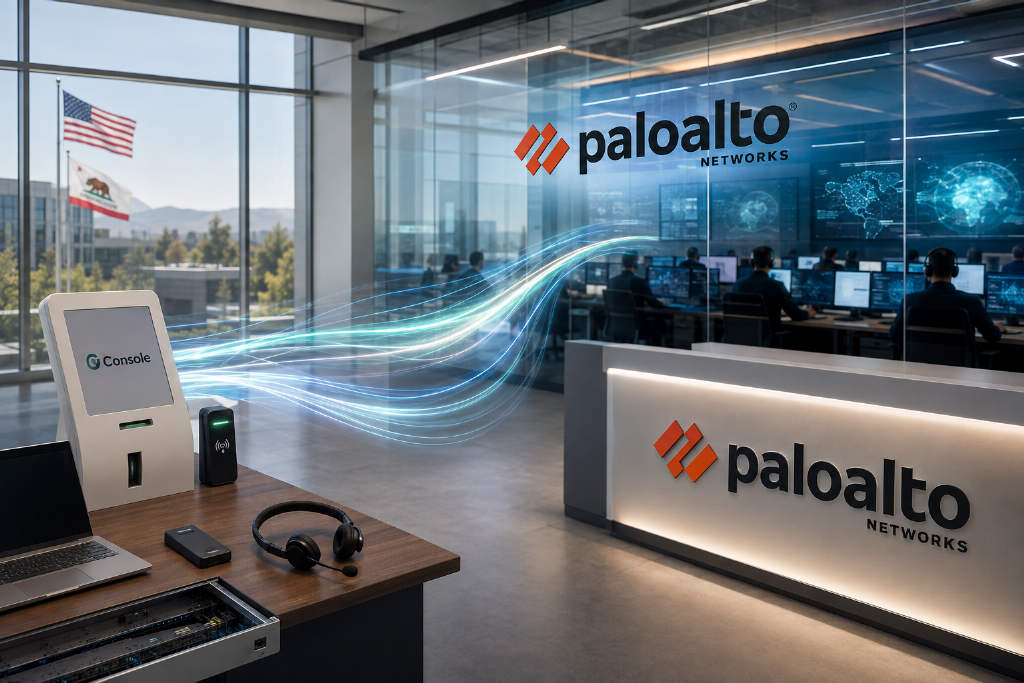
Palo Alto Net2026-09-03 12:23:45Palo Alto Networks to buy AI agent startup Console in $500 million cash-and-stock dealPalo Alto Networks has agreed to acquire AI agent startup Console in a deal valued at $500 million, according to Techcrunch. The transaction will be paid in a mix of cash and stock. Founded in 2024, Console uses AI agents to automate routine IT tasks such as password resets, application access provisioning, and day-to-day troubleshooting. Its listed customers include Ramp, Flock Safety, and Scale AI. Palo Alto Networks said it plans to integrate Console into Cortex, its AI-driven security platform, so security teams can investigate and respond to alerts using natural language and run more automated enterprise security operations. The deal is also the company’s seventh acquisition completed this year. Earlier transactions mentioned in the report include the acquisition of Chronosphere at a $3.35 billion valuation and the $400 million purchase of cybersecurity startup Koi.1010
US stocks2026-09-02 13:31:17US Stocks Open: AI Concept Stocks Fall, Palo Alto Networks Down 5.6%US stocks opened mixed, with the Dow up 0.39% and the Nasdaq down 0.02%. AI concept stocks broadly declined, led by Palo Alto Networks (-5.61%), Palantir (-2.85%), Snowflake (-2.81%), Marvell (-2.52%), and CrowdStrike (-2.52%). MSX, a leading RWA trading platform, has listed hundreds of RWA tokens including NVDA, GOOGL, and other popular stocks.1330