SHR

SHROOM
2026-09-05 07:18:13

SHROOM hits $44 million market cap in three days, with Micron stock tokens used as holder rewards

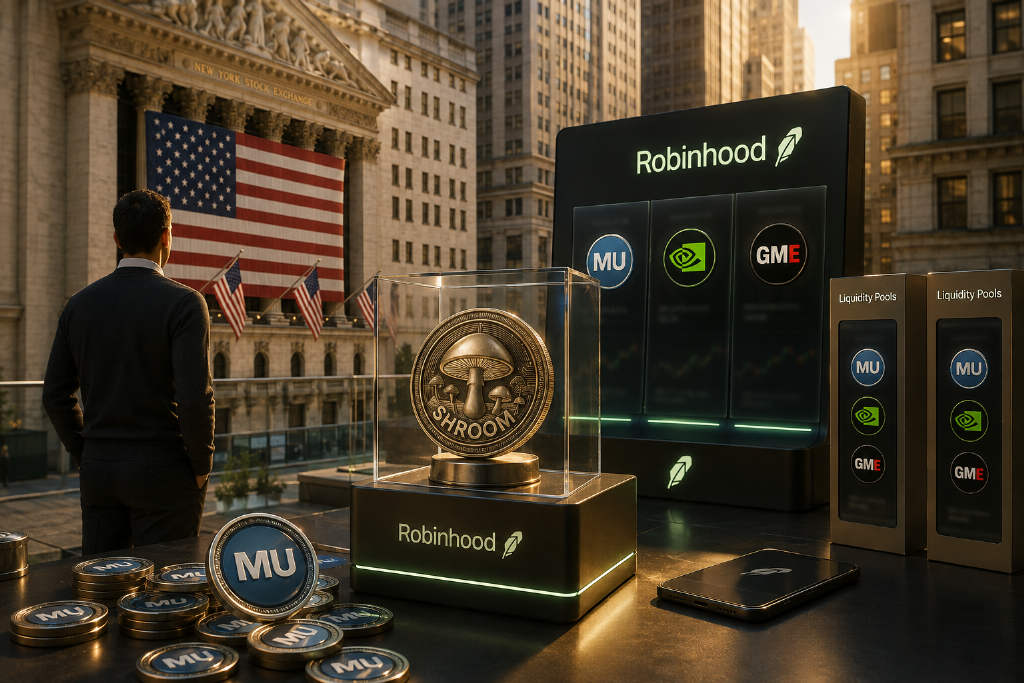
SHROOM, a meme coin on Robinhood Chain, climbed to roughly $44 million in market capitalization just days after its first liquidity pool launched on Sept. 2. At its peak, the token reached about $58.33 million, while its main trading pool posted a 442% gain over 24 hours, according to the source article citing DexScreener data. The token was trading at $0.0432, and combined 24-hour volume across 30 pools stood at about $25.59 million. On-chain data in the report says SHROOM’s contract name is MUSHROOM, with a fixed supply of 1 billion tokens. So far, 12,682,719 tokens have been sent to a burn address, equal to 1.268% of supply. The project describes itself as a liquidity network for stock tokens, pairing SHROOM with assets such as Micron (MU), NVIDIA (NVDA), Microsoft (MSFT), Coinbase (COIN), GameStop (GME), AMC, Eli Lilly (LLY), Hims & Hers (HIMS), GLD, along with USDG and ETH. The report also says holders receive periodic MU rewards, with 251 MU already distributed by Pons. Based on Micron’s Sept. 4 close of $1,016.59, that amount was worth about $255,000. DexScreener showed around $2.92 million in liquidity across 30 pools, while the project website listed $4.04 million in TVL across 142 pools.

230
SHROOM hits $44 million market cap in three days, with Micron stock tokens used as holder rewards
SHROOM
2026-09-05 04:49:28

SHROOM briefly tops $35 million market cap with 24-hour gain above 340%

GMGN market data showed on Sept. 5 that SHROOM, a meme coin tied to the Robinhood ecosystem, briefly pushed its market capitalization above $35 million after rising more than 340% in 24 hours. Trading volume over the same period reached $10.5 million. According to the project description cited in the report, SHROOM is designed to build a liquidity network for tokenized stocks. The protocol pairs SHROOM with stock tokens and other assets through protocol-owned liquidity pools, currently around 53 in total, to enable routed token swaps. It collects fees from trading activity and price volatility across those paired assets, including deviations from off-chain real-world prices, and automatically reinvests those fees to deepen liquidity. The report also said SHROOM holders can periodically receive MU rewards, with 228 MU distributed so far by Pons. Once liquidity reaches a critical scale, excess fees are intended to be used to buy back and burn SHROOM on the market, reducing supply. BlockBeats added a risk warning that most meme coins lack practical use cases and can be highly volatile.

250
SHROOM briefly tops $35 million market cap with 24-hour gain above 340%
Robinhood Cha
2026-08-31 17:34:35

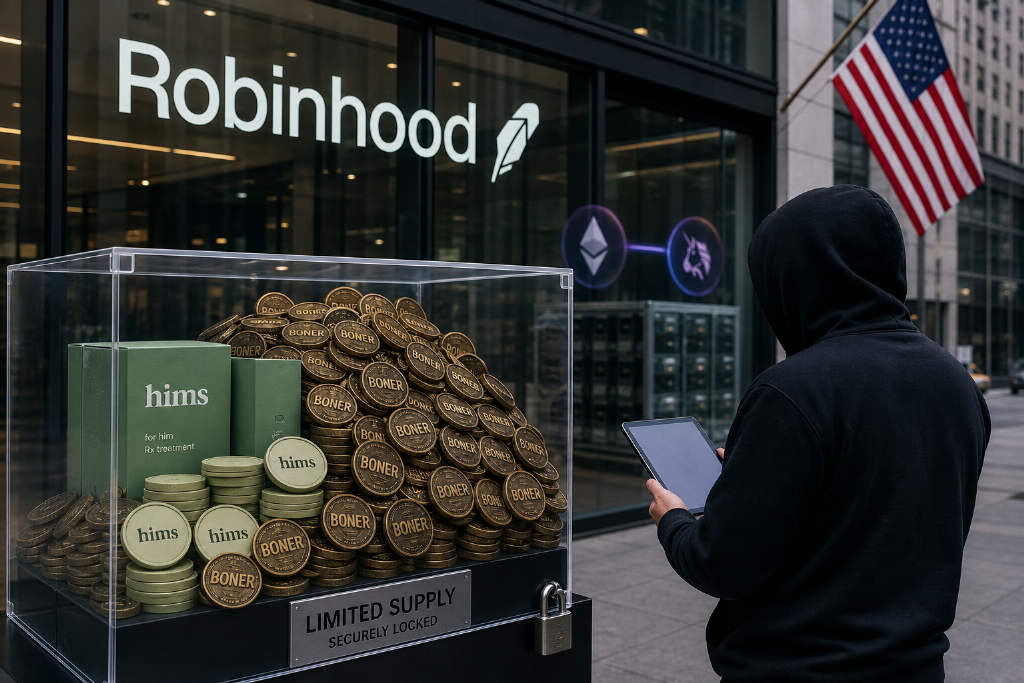
BONER Locks Up More Than Half of Robinhood Chain’s Tokenized HIMS Float

A memecoin tied to the short-interest narrative around Hims & Hers Health has pulled more than half of Robinhood Chain’s tokenized HIMS supply into its own liquidity pool, creating a weekend price dislocation that briefly sent the wrapper to $132.64 while the underlying stock was far lower. Data cited by The Defiant shows BONER’s main BONER/HIMS pool alone held 31,198 HIMS tokens as of Monday, equal to 53% of all issued tokenized shares on the chain, while 83% of total supply sat inside Uniswap v4’s pool manager contract. Because only BBVI, the sole authorized participant named in Robinhood’s documentation, can mint or burn these stock tokens, ordinary traders had no way to expand supply during the squeeze in onchain liquidity. The article argues that a thin float, memecoin launchpads that use stock tokens as quote assets, and weekend market closure combined to let relatively small orders move the wrapper far away from the real equity. Once the NYSE reopened and new HIMS tokens were minted into the premium on Monday, the gap narrowed back toward spot equity pricing. The episode also highlights how Robinhood Chain’s real-world asset pitch is colliding with memecoin speculation, with stock-linked meme pairs now accounting for some of the chain’s most active pools.

1300
BONER Locks Up More Than Half of Robinhood Chain’s Tokenized HIMS Float
Artificial In
2026-08-31 10:55:20

From the Dartmouth proposal to Jensen Huang’s AGI remark: a 70-year history of AI booms, winters and shifting definitions

MarsBit revisits the 70-year arc of artificial intelligence through a current flashpoint: Jensen Huang’s remark on Nvidia’s August 26, 2026 earnings call that, "for a lot of tasks, we can say that we have achieved AGI." The article does not treat that line as settled fact. Instead, it uses the debate around it to trace AI from the 1955 Dartmouth proposal, where John McCarthy, Marvin Minsky, Nathaniel Rochester and Claude Shannon outlined a summer project built on the idea that learning and intelligence could, in principle, be described precisely enough for a machine to simulate them. The piece walks through the field’s early optimism, the perceptron era, symbolic AI, the Lighthill report, expert systems, the two AI winters, and the period when researchers avoided the term "AI" altogether in favor of machine learning, pattern recognition and related labels. It then follows the buildup to the deep learning turn, including ImageNet, AlexNet, DeepMind’s reinforcement learning work, AlphaGo, and the Transformer paper "Attention Is All You Need," before moving into BERT, GPT, scaling laws, Chinchilla, diffusion models and ChatGPT. The central argument is that AI history keeps repeating a few patterns: promises outrun capabilities, definitions keep moving, and methods built to scale with compute often overtake systems packed with hand-crafted human knowledge. On that basis, the question of whether AGI has been achieved remains unresolved not only because capability is contested, but because the term itself has never had a fixed, falsifiable definition.

300
From the Dartmouth proposal to Jensen Huang’s AGI remark: a 70-year history of AI booms, winters and shifting definitions
Bitcoin
2026-08-29 14:30:00

Blockstream study weighs Bitcoin lattice signatures against quantum risk, favors Falcon-1024 if forced to choose

Blockstream Research has published a full review of lattice-based signature schemes for Bitcoin, comparing Dilithium, Falcon, and Hawk as post-quantum replacements for Schnorr and ECDSA. The report starts from a practical concern: Shor’s 1994 result showed that sufficiently powerful quantum computers could break today’s elliptic-curve signatures, so Bitcoin needs a deployment path before that threat becomes real. The study ranks candidates across four criteria that matter specifically to Bitcoin: on-chain cost, implementation complexity, deployment risk, and long-term development potential such as BIP-32-style key derivation. It argues that Bitcoin should target at least NIST security level 3 because outputs may remain unspent for decades. In that framework, Dilithium stands out for simple integer-only implementation and the strongest basis for future key derivation work, but its signatures are large. Hawk had looked attractive on size and memory use, yet a newly disclosed structural attack weakened confidence enough for the team behind it to withdraw the scheme from the NIST process. That leaves Falcon as the most balanced option in the report’s view. Its signatures are compact, verification is the fastest among the three, and its security assumptions are more established. Falcon still has unresolved issues, including floating-point complexity in signing, no practical key derivation method, and a standard that has not yet been finalized. Even so, the report says Falcon-1024 would be the preferred lattice-based choice today, while hash-based signatures remain the more conservative near-term path for Bitcoin.

260
Blockstream study weighs Bitcoin lattice signatures against quantum risk, favors Falcon-1024 if forced to choose
Blockstream
2026-08-28 10:31:35

Blockstream researchers publish SHRINCS draft, a post-quantum Bitcoin signature aimed at limiting block-space costs

Blockstream researchers on Thursday released a draft specification for SHRINCS, a post-quantum signature scheme built specifically for Bitcoin. The proposal is designed to hold up against quantum computers without causing the steep transaction-capacity drop that has weighed on many post-quantum migration plans. Built on SHA-256, which already sits inside Bitcoin’s consensus rules and mining system, SHRINCS combines a compact stateful signing path with a stateless fallback in case a wallet loses track of signing state. The draft says the public key is 48 bytes, the smallest stateful signature is 548 bytes and grows by about 16 bytes each time a key is reused, while the stateless fallback is 5,776 bytes. Blockstream previously estimated Bitcoin could process about 6.5 transactions per second if all transactions used Schnorr signatures, versus roughly 0.36 under NIST-standardized SLH-DSA. SHRINCS, it said, gets that figure back to close to three. The specification also warns about wallet state management and compatibility risks tied to hypertree pruning. A formal security proof is still pending, and the reference software has not been audited or prepared for production use. Bringing SHRINCS to Bitcoin would require a soft fork and broad network support.

200
Blockstream researchers publish SHRINCS draft, a post-quantum Bitcoin signature aimed at limiting block-space costs
Bitcoin
2026-08-27 12:01:38

Blockstream review says Falcon-1024 is the strongest lattice-signature candidate for Bitcoin, while hash-based signatures remain the near-term fallback

Blockstream Research has published a detailed review of post-quantum lattice signatures for Bitcoin, comparing Dilithium, Falcon and Hawk across on-chain footprint, verification cost, implementation difficulty, deployment risk and long-term usability. The report starts from a practical premise: Bitcoin’s current Schnorr and ECDSA signatures are efficient today, but Shor’s 1994 result means a sufficiently capable quantum computer could break them, so migration planning cannot wait until the threat is immediate. The study argues that Bitcoin should target at least NIST security level 3 because coins can remain unspent for decades, leaving funds exposed if future cryptanalysis weakens lower-margin parameters. On that basis, Dilithium stands out for simple integer-only implementation and broad software support, but its size is a major drawback on-chain. Falcon offers much smaller signatures and the fastest verification, though its signing path is harder to implement safely because of floating-point Gaussian sampling. Blockstream says deterministic, integer-simulated Falcon can address that issue at the cost of slower signing. Hawk, once notable for very small signatures and low memory use, has dropped out after Straznickas and Weis of Anthropic found a structural flaw that sharply reduced its estimated security. Blockstream’s bottom line is that if a lattice-based option had to be chosen today, Falcon-1024 would be the pick. Even so, the report says the conservative short-term path for Bitcoin is still hash-based signatures until the FN-DSA standard is finalized and production-grade implementations and hardware support mature.

370
Blockstream review says Falcon-1024 is the strongest lattice-signature candidate for Bitcoin, while hash-based signatures remain the near-term fallback
Bitcoin
2026-08-27 02:38:28

New Bitcoin BIP proposes SHRINCS as a quantum-safe signature upgrade

A new Bitcoin Improvement Proposal, or BIP, centered on the SHRINCS signature scheme has been released, according to Techub News. The proposal is aimed at upgrading Bitcoin with quantum-safe protections and lays out a technical path for moving the network toward post-quantum cryptography. SHRINCS is described as a hash-based signature scheme that is considered capable of resisting attacks from future quantum computers. The release of the proposal points to a concrete step by the Bitcoin community in addressing potential threats tied to quantum computing. Techub attributed the item to @Cointelegraph.

210
New Bitcoin BIP proposes SHRINCS as a quantum-safe signature upgrade