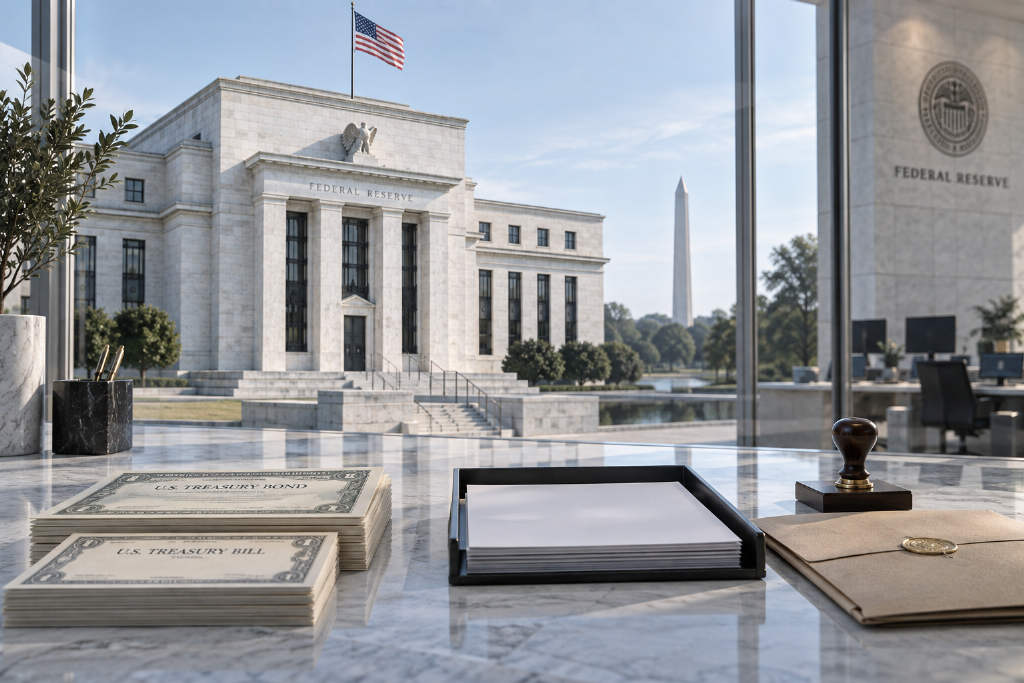
Federal Reser2026-09-15 13:16:30Wall Street Expects Fed to Keep Reserve-Management Treasury Purchases at Zero This Month, With a Possible Restart in OctoberThe Federal Reserve has extended the suspension of reserve-management purchases, or RMP, through mid-October, meaning it will not buy U.S. Treasuries for the purpose of managing banking-system reserves during that period. The move suggests the Fed still sees reserve levels in the banking system as relatively ample, based on its latest announcement. Market views cited in the report say the pause also points to confidence in near-term funding conditions. Secured Overnight Financing Rate, or SOFR, has spent most of the recent period near or below the interest rate paid on reserve balances, while Treasury bill repayments ahead of the quarterly tax deadline have helped ease pressure in funding markets. Wall Street forecasts are split on what comes next. Strategists at Wells Fargo and Bank of America expect the Fed to keep RMP purchases at zero this month and potentially resume them in mid-October if increased Treasury issuance creates added strain in funding markets. Barclays strategist Samuel Earl expects purchases to return at $10 billion in October and rise to $20 billion in November. Citi strategists, by contrast, think the Fed could keep RMP paused for the rest of the year, arguing reserve balances have fallen back to a “slightly ample” level. The report also notes that the RMP pause does not signal a fundamental shift in the Fed’s monetary-policy stance or balance-sheet strategy.660
Federal Reser2026-09-14 23:30:44Fed Pauses Reserve-Management Treasury Purchases for a Second Straight MonthThe Federal Reserve said Monday it will go a second consecutive month without buying U.S. Treasuries for reserve-management purposes in the upcoming operating period, a sign that policymakers view reserve levels in the banking system as appropriate. The New York Fed’s open market trading desk said it does not plan reserve-management purchases during the monthly period running through Oct. 14, though it still expects to conduct about $15.6 billion in reinvestment purchases over the same window. According to the report, the move points to confidence in money-market conditions rather than a shift in the Fed’s broader policy stance. That view is reflected in the Secured Overnight Financing Rate, or SOFR, which has spent most of the past month near or below the Interest on Reserve Balances rate. The report also noted that the U.S. Treasury has reduced bill supply ahead of the quarterly tax payment deadline. It added that reserve-management purchases are meant to fine-tune reserve levels in the banking system and are not the same as traditional quantitative easing, while mortgage-backed securities reinvestment operations continue as part of balance-sheet management.760
Federal Reser2026-08-19 07:38:44Rate options traders shift toward Fed cuts, with positions building for a 2027 easing cycleRate options traders are reworking their Federal Reserve bets after a run of weaker U.S. economic data. While long-dated Treasury yields remain near multi-year highs, investors have started positioning for future rate cuts and using options to hedge against a slowdown. Recent data showed softer July inflation and consumer demand, an unexpected drop of 23,000 jobs in the nonfarm payrolls report, the biggest decline in retail sales in more than a year, and weaker consumer sentiment. That shift is showing up across rate markets. Some investors are unwinding earlier wagers on Fed hikes in September and December and moving into trades tied to cuts before mid-2027. In the SOFR options market, recent activity has included contracts betting the Fed will leave rates unchanged in September, along with call options expiring in March and June 2027. Swaps now imply only about 9 basis points of tightening at the September meeting and roughly 40 basis points of cumulative tightening by June 2027. Prediction markets Polymarket, Kalshi, and Myriad are also clustered around a 74% to 75% chance that the Fed stands pat in September.1430
Extended2026-08-05 13:06:56Extended Launches RWA Prime Market Backed by 36 US Equities and SOFR-Based Funding RatesBlockBeats reports that on August 5, Extended, a blockchain-based perpetual futures platform, launched RWA Prime, a market supporting roughly 36 US-listed stocks including semiconductor, foundry, Chinese ADR, cloud software, and Bitcoin miner names. Trading runs 24/5, pausing on weekends and exchange holidays while positions remain open. Funding rates use SOFR as the benchmark, determined by open interest skew instead of order book spread pressure.1980
Sky Protocol2026-07-18 09:18:01Sky proposal would cut Sky Spread to 0% and switch benchmark reference to SOFRA community member of Sky Protocol has submitted an Atlas Edit Weekly proposal on the governance forum that would reduce Sky Spread from 0.1% to 0%. If adopted, the total spread between the Sky Savings Rate and the benchmark rate would be left with only a 0.2% allocation rewards fee. The proposal also seeks to replace the reference rate used for subsidized borrowing and active stable collateral, moving from Treasury bill rates to SOFR. Beyond rate changes, the draft includes several technical and naming updates: migrating Prime Agents foundation and development company entries from custom instance parameters to standard parameters, correcting the term "Instance Total RRC" to "Instance Total CRR," renaming SEJRC to PEJRC across the system, and updating the naming of Spark stablecoin transfer instances along with the ecosystem operations repository link to the Soter Labs organization. The full proposal has been published on GitHub for community review.2050
STRC2026-06-27 20:44:05STRC Price Stability Mechanism Fails, Strategy May Need to Buy Back Shares to Fix ProblemsFarside Investors analyzes that Strategy's (MSTR) preferred stock STRC has essentially lost its price stabilization mechanism. The product, priced at $100, currently trades around $75 with no dividend hike from the company. The mechanism—raising dividends when price falls and lowering when it rises—is inherently unstable because it relies on company credit; a dividend hike could worsen credit risk, creating a death spiral. From a financial logic perspective, issuing a perpetual instrument yielding 11.5% to buy Bitcoin is a bad trade, as Bitcoin's long-term average annual return (10% plus 5% inflation) may not cover the cost. With the company's right to reduce dividends to SOFR (~3.6%), STRC's fair value is estimated at $55. Current realistic options for Strategy are buying back STRC or abandoning the stabilization mechanism and cutting dividends. Buyback is the most likely outcome, though the company may take time to capitulate.1390
Crypto Benchm2026-06-18 00:00:50How Crypto Could Build Its Own Benchmark Interest Rate CurveBlockbooster researcher BlazingKevin_ argues that crypto leverage, lending and yield products still lack a shared benchmark rate comparable to SOFR. Perpetual funding rates, Bitfinex FRR, Aave rates, Sky SSR, tokenized Treasuries and Ethena sUSDe each measure different risks, and none currently combines broad market depth, term structure and independent governance.2140
Crypto benchm2026-06-17 23:00:51How Crypto Could Build Its Own Benchmark Interest RateBlockbooster researcher BlazingKevin_ argues that crypto leverage, lending and yield products still lack a widely trusted benchmark curve comparable to SOFR. The article compares perpetual funding rates, Bitfinex FRR, Aave, Sky SSR, tokenized Treasuries, sUSDe and CME basis, and explains why a proper benchmark should be transaction-based, deep, independently governed and ideally term-structured.2150