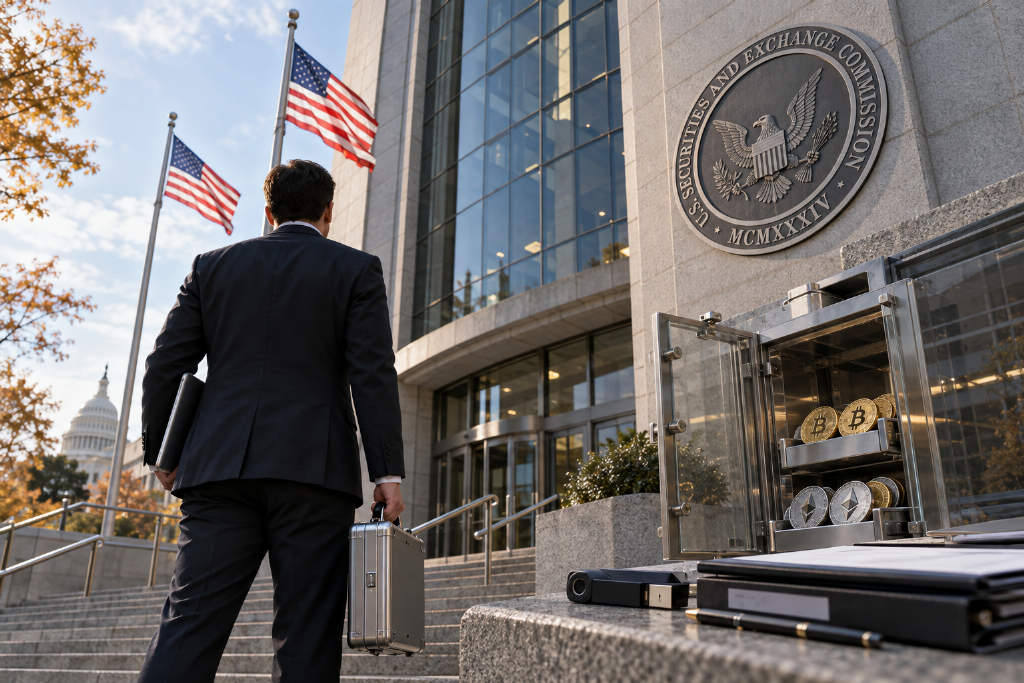
SEC2026-10-02 03:14:16SEC Proposes Crypto Custody Framework for Advisers and Funds, With Limited Self-Custody OptionThe U.S. Securities and Exchange Commission on Oct. 1 proposed a new crypto asset custody rule aimed at registered investment advisers, regulated funds and business development companies, opening a clearer compliance route for handling digital assets. The proposal would, in limited circumstances, allow advisers and funds to self-custody crypto when no suitable qualified or permitted custodian is available. SEC data cited in the proposal show regulatory assets under management reported by investment advisers reached about $177 trillion in 2025, up 21% from a year earlier, putting the potential scope of the rule change squarely in one of the world’s largest asset-management markets. The proposal also would expand the pool of third-party crypto custodians by allowing eligible state-chartered trust companies to serve in that role. SEC Chair Paul Atkins said existing U.S. custody rules were built mainly around traditional securities markets and have not kept pace with digital assets. Commissioner Hester Peirce said the current system has left some advisers without clear rules and without workable custodians. The proposal remains at the draft stage and could still change after public comment.60
self-custody2026-10-01 22:19:22Self-custody proposal would require RIAs to spell out bankruptcy protection for crypto assetsA self-custody proposal would put bankruptcy protection at the center of how registered investment advisers handle client crypto, according to a post on X by a Fox Business crypto reporter. The proposal would require RIAs and their clients to sign a written agreement stating that crypto assets held in self-custody by the adviser would be treated as financial assets under Article 8 of the Uniform Commercial Code. The reported aim is to reduce the risk that clients could lose those crypto assets if an adviser becomes insolvent. The update was cited by Odaily in a brief report and did not include further details on the proposal’s timeline or scope.80
SEC2026-10-01 21:38:21SEC unveils crypto custody proposal allowing self-custody under specific conditionsThe U.S. Securities and Exchange Commission on Oct. 1 formally announced a new set of crypto asset custody rules and amendments aimed at registered investment advisers and regulated funds. The proposal is designed to replace older rules that the agency says no longer fit digital assets, while creating a clearer compliance path for advisers offering crypto-related guidance. One of the central changes is that self-custody would be permitted under specific conditions, rather than forcing a single centralized custody model. The proposal also adds state trust companies to the list of qualified custodians that may hold crypto assets for clients and funds. According to the SEC, the framework is grounded in amendments tied to the Investment Advisers Act of 1940 and the Investment Company Act of 1940, and applies to regulated funds including registered investment companies and business development companies. SEC Chair Atkins said crypto has grown into a multi-trillion-dollar asset class since Bitcoin launched in 2008, while many existing custody rules were written before the internet became widespread. Once the proposal is published in the Federal Register, it will enter a 60-day public comment period, after which the commission will vote on the final version and implementation timeline.70
Netherlands2026-10-01 13:21:08Dutch proposal could tax unrealized gains on self-custodied Bitcoin each yearA proposed change to the Netherlands' 2028 Box 3 tax regime could subject gains on crypto assets held in self-custody wallets to annual taxation, even if the investor has not sold the assets, according to a post by Bitcoin News on X. The reported approach would set self-custodied holdings apart from crypto kept through banks or standard investment accounts, where taxes would generally apply when gains are realized. The proposal has already passed the Dutch House of Representatives, but it has not yet become law. It still needs approval from the Senate before taking effect. The update points to a possible difference in tax treatment based on how crypto is held, with self-custody wallets facing annual taxation on gains under the proposed framework.40
Hyperliquid2026-09-30 13:37:59Hyperliquid co-founder says onchain finance is defined by self-custody and transparency, not 24/7 tradingHyperliquid co-founder Jeff Yan said at Korea Blockchain Week on Sept. 30 that round-the-clock trading is not the defining advantage of onchain finance over traditional trading venues. He argued that crypto assets are global by nature and do not need to follow conventional market hours, while traditional exchanges themselves are already extending trading sessions. In his view, the real edge of onchain systems is that users keep control and custody of their own funds, which can reduce common single points of failure when counterparties, intermediaries, or custodians run into trouble. Yan also pointed to transparency as another core advantage, saying users can theoretically see everything happening inside the system, offering a level of trust and neutrality that privately controlled systems cannot match. He added that 24/7 trading still has practical value for assets that lack public price discovery after traditional markets close, including commodities, stocks, and pre-IPO assets. Yan said private markets could become the next major asset class to adopt always-on trading, with global price discovery potentially letting more users access those markets earlier instead of being limited to a single jurisdiction.60
Hyperliquid2026-09-30 13:41:04Hyperliquid co-founder Jeff Yan says onchain trading’s edge is custody and transparency, not 24/7 hoursHyperliquid co-founder Jeff Yan said at a Korea Blockchain Week 2026 fireside chat that round-the-clock trading is not the defining difference between onchain venues and traditional exchanges. According to The Block, Yan argued that crypto assets do not need to follow conventional market hours because they are inherently global, and some traditional exchanges have already moved to extend trading sessions. Yan said the more durable value proposition of onchain finance lies in users retaining control and custody of their own funds. In his view, that structure helps reduce a common single point of failure risk, especially if a counterparty, intermediary, or custodian runs into trouble. He also described transparency as another key feature of onchain trading. While that may not be a major selling point for ordinary consumers, he said it is essential to building trust across the system, since users cannot get the same level of trust and neutrality in a system controlled by a single private organization. He added that continuous trading still serves a real need for assets that lack public pricing when traditional exchanges are closed, citing commodities, stocks, and Pre-IPO names traded on Hyperliquid before reference markets opened over the counter.70
Illinois2026-09-30 04:29:28Illinois draft rules spell out crypto tax treatment for stablecoins, DeFi and bridgingIllinois tax officials have released draft rules that explain how the state’s already-enacted 0.2% digital asset transaction tax would apply across several parts of the crypto market, including stablecoins, DeFi activity, crypto bridging and some transfers to self-custody wallets. The proposal says stablecoins would count as taxable digital assets, while nonfungible tokens would sit outside the tax’s scope. It also draws lines around DeFi usage: transactions are generally exempt, but taxes could apply when users pay fees deemed "valuable consideration," such as protocol fees tied to operating or maintaining a platform. By contrast, network fees and swap fees paid only to liquidity providers would not trigger the tax. The draft also treats certain bridge transactions as taxable exchanges when a digital asset broker is involved for consideration, and says transfers from centralized exchanges to self-custody wallets could be taxed if the exchange charges a fee. Illinois passed the Digital Asset Tax Act in June despite opposition from crypto industry groups. The tax is set to take effect on Jan. 1, 2027, and the Illinois Department of Revenue said Monday it will accept public comments on the draft through Oct. 30.250
Ethereum2026-09-29 20:30:17PistachioFi founders to join Ethereum Builders Live on self-custodial yield accessThe Ethereum Foundation account @ethereumfndn said it will host an online "Ethereum Builders Live" event at 24:00 Beijing time on Sept. 30. The session will feature PistachioFi founders @jchaskin22 and @bsmokes. According to the announcement cited by Techub News, the discussion will center on how Pistachio is trying to reduce the complexity of self-custodial, onchain yield strategies. The topics listed for the event include a simplified onboarding flow, a curated selection of DeFi vaults, and support for gasless transactions. The event notice did not provide additional details beyond the scheduled time, the guest lineup, and the subjects to be discussed.160