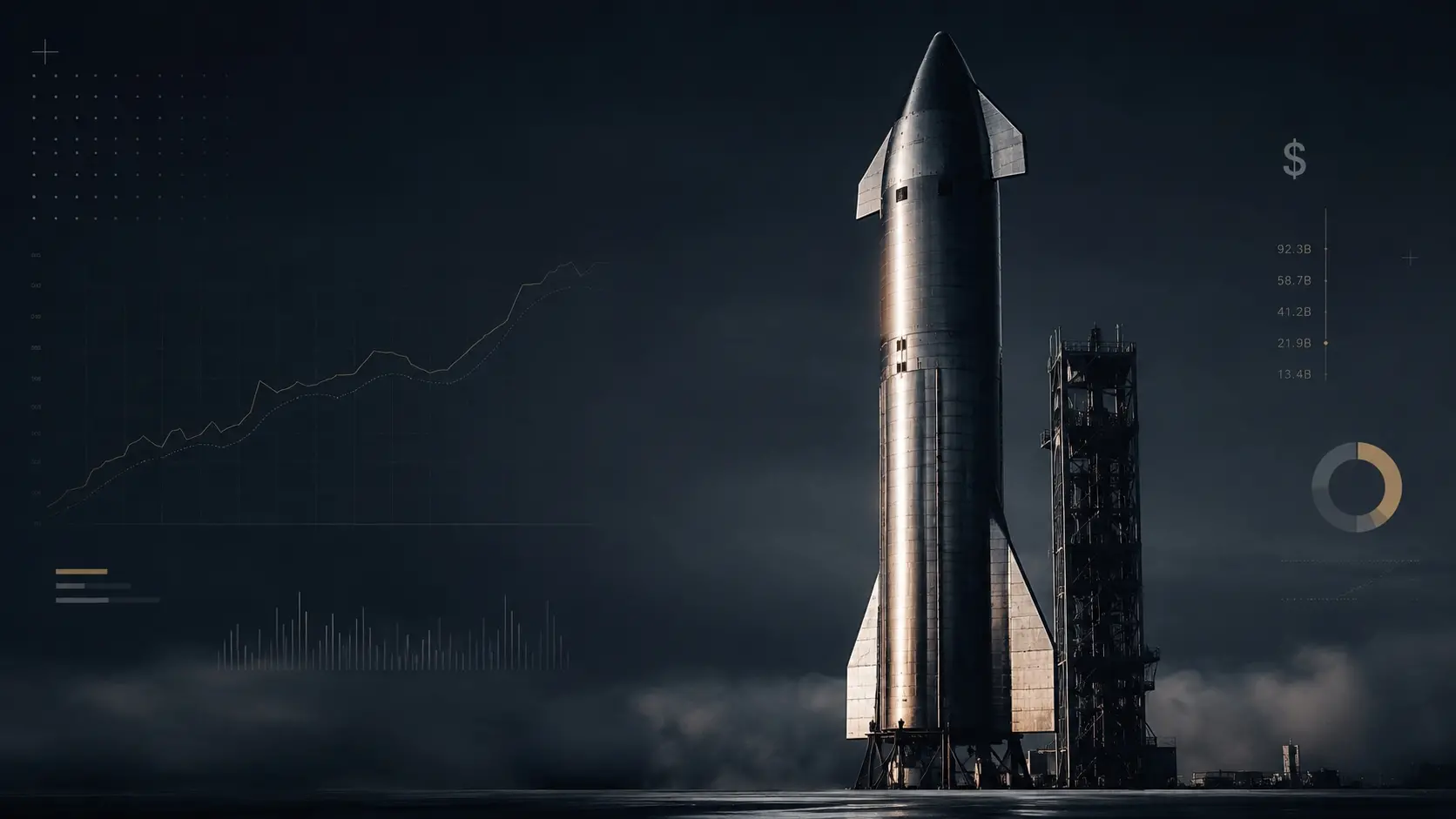
HSBC2026-08-20 08:32:50HSBC says Starlink and Starship are already feeding space-economy gains back into industries on EarthHSBC said in an Aug. 18 cross-sector report that the most urgent value of the space economy is not asteroid mining or Mars colonization, but the way it is already reshaping industries on Earth. The report, led by HSBC Global Equity Research Co-Head Raj Sinha, spans 12 sectors including telecoms, semiconductors, power, industrials, agriculture, insurance and finance. According to the report, SpaceX’s satellite internet business had 10,200 satellites in orbit and 12 million broadband users as of June 30, 2026, covering 167 markets. Another 7.4 million monthly active devices used Direct to Cell service across 30 countries. HSBC argues that satellite connectivity has moved beyond a backup option for remote areas and is becoming default infrastructure in shipping, aviation and trucking. The bank also sees Starlink’s relationship with terrestrial telecom operators as largely complementary, pointing to deals with T-Mobile, KDDI and Airtel Africa. HSBC also highlighted launch economics. Falcon 9 low-earth-orbit launch costs were cited at $2,940 per kilogram, Falcon Heavy at $1,520, while Starship is targeting $100 to $300 per kilogram. The bank said those cost declines are forcing a rethink of satellite manufacturing, orbital data centers and asteroid-mining models. In HSBC’s view, power, semiconductors and robotics are the three sectors seeing the clearest and most immediate impact.570
Musk2026-08-08 00:04:16Musk Says Starship Recovery After 13th Test Flight Not Looking OptimisticElon Musk said the recovery of the Starship spacecraft after its 13th test flight is not looking optimistic, according to a report by Odaily Planet Daily citing Jinshi. Still, close-up photos of the heat shield and key engine regions have been obtained, and those images are expected to support future upgrades.1880
SpaceX2026-08-06 09:57:08Bernstein Keeps $239 Target on SpaceX After First Public Earnings, With AI Pricing and Starship Execution at the CenterSpaceX’s first quarterly report as a public company gave investors a sharper look at what is driving the stock — and what is still holding it back. The company reported $7.814 billion in second-quarter revenue, up 92% from a year earlier, beating consensus estimates cited by both S&P Visible Alpha and Bernstein. Diluted loss per share came in at $0.09, better than the expected $0.24 loss, while combined operating loss across its three business segments narrowed to $143 million. Bernstein kept its Outperform rating and $239 price target after the August 4 results, implying roughly 91% upside based on the stock’s $125.33 close that day. But the firm’s valuation is not built on Elon Musk’s full vision. Bernstein still models 2031 revenue at $554 billion, well below management’s $1 trillion target, and assumes long-term AI compute pricing falls back to about $10 per watt rather than the $30 to $50 per watt range Musk referenced. The report argues that SpaceX’s investment case rests on three separate pillars. Connectivity, led by Starlink, supplies the current profit base. AI compute drives revenue upside but requires heavy capital spending. Starship determines whether long-term scale can be achieved at meaningfully lower cost through full reusability. Those questions remained in focus as the stock fell to $108.27 on August 5, down 13.6% in a single session.1980
Elon Musk2026-08-06 05:54:13Musk Says SpaceX Solved Heat Shield Issue, Plans Daily Starship LaunchesElon Musk told investors on Aug. 4 that SpaceX has resolved the heat shield issue on its Starship and plans to launch daily within the next 12 months. The next test flight is expected in late August. Heat shield tiles, long an engineering bottleneck, protect the spacecraft during reentry. Daily launches would accelerate Starlink V3 deployment and bring challenges to the DePIN sector, though regulatory approval and infrastructure work remain hurdles.1860
SpaceX2026-08-05 02:48:27SpaceX’s First Post-IPO Earnings Top Estimates as Starlink Carries Profit, AI Losses NarrowSpaceX reported its first quarterly results since listing, and the headline numbers came in well ahead of market expectations. For the quarter ended June 30, 2026, revenue rose 92% year over year to about $7.8 billion, while adjusted EBITDA climbed roughly 192% to $3.5 billion. Net loss narrowed to about $541 million from around $1 billion a year earlier. Starlink remained the company’s main earnings engine, with the connectivity segment posting $4.29 billion in revenue and $1.66 billion in operating profit as users doubled to 12 million. The AI unit delivered one of the quarter’s biggest surprises. Revenue jumped about 247% to $2.56 billion, and operating loss narrowed to $1.26 billion, much lower than analysts had expected. Even so, AI spending stayed elevated. The company said AI capital expenditures were about $15.8 billion in the quarter, above expectations, and executives told investors that total capex in the third and fourth quarters would stay roughly in line with the second quarter. SpaceX also highlighted more than $6 billion in multi-year U.S. government contracts tied to Starshield, underscoring the growing weight of defense-related demand. Still, the stock failed to hold gains after the report. Shares had closed up 9.4% before earnings, then swung lower in after-hours trading and were at one point down nearly 9%, as investors focused on valuation, lock-up concerns, persistent losses outside Starlink, and the company’s still-heavy cash burn.2820
Elon Musk2026-08-04 21:30:41Musk says Starship could safely carry humans by the end of 2027According to a ChainCatcher newsflash citing Jinshi, Elon Musk said Starship is expected to be able to safely carry humans by the end of 2027. The brief item did not include additional details beyond that timeline estimate.1770
SpaceX2026-08-04 14:05:52SpaceX earnings debut puts Starship timeline ahead of near-term lossesSpaceX is set to release its first quarterly earnings report since going public at 04:00 Beijing time on Wednesday, after the U.S. market close on Tuesday. Consensus estimates compiled by Bloomberg point to an operating loss of about $1.6 billion for the quarter and roughly $18 billion in capital expenditures, with the newly formed AI unit — created after Elon Musk folded xAI into SpaceX — expected to post a $2.4 billion operating loss in the second quarter. Starlink remains the company’s only profitable business. The stock has also come under pressure since its June 12 IPO. Shares were priced at $135, climbed to $201.80 by the third trading day, and briefly pushed SpaceX to a $1.5 trillion valuation. By Monday’s close, the stock had fallen to $114.46, more than 15% below the offer price. Lockup expirations for early investors and insiders begin on Thursday and could add another layer of pressure. Still, analysts cited in the report argue that the quarter’s profit and loss figures say little about SpaceX’s long-term value at this stage. The real question is when Starship can move into commercial service, achieve full reusability, and support missions tied to NASA’s Artemis III program. That timetable, rather than one quarter’s earnings swing, is seen as the clearest guide for investors.1820
SpaceX2026-08-04 12:11:00SpaceX heads into its first quarterly report with AI spending, Starlink growth and lockup expirations in focusSpaceX is set to release its first quarterly earnings report as a public company after the U.S. stock market closes on Aug. 4, giving investors their first detailed look at how its three main growth pillars are developing: AI infrastructure, Starlink and launch operations. Ahead of the release, the stock has been volatile, falling to an intraday low of $104.83 on Monday before rebounding 5.7% to close at $114.53. With the company valued at about $1.4 trillion, the central question is not just near-term profit, but whether management can show that its long-range growth case is starting to translate into revenue. Investors are expected to focus on xAI’s heavy spending after its February merger with SpaceX, including whether data center construction and compute leasing are generating meaningful income. Starlink, already SpaceX’s most established commercial business, will be watched for user growth, ARPU trends and enterprise and government demand. The report also arrives days before a large share unlock, with about 912 million shares set to come off lockup on Aug. 6 and another 319 million a week later, adding a trading overhang to an already closely watched earnings event.2130