Kevin Hassett2026-10-02 13:57:58Hassett says U.S. does not want to inflate away debt, calls current interest burden unacceptableKevin Hassett, director of the White House National Economic Council, said the United States does not want to reduce its debt burden through inflation and described the current level of interest payments as unacceptable. He said the president is taking deficit reduction seriously. Hassett also said Warsh still has to deal with the situation left by Powell, calling it highly unusual. On rates, he said the rise in U.S. Treasury yields reflects a strong economy, while adding that he respects the Federal Reserve’s independence. He also pointed to strong U.S. consumer data and said holiday-season spending is expected to remain solid. The remarks were carried by Jin10 and reposted by BlockBeats.60
Bitcoin2026-10-02 12:58:25Bitcoin climbs to $86,757 as cooler inflation and ETF inflows kick off “Uptober”Bitcoin rose to $86,757 on Friday, gaining 3% over 24 hours and 2% on the week, after a September that broke the month’s long-standing weak reputation. The move followed softer-than-expected U.S. inflation data, with August core PCE at 3.0% versus a 3.3% forecast, pushing markets toward a view that the Federal Reserve will hold rates at its Oct. 28 meeting. CME FedWatch showed a 74% chance of no change, up from 35.8% a week earlier, while Myriad priced the odds at 75%. Analysts cited a mix of macro repricing, short covering, and continued spot Bitcoin ETF demand. SoSoValue data showed spot Bitcoin ETFs pulled in $2.65 billion in September and $6.34 billion in the third quarter, with net assets at $109.3 billion. At the same time, labor data sent mixed signals: jobless claims and ADP payrolls looked firm, but September nonfarm payrolls rose only 29,000, below forecasts of about 90,000, and unemployment edged up to 4.2%. Market participants now turn to the Sept. CPI report due Oct. 14, while analysts remain split on whether Bitcoin’s latest advance is being driven by leverage or by longer-term allocation flows.30
Bitcoin2026-10-02 10:15:24QCP says fund flows pushed Bitcoin to its highest level since Sept. 23Bitcoin climbed out of its recent range to $86,913, its highest level since Sept. 23, according to a market note cited by Odaily that attributed the move to concentrated capital inflows rather than a shift in inflation expectations. QCP said the token is up 14.6% from its Sept. 15 low. The firm placed the rally alongside a sharp move in U.S. Treasury yields. The 30-year Treasury yield reached 5.62%, while the 10-year yield at one point rose to 5.29%. In September, real rates increased by 44 basis points, while breakeven inflation was largely unchanged, QCP said. Across major assets, gold fell 8.5% during the same period, while Bitcoin rose 12%. QCP argued that the latest advance was driven by concentrated fund flows, pointing to spot ETF inflows of $3.5 billion in August and $2.6 billion in September.40
Bitcoin2026-10-02 05:22:48Bitcoin climbs above $86,500 ahead of U.S. payrolls as October Fed hike odds fall to 25%Bitcoin rose sharply ahead of the U.S. September nonfarm payrolls report, with BTC trading around $86,560 at midday in Asia on Oct. 2 after touching an intraday high of $86,794. The move marked a rebound of more than 4% from the day’s low near $83,200 and pushed the asset back toward the $87,000 resistance area. According to a Reuters survey, economists expect U.S. nonfarm payrolls to increase by about 90,000 in September, down from 162,000 in August, while the unemployment rate is seen holding at 4.1% and average hourly earnings rising about 3.2% year over year. Reuters also reported that traders now price only a 25% chance of another Federal Reserve rate hike at the Oct. 27-28 meeting, down from roughly 70% a week earlier. Even so, U.S. 10-year Treasury yields remain elevated near 5.25% after earlier reaching 5.34%, a level Reuters said was the highest since 2002. That leaves the payrolls release as a key test of whether Bitcoin can hold above $85,000 after its latest surge.30
Bitcoin2026-10-02 01:33:33Bitcoin rebounds to $84,750 as Ether holds $2,707, with $187.83 million in liquidationsCrypto markets staged a modest rebound on the first trading day of October, with Bitcoin rising from a 24-hour low of $83,510 to $84,750 and Ether holding at $2,707. CoinGlass data showed total liquidations across the market reached $187.83 million over the past 24 hours, affecting 65,813 traders. Long positions accounted for $104.35 million, while short liquidations came in at $83.48 million. The largest single liquidation was a $3.13 million ZEC-USD trade on Hyperliquid. The move came as broader macro pressure remained in focus. The U.S. 10-year Treasury yield climbed to 5.342% intraday on Oct. 1, its highest level since April 2002, before easing after Federal Reserve Vice Chair Philip Jefferson suggested rate hikes could be paused. Brent crude also moved above $100, while WTI rose past $91. At the same time, the Crypto Fear and Greed Index fell to 72 from 74 a day earlier, showing greed was still present but had started to cool.40
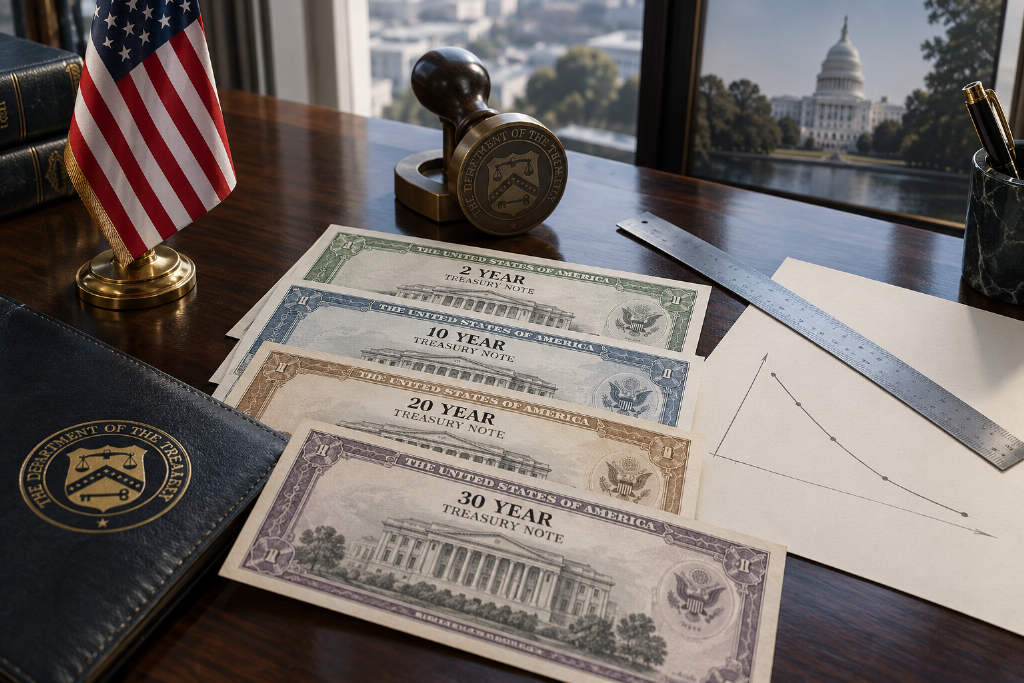
US Treasury2026-10-01 15:27:44US Treasury yields fall intraday, led by the 2-year noteUS Treasury yields moved lower during the day, according to ChainCatcher. The 2-year Treasury yield posted the biggest decline among the tenors mentioned, falling 7.28 basis points to 4.814%. The 10-year yield also edged lower, dropping 2.07 basis points to 5.272%. Longer-dated maturities showed smaller moves. The 20-year Treasury yield fell 1.19 basis points to 5.674%, while the 30-year yield slipped 0.58 basis points to 5.633%. The update covers four key points on the US Treasury curve — 2-year, 10-year, 20-year, and 30-year maturities — and shows all of them trading lower on the day.40
US Treasuries2026-10-01 10:10:00US 10-year Treasury yield climbs to its highest level since 2002 as global bond sell-off deepensA broad sell-off in sovereign debt markets intensified on Oct. 1, pushing US Treasury yields to multi-decade highs and lifting borrowing costs across major economies. Citing LSEG data, CNBC reported that the US 10-year Treasury yield rose 4 basis points to 5.3338%, its highest level since April 2002. The 30-year yield added 3 basis points to 5.6702%, the highest since July 2002, while the 2-year yield rose 2 basis points to 4.91%. The move was not limited to the US. Japan’s 10-year government bond yield reached 3.126%, a 30-year high, while Germany’s 10-year yield rose 4 basis points to 3.6179%, the highest since 2008. France, Italy and the UK also saw yields move higher. CNBC said investors were worried that governments had not dealt with fiscal deficits, while inflation remained elevated and rates continued to rise. The Institute of International Finance, or IIF, said last week that major economies face large long-term deficits and rising interest costs. CNBC also linked bond-market swings to oil. International crude prices rose on Oct. 1, with Brent crude returning to $100 a barrel. Prinsights Global founder Nomi Prins said on CNBC that moves in long-dated yields were partly being driven by oil and inflation.20
China stocks2026-10-01 03:20:50China AI hardware stocks post worst quarter as STAR 50 drops 30% despite profit surgeChina’s AI hardware names suffered their sharpest quarterly selloff even as earnings growth stayed strong. The STAR 50 Index fell 30.70% in the third quarter and the ChiNext Index lost 27.80%, both marking their biggest quarterly declines on record. The reversal came after a strong first half, when the STAR 50 had gained 64.25% and AI chip designer Cambricon briefly became the first STAR Market company to top a 1 trillion yuan valuation. The shift, according to comments cited from CEIBS Fund to Yicai, was a move away from valuation expansion and toward earnings verification. That change hit even though Shanghai Stock Exchange data showed STAR Market companies posted 144.887 billion yuan in net profit in the first half, up 437.6% year over year, while official statistics showed profits in China’s electronics industry rose 1.1 times in the first eight months. The report also pointed to pressure from higher U.S. rates and trade restrictions. Reuters reported on Aug. 5 that the Trump administration was drafting a ban on imports of new Chinese-made optical transceiver modules. At the same time, capital inside China’s A-share market rotated toward banks and other financial stocks, while some fund managers said the fourth quarter would test which AI companies have real growth and which do not.40