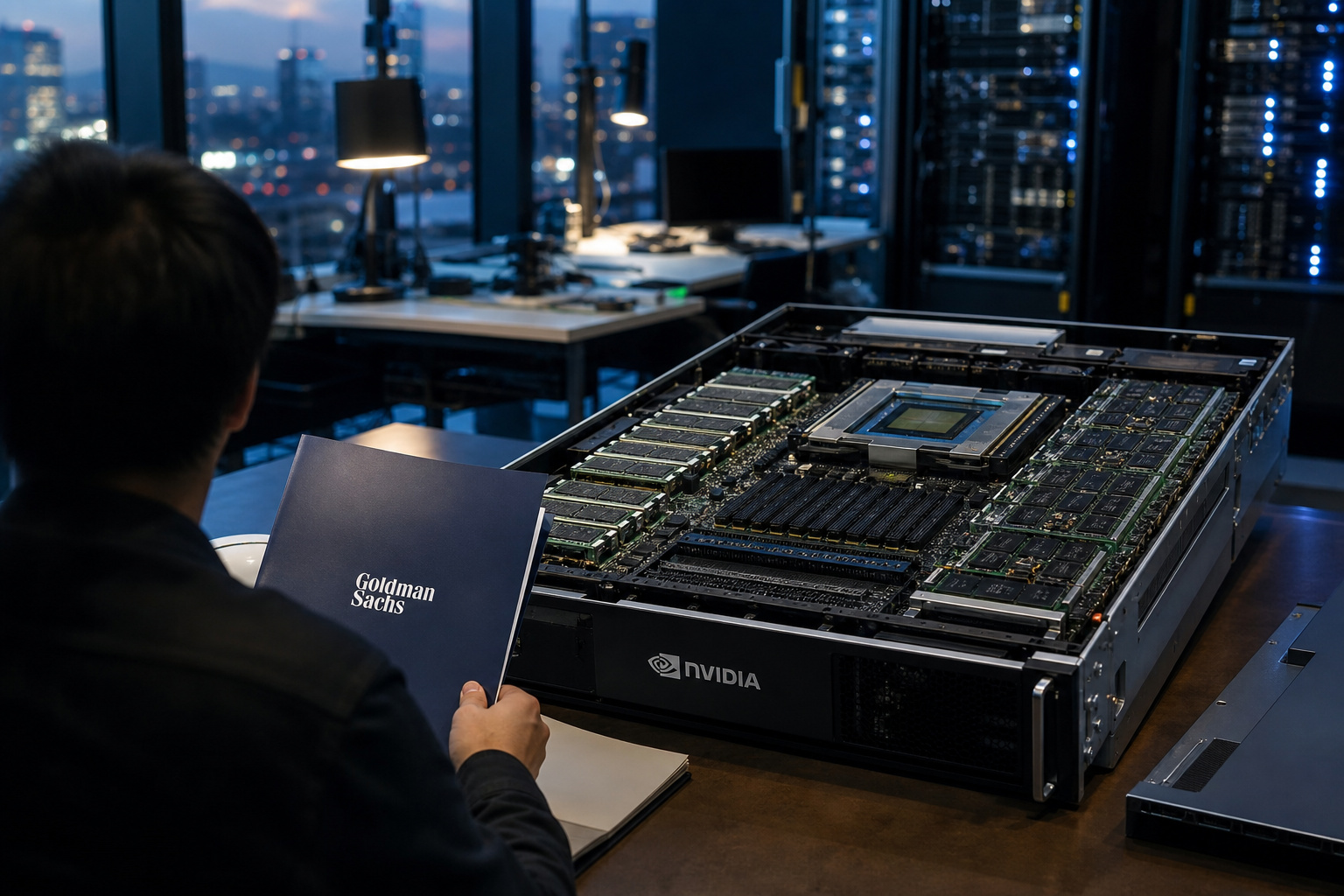
Goldman Sachs2026-08-10 15:34:00Goldman Sachs says memory could account for about 62% of Nvidia Vera Rubin BOMGoldman Sachs said in a report dated Aug. 10 that memory components are expected to make up about 62% of the bill of materials for Nvidia’s next-generation Vera Rubin superchip. Citing Goldman’s analysis, ZeroHedge said the cost share of SOCAMM2 memory modules on the CPU side of the Vera Rubin platform is notably higher than that of HBM4 high-bandwidth memory on the GPU side. Goldman had already noted in May that as demand for AI infrastructure keeps rising, memory is becoming a key part of the hardware cost structure for AI servers. The latest note adds to that view by pointing to the growing weight of high-performance memory in next-generation AI computing platforms and the rising importance of the memory segment across the AI chip supply chain.1930
SK Hynix2026-08-08 07:09:13Rumor in South Korea links SK Hynix HBM4 pricing and yield issues to Nvidia supply talksA market rumor circulating in South Korea has put SK Hynix, Nvidia, HBM4 pricing, and the SK Group’s data center ambitions in the same conversation, but none of the claims have been confirmed by the companies involved. The post appeared by the evening of Aug. 6 on DCInside’s “Short Position” board and was explicitly labeled as a “Yeouido jirashi,” a term used for unverified talk that spreads in Korea’s securities circles. According to the post, SK Hynix is supplying HBM3E to Nvidia under annual fixed pricing at relatively low levels, while rival suppliers may raise HBM4 quotes to Nvidia by more than 80% next year. SK Hynix, the rumor says, may only secure an increase of about 50%. The most sensitive claim goes further, alleging that defects in SK Hynix’s HBM4 have delayed Nvidia’s Vera Rubin launch. The same post also says the SK Group may have accepted weaker pricing leverage at the memory unit level in exchange for priority access to Nvidia GPUs for its data center business. It adds a detailed and highly dramatic account of how the information supposedly spread, including references to an SK Hynix salesperson, a former company analyst, and fund managers. As of now, SK Hynix and Nvidia have not verified any part of the story.2060
SpaceX2026-08-05 00:24:37Musk says SpaceX will run future AI services exclusively on Nvidia systemsSpaceX CEO Elon Musk said on the company’s first earnings call that future SpaceX AI services will run exclusively on Nvidia systems. Musk said the company views Nvidia’s Vera Rubin architecture as the best option for AI computing. SpaceX expects its computing capacity to exceed 2 gigawatts by the end of this year and rise to nearly 10 gigawatts by the end of next year. The company also plans to deploy Nvidia Vera Rubin NVL72 rack-scale systems on the ground and in space, with those systems tied to the Starmind satellite project. Musk said the related satellites are expected to begin launching next year. The remarks outline both the vendor choice for SpaceX’s AI stack and the scale of the computing buildout the company is targeting over the next roughly 18 months.1780
Nvidia2026-08-02 13:44:12Nvidia Rubin cutback talk centers on Ultra, while Vera Rubin NVL72 is already shipping to dozens of customersMarket discussion around a supposed Nvidia Rubin HBM downgrade does not apply to the standard Vera Rubin NVL72 systems that are already being delivered, according to a clarification posted by analyst qinbafrank on Aug. 2. The uncertainty instead concerns Rubin Ultra, the upgraded version originally slated for the second half of 2027, whose final configuration has yet to be locked in. The post said Vera Rubin is moving ahead smoothly. Dell delivered the first NVL72 systems to CoreWeave in early June and completed what was described as the industry’s first full boot validation. By July, dozens of customers had received test racks or early shipments, including Microsoft, OpenAI, Anthropic, Google Cloud, Oracle, Nebius and SpaceX AI, with some units already running in customer data centers. Larger-volume deliveries are expected to begin in the fall, and the overall schedule was described as running ahead of Blackwell, with rack assembly time cut to roughly five minutes. The debate is focused on Rubin Ultra. A configuration shown at GTC 2026 called for four compute dies near reticle limits and 16 HBM4E stacks for roughly 1 TB of memory in a single package. Reports from SemiAnalysis and others in late June questioned that design, citing TSMC CoWoS-L substrate warping, reticle-size constraints and yield challenges. TrendForce later said the HBM specification still had not been finalized.2290
Nvidia2026-07-28 11:18:51Nvidia backs SSI in strategic deal tied to Vera Rubin compute platformNvidia said on July 27 that it has entered a long-term strategic partnership with Safe Superintelligence (SSI), the AI company co-founded by former OpenAI chief scientist Ilya Sutskever, and made what it called a “substantial investment” in the startup. The company did not disclose the size of the deal, but Bloomberg reported it was worth about $5 billion, while a source cited by TechCrunch said Nvidia’s investment ran into the billions of dollars. According to PitchBook data cited by TechCrunch, SSI has raised about $7 billion to date and is valued at $32 billion post-money, with backers including Andreessen Horowitz, Alphabet, Lightspeed, GV and Sequoia. The partnership is also designed to expand SSI’s access to computing power. Nvidia said SSI will be able to use its next-generation Vera Rubin computing platform, a move the company said would increase SSI’s compute resources by roughly an order of magnitude, or close to 10x. Sutskever said the company now has research worth scaling, while Nvidia CEO Jensen Huang said he was eager to see what breakthroughs SSI could make on the new platform.1910
Nvidia2026-07-25 01:02:07Nvidia plans AI partnership with South Korea’s SK Group valued at more than $500 billionNvidia said Friday it plans to work with South Korea’s SK Group on an AI initiative valued at more than $500 billion, covering large-scale AI data center construction and next-generation memory technology. The plan includes a long-term partnership with SK hynix designed to secure Nvidia’s access to next-generation memory supply. The two sides also aim to jointly develop high-bandwidth memory, or HBM, for AI training, AI agents, and physical AI applications. Separately, SK Telecom plans to build an AI data center with installed capacity of 2 gigawatts. The facility is set to use Nvidia’s Vera Rubin chips alongside SK hynix’s HBM4 memory. The first facility is expected to begin operations in 2027, according to the announcement cited by BlockBeats. The statement ties chip supply, memory development, and data center buildout into one broader AI push between Nvidia and companies under the SK Group umbrella.1850
NVIDIA2026-07-22 13:25:13Jensen Huang Unveils Token Economics as Nvidia Starts Full Vera Rubin ProductionAt GTC Taipei 2026, Jensen Huang said AI data centers are shifting from hardware sales to monetized compute. Nvidia also said Vera Rubin is now in full production, with Groq-backed inference pushing 1GW annual revenue estimates to $300 billion.470
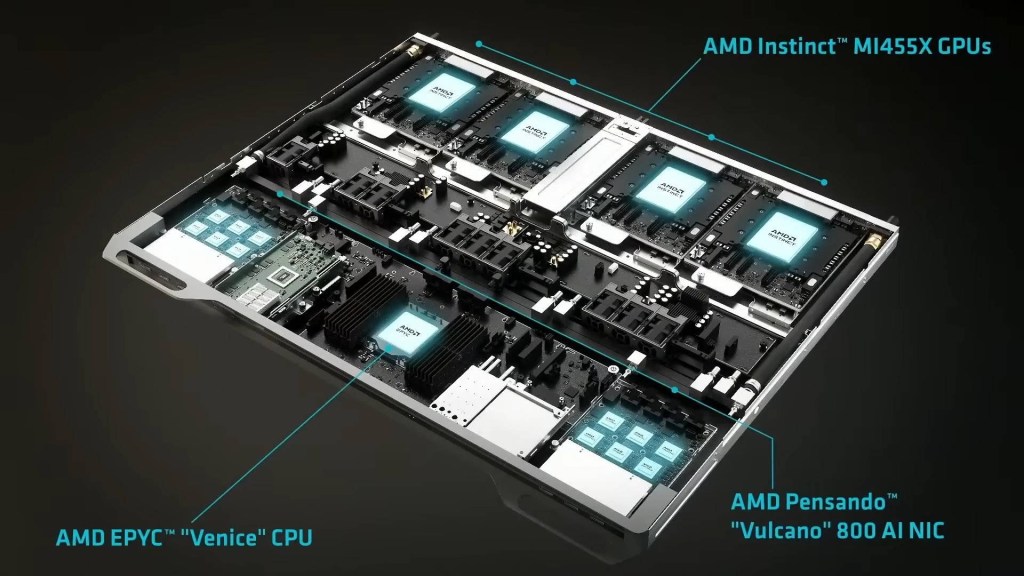
AMD2026-07-22 07:32:58AMD Helios rack is reportedly priced about 40% above Nvidia Vera Rubin, with Microsoft Azure as first buyerAdvanced Micro Devices is no longer being framed as the low-cost alternative in AI infrastructure. Citing a new report from research firm Futurum, Wccftech said AMD’s Helios AI rack is expected to sell for $5 million to $5.5 million per rack, compared with an estimated $3.5 million to $4 million for Nvidia’s second-generation Vera Rubin rack. That puts Helios roughly 40% higher on price, though the figure is based on bill-of-materials analysis rather than an official AMD quote. Helios is AMD’s first rack-scale, full-stack system built for AI workloads. It combines the Instinct MI455X GPU, sixth-generation EPYC Venice CPUs, Pensando Vulcano 800 AI NICs, Salina DPUs, Infinity Fabric interconnect and the ROCm software platform in one architecture. On specs, Nvidia’s Vera Rubin leads in FP4 compute and HBM4 bandwidth, while AMD leads in FP8 compute and memory capacity, with 432 GB of HBM4 versus Rubin’s 288 GB. Microsoft has confirmed it will deploy Helios in Azure AI services. OpenAI, Meta, Oracle, Celestica, Nutanix and the U.S. Department of Energy were also listed as customers, giving AMD an early roster across cloud, enterprise IT and government.1930