Policy Regula2026-08-29 20:39:52ICBA opposes CLARITY Act, says stablecoins could drain bank depositsThe Independent Community Bankers of America, which represents about 5,000 U.S. community banks, is opposing the Digital Asset Market Clarity Act, or CLARITY Act, according to ChainCatcher. ICBA President and CEO Rebeca Romero Rainey said what she described as a loophole tied to stablecoin rewards must be fully closed, adding that there is no middle ground on the issue. The group argues that stablecoins could pull $1.3 trillion in deposits out of the banking system and reduce local lending by $850 billion. ICBA has also pushed Republican senators Josh Hawley and Jerry Moran to oppose the bill in its current form. Romero Rainey said there is no sign that crypto would replace those deposits and send them back into local communities. She also criticized a White House Council of Economic Advisers report titled “The Effect of Prohibiting Stablecoin Yield on Bank Lending,” saying it downplayed banks’ concerns about deposit outflows. The Senate is scheduled to vote on the CLARITY Act on Sept. 15. If the bill fails to secure at least 60 votes, it will not move to the next stage of consideration and could stall for the foreseeable future.1020
Policy Regula2026-08-29 20:39:36ICBA opposes CLARITY Act and calls for a full ban on stablecoin rewardsThe Independent Community Bankers of America, which represents about 5,000 U.S. community banks, is pushing back against the Digital Asset Market Clarity Act, or CLARITY Act. ICBA President and CEO Rebeca Romero Rainey said loopholes tied to stablecoin rewards should be closed completely, with no compromise. The group argues that stablecoins could pull as much as $1.3 trillion in deposits out of the banking system and reduce local lending by $850 billion. ICBA also said it helped persuade Republican Senators Josh Hawley and Jerry Moran to oppose the current version of the bill. Rainey added that there is no sign crypto would replace those deposits in a way that sends money back into local communities. She also criticized a Council of Economic Advisers report titled Impact of Stablecoin Yield Ban on Bank Lending, saying it downplayed banks’ concerns about deposit outflows. The Senate is scheduled to vote on the CLARITY Act on Sept. 15. If the bill fails to win at least 60 votes, it will not move to the next stage of consideration and could stall for the foreseeable future, according to Bitcoin.com News.1030
Avalanche2026-08-27 22:30:43Delphi Digital says Avalanche could help community banks reach institutional capitalTechub News, citing a post from @Delphi_Digital, reported that Avalanche may offer a path for community banks to access institutional capital. The analysis argues that loan securitization is currently expensive, with a single transaction often needing to exceed $500 million to be economically viable. That leaves smaller loan portfolios with few practical options. According to the same view, the structure of traditional loan securitization creates a high entry barrier for community banks seeking links to institutional investors. If a blockchain network can reduce issuance costs while improving transparency, it could open a new liquidity route for small and mid-sized loan portfolios. The post also framed that possibility as a potential expansion point for real-world asset, or RWA, use cases.1160
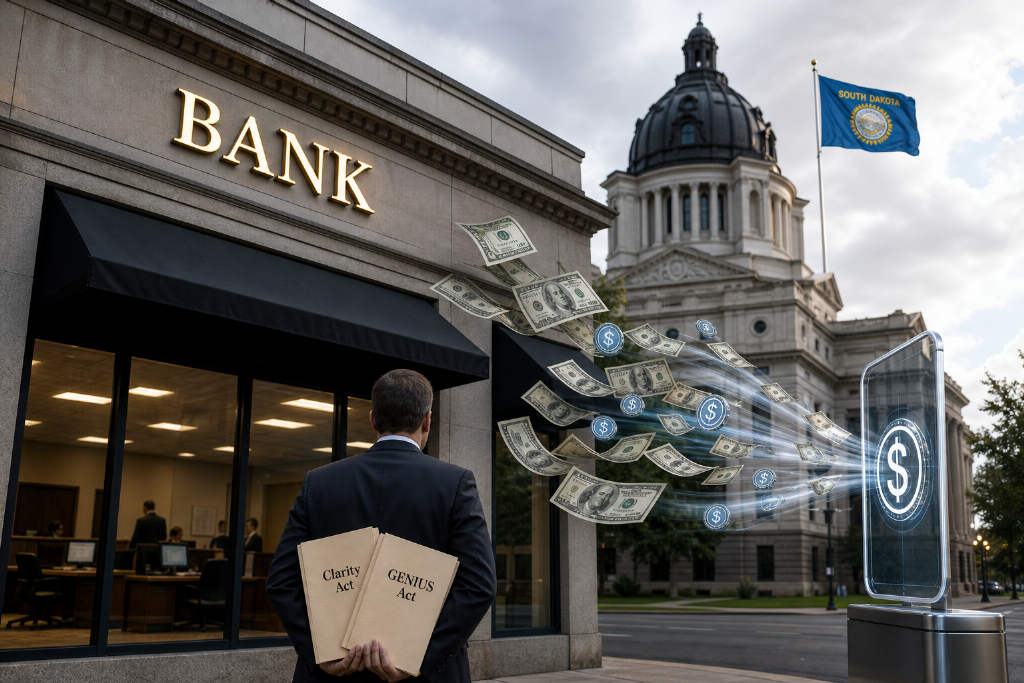
Policy and Re2026-08-27 12:51:10South Dakota community banker says Clarity Act yield language could drain deposits and cut lendingA South Dakota community banking professional has publicly pushed back against the Blockchain Association over stablecoin legislation, warning that the Clarity Act could pull deposits away from local banks if its yield language remains unchanged. In a CoinDesk opinion piece, Nate Franzén argued that community banks are not disputing whether stablecoin reserves stay somewhere in the financial system. His concern is that money leaving small local banks for stablecoin wallets no longer supports lending in those communities. Franzén said South Dakota community banks hold roughly $47 billion in local deposits. Citing a conservative estimate from the American Bankers Association, he wrote that as much as $4.7 billion could be drawn into stablecoins if Congress does not impose reasonable limits, reducing lending capacity by up to $3.7 billion. He argued that this matters in a state tied closely to agriculture, ranching, and small businesses. The dispute centers on a gap between two bills. Franzén said the House version of the GENIUS Act clearly bars stablecoin issuers from paying interest, while the Senate version of the Clarity Act uses broader yield language that could still allow exchanges or wallet providers to offer rewards resembling interest. He said stablecoins should remain payment tools, not become deposit substitutes built around yield.1010
policy regula2026-08-27 12:30:00Community banker says Clarity Act stablecoin rewards language could hurt local banksA CoinDesk opinion piece published on Aug. 27 argues that language on stablecoin rewards in the Clarity Act could leave Main Street community banks at a disadvantage. The piece cites community banker Nate Franzén, who said Blockchain Association executive Summer Mersinger downplayed the potential harm to local banks while defending the bill’s stablecoin rewards provision. The article frames the dispute around how the legislation may affect smaller banking institutions rather than larger financial players, with Franzén directly challenging Mersinger’s defense of the measure. The source material does not provide further detail on the specific wording of the provision or any additional policy timeline.1000
stablecoins2026-08-26 17:41:34Study says stablecoin rewards did not drive deposit losses at U.S. community banksResearch cited by Techub says stablecoin reward programs did not cause deposit outflows from U.S. community banks, pushing back on claims from the American Bankers Association. Data from June 2019 to March 2026 showed community bank deposits rose by $482 billion, or 26%, during the same period when platforms including Coinbase offered stablecoin rewards. Charles River Associates found no significant relationship between stablecoin activity and declines in bank deposits. A White House analysis also suggested that even a full ban on stablecoin rewards would lift traditional lending by only 0.02%, or about $2.1 billion, with most of that increase going to large banks. On the legislative side, the GENIUS Act allows third-party platforms to offer rewards, while the CLARITY Act seeks to restrict that channel.980
stablecoins2026-07-23 16:25:16US Banking Groups Challenge White House Stablecoin Yield Analysis Over Deposit RisksUS banking groups say the White House focused on the wrong policy question in its stablecoin yield analysis, arguing the bigger risk is deposit migration if yield-bearing stablecoins scale.2040
USHCC2026-07-23 14:19:53USHCC tells Senate leaders Clarity Act could speed up deposit outflowsThe U.S. Hispanic Chamber of Commerce, or USHCC, sent a letter to Senate leadership this week saying it shares community banks’ concerns that the Clarity Act could accelerate deposit outflows, according to a post on X by a Fox Business crypto reporter. The group, which says it represents millions of Hispanic-owned businesses in the United States, argued that the bill could reduce lending to Hispanic small businesses. It also said the measure could weaken investment in underserved communities. The update points to a widening policy debate around the proposed legislation, with business and banking groups raising concerns about how the bill could affect credit access and local capital flows.1800