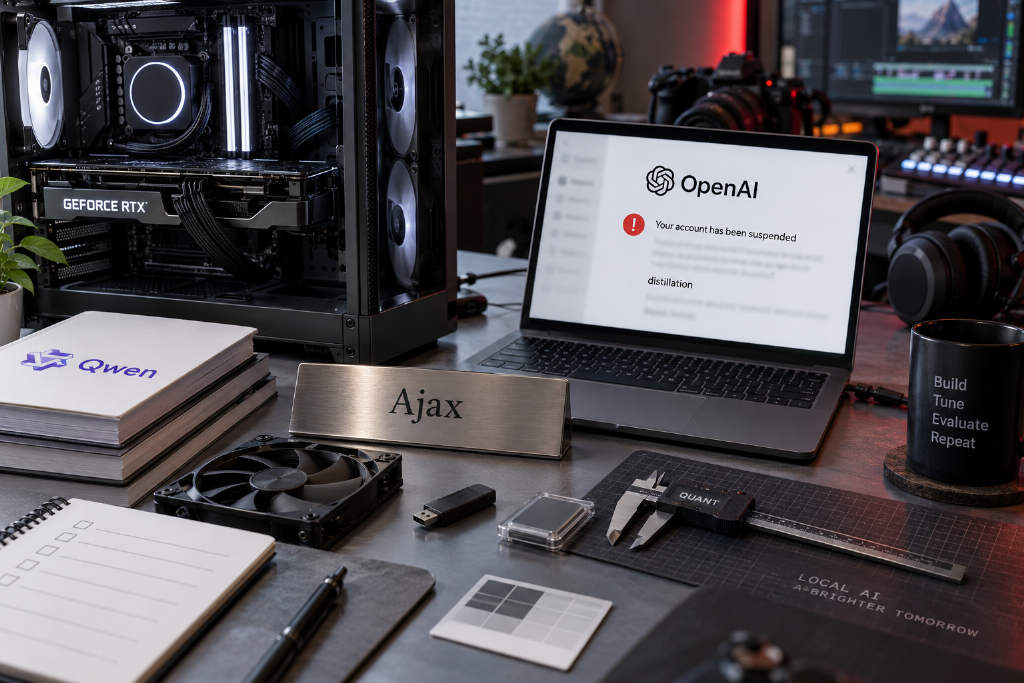
PewDiePie2026-10-03 05:05:39PewDiePie says OpenAI banned him twice while building Ajax, a local AI model based on Qwen3.5-9BYouTuber PewDiePie has unveiled Ajax, a self-made AI model he describes as uncensored and capable of running on a home computer. According to Tom’s Hardware, the model was fine-tuned from Alibaba’s Qwen3.5-9B and built for his AI workspace, Odysseus, which he introduced in May. In a newly released video, PewDiePie said OpenAI banned two of his accounts during development. One email he showed reportedly listed the reason as “distillation.” He said the first account was later restored, while the second ban came after he ran a model again to create seed data for training. Ajax’s introduction page says the model can handle daily tasks such as search, web browsing, email, and calendar functions, and that it is fully private. The page also says refusal settings were removed to create a less restricted experience, while asking users to act responsibly. PewDiePie said, following legal advice, that Ajax was not designed to provide dangerous actionable instructions. He also said the next version of Ajax still needs two more days of reinforcement learning, followed by another round of de-censorship, quantization, and evaluation.520
Meta2026-08-11 03:30:00Zuckerberg’s AI manifesto backs distillation, warns concentration is the bigger threatMeta CEO Mark Zuckerberg published a lengthy essay on Aug. 10 titled "The Future is for Everyone" and paired it with the open release of Muse Glimmer, a 30 billion-parameter agent model under the Apache 2.0 license. The message was clear even without naming names: Meta wants to frame open models as a safeguard against concentrated AI power, while casting closed ecosystems as a path toward monopoly. The essay rests on three ideas. Zuckerberg argues that broad access to advanced AI gives individuals more leverage, that invention matters more than pure labor replacement, and that safety comes from competing labs checking one another rather than from one company controlling frontier systems. He also defends distillation, saying people should be free to learn from what they can observe, a line widely read as a challenge to efforts to restrict model outputs from being used to train rivals. The essay also leaves room for limits. Zuckerberg says the benefits of superintelligence should be shared broadly, but adds that Meta will need to be careful about what it open-sources as risks rise. He points to board oversight for release standards, outlines a future built around personal AI agents and a "full private mode," and adds a $1 billion community fund tied to data center investment.530
Anthropic2026-07-28 02:36:42Anthropic CEO says company never pushed to ban open-weight AI models, flags drone training systems as a bigger riskAnthropic CEO Dario Amodei said in a public statement that the company has never argued for banning open-weight AI models, pushing back against claims that it wants to restrict the category for its own benefit. While he did not directly name Nvidia CEO Jensen Huang, Amodei said he agrees with the view shared by Nvidia and other tech leaders that blocking open-weight models developed overseas would not solve national security concerns on its own. Amodei argued that the more direct response is to keep advanced chips and chipmaking equipment out of China and other authoritarian states. He said the models that deserve the most attention may not be public open-weight systems, but secretly trained AI used for drone training, military applications, surveillance, and repression. He also warned that industrial-scale distillation could let countries build near-frontier model capabilities without large volumes of top-end chips, weakening the effect of existing hardware restrictions. At the same time, Amodei acknowledged that open-weight models can carry higher misuse risks than closed systems because safeguards are harder to apply and weights cannot be pulled back once released. Even so, he said that does not justify a blanket ban on U.S. companies using such models.1990
Moonshot AI2026-07-23 01:12:19Moonshot AI pushes back on White House official’s K3 distillation allegationMoonshot AI has responded after Michael Kratsios, director of the White House Office of Science and Technology Policy, accused the company of referencing Anthropic’s Fable while developing its K3 model and of building a large-scale internal distillation platform. Randy Xia, a member of the Moonshot AI team, disputed the claim by pointing to the timeline cited in the discussion: Fable was released on July 1, while K3 went live on July 15. By that sequence, he said, Moonshot AI would have had to complete model research, distillation, training, and release within 15 days. Xia mocked that implication, saying the team would have set a Guinness World Record by training a brand-new frontier model in such a short window. Kratsios had also alleged that Moonshot AI procured GB300 servers and accessed equipment in Thailand for training. The U.S. side said it supports lawful distillation but opposes the covert industrial use of distillation to steal technology.1910
Meta2026-06-30 19:01:42Meta Internally Restricts Engineers' Use of Claude Code and Codex to Avoid Distillation Trap and Reduce CostsMeta has implemented an internal policy restricting engineers from using external AI coding models such as Claude Code and Codex. The goal is to prevent their outputs from contaminating the training and evaluation data of Meta's in-house AI coding assistant, MetaCode. This avoids the "distillation trap" — inadvertently replicating competitor model capabilities — while also cutting high AI usage costs. The move highlights growing concerns among big tech firms about data isolation and cost control in AI development.620