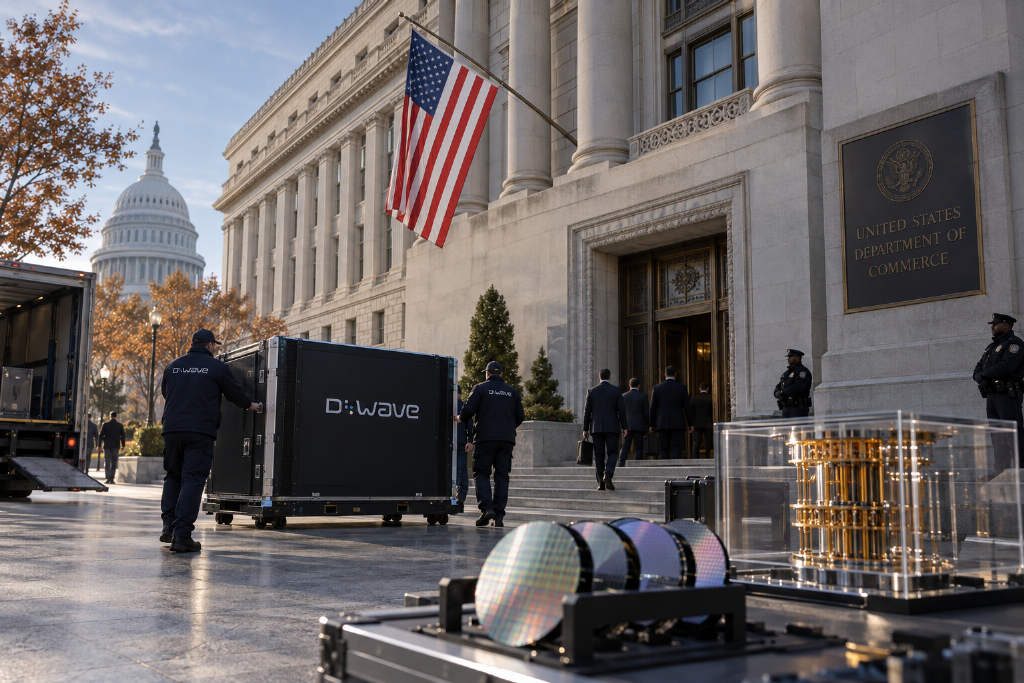
D-Wave2026-09-08 11:37:12D-Wave secures $100 million CHIPS Act funding agreement with U.S. Commerce DepartmentQuantum computing company D-Wave has reached a $100 million funding agreement with the U.S. Department of Commerce under the CHIPS Act, according to Techub, which cited Crypto Briefing. The agreement is intended to support the development of quantum computing technology. The report also said the deal highlights the strategic importance of quantum technology in national security. No additional terms of the funding agreement were disclosed in the source brief. The update was published by Techub as a policy and regulation item.830
G72026-09-04 21:16:04G7 urges early action on quantum threats as crypto networks examine post-quantum upgradesThe G7’s cybersecurity working group is calling on governments and businesses to start preparing now for quantum-enabled cyberattacks, warning that the shift to post-quantum cryptography could take years and that sensitive data may already be exposed to future decryption risks. In a new report, the group said quantum computing poses both security and economic risks to public and private organizations, extending well beyond operators of critical infrastructure. The report does not mention cryptocurrency directly, but the same public-key cryptography underpins blockchain wallets and transaction authorization. That link has kept the issue on the radar for major crypto ecosystems. Bitcoin developers are weighing proposals such as BIP-360, though any major change would require broad agreement across developers, miners, businesses, and users. Ethereum researchers are studying replacements for several cryptographic components, including a proposal to rebuild the deposit contract to handle larger post-quantum keys. Researchers have also said Solana may face a simpler migration path because it uses EdDSA signatures, and the Solana Foundation has already tested post-quantum signatures on a test network while introducing an optional hash-based vault.370
G72026-09-04 21:19:49G7 Warns Quantum Computing Poses Security and Economic Threat, Urges Migration to Post-Quantum CryptographyThe G7 cybersecurity working group has issued a report warning that quantum computing poses both a security and economic threat to public and private institutions. The group urges immediate migration to post-quantum cryptography (PQC), noting that attackers are already collecting encrypted data for future decryption. While not specifically mentioning cryptocurrencies, the report highlights the risk to digital signatures and public-key cryptography, which underpin blockchain wallets and transactions. Ethereum and Solana are already exploring post-quantum solutions.910
G72026-09-04 21:19:13G7 Urges Immediate Migration to Post-Quantum Cryptography; Bitcoin, Ethereum, Solana Test DefensesThe G7 cybersecurity working group has called for organizations to immediately begin migrating to post-quantum cryptography (PQC), warning that quantum computing poses both security and economic threats. Attackers can already harvest encrypted data for future decryption. While the report doesn't mention crypto, blockchain relies on the same public-key cryptography. Bitcoin, Ethereum, and Solana developers are already testing PQC defenses, including BIP-360, cryptographic component replacements, and hash-based vaults on testnet.920
Bitcoin2026-09-04 17:34:53Oxford scholar says quantum memory could decide whether Bitcoin is broken or displacedOxford quantum computing lecturer Stefano Gogioso said progress on quantum memory devices could become a defining milestone for the sector and shape Bitcoin’s long-term fate. In his view, the same class of hardware may determine whether Bitcoin is eventually broken by quantum computers or overtaken by new forms such as quantum money. Gogioso said a viable quantum memory device would need to keep quantum states stable for months, remain portable, and support capacity on the scale of billions of independent states. Current laboratory systems, he said, can preserve quantum states only for seconds. He argued that a fault-tolerant quantum computer must maintain quantum states over long periods, which effectively makes it a quantum memory device in practice. He added that if such hardware is achieved, it could be used both to attack Bitcoin signatures and to support applications such as quantum money. According to his remarks, attacking Bitcoin signatures would require about 500,000 physical qubits. The comments were cited by BeInCrypto and summarized by Techub.730
QuFi Network2026-09-04 17:24:45QuFi Network Launches Post-Quantum Verification Platform, Completes Proof of Concept on Bitcoin TestnetQuFi Network has launched a post-quantum verification platform and completed a proof of concept on the Bitcoin testnet. The platform separates verification from settlement, aiming to cost-effectively address the security threat of quantum computing to crypto assets.760
USDC2026-09-04 04:14:18USDC’s quantum migration problem spans 37 blockchains, and Circle cannot solve it aloneCircle has warned that the quantum resources needed to break mainstream blockchain signature schemes are falling, citing a low-resource record of 813 logical qubits. But the core issue for USDC is not Circle’s own systems alone. According to the company’s current contract documentation, USDC is deployed across 37 mainnets, which means any credible post-quantum migration would also depend on host chains, wallets, custodians, bridges, and end users adopting safer authorization methods. The report argues that the 813-qubit figure is a reference point, not a countdown clock. It reflects improving circuit efficiency, yet does not by itself describe attack depth, error-correction costs, runtime on physical hardware, or when such hardware might exist. It also challenges Circle’s comparison between attack-oriented logical qubits and Google’s Willow, which was described by Google as a 105-qubit processor rather than 105 logical qubits usable for cryptographic attacks. Circle’s Arc stack may help test post-quantum verification, including an SLH-DSA-SHA2-128s precompile, but it does not automatically replace transaction signing across public networks. The article’s conclusion is that USDC’s quantum security will require coordinated changes across 37 independent network paths, not a unilateral switch by the issuer.890
BTQ2026-09-03 19:00:10BTQ Launches Bitcoin Quantum Network, Completes First BIP 360 ImplementationQuantum technology firm BTQ Technologies has launched 'Bitcoin Quantum,' a real-time post-quantum network built on Bitcoin's architecture, and completed the first BIP 360 work implementation. The company also acquired quantum software firm QPerfect, integrating its MIMIQ and QLU technologies into its ecosystem. The move aims to address the potential threat quantum computing poses to Bitcoin's security.840