SEC2026-08-31 08:18:17SEC proposes crypto asset rule with two exemptions and an investment contract safe harborThe U.S. Securities and Exchange Commission released a proposed rule for crypto assets on Aug. 18 under the title Regulation Crypto Assets, according to Techub News. The proposal sets out two registration exemptions and an investment contract safe harbor. One exemption would let startups raise up to $5 million in aggregate over four years. A separate financing exemption would come in two tiers, at $20 million and $75 million. The draft stems from the Project Crypto modernization initiative launched in July 2025 and follows the crypto asset classification framework issued in March 2026. Beyond the two exemptions, the proposal also includes a safe harbor for the termination of an investment contract and a provision excluding the application of state securities laws. The stated aim in the draft is to create a clearer federal compliance path for crypto projects. The item was attributed to NADA NEWS in the Techub summary.930
SEC2026-08-27 07:15:08SEC safe harbor proposal would let crypto tokens exit securities rules before full decentralizationThe U.S. Securities and Exchange Commission is weighing a crypto safe harbor framework that would let tokens move out of securities-law treatment once the underlying protocol becomes either decentralized or simply functional, rather than waiting for complete decentralization. The proposal, advanced through the SEC-led crypto task force and associated with Commissioner Hester Peirce, aims to address a long-running problem for token projects: they often need centralized fundraising, development, product iteration and distribution in order to build a working network, yet those same activities can make a token sale look like a securities offering at the outset. Under the proposed Regulatory Framework for Crypto Assets, tokens sold to investors would still be treated as investment contracts during an initial phase, but projects could receive a temporary exemption while they work toward a network that no longer depends on a person or group for essential managerial or entrepreneurial efforts. The framework would give developers as long as four years. It also says services that maintain, improve or enhance the network, or help create network effects, would not count as critical managerial work. The approach leaves room for self-certification, while also raising questions about whether teams may respond by making fewer promises in the first place.880
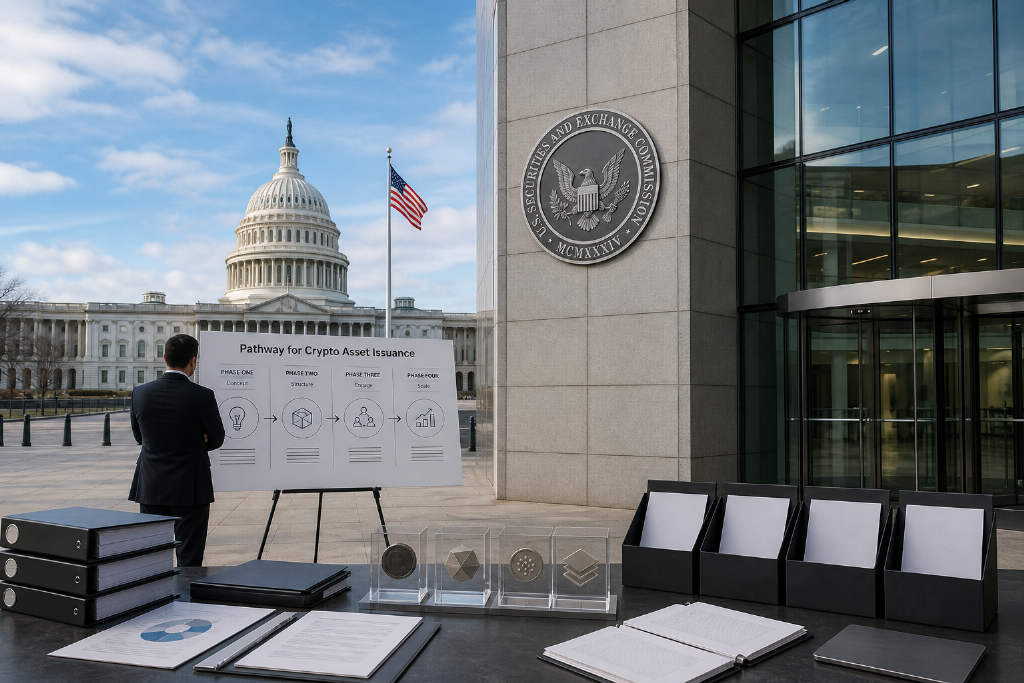
SEC2026-08-21 14:46:10Galaxy research head says SEC has proposed Reg Crypto framework for token offeringsThe U.S. Securities and Exchange Commission has proposed a new framework called Regulation Crypto Assets, or Reg Crypto, according to a post on X cited by ChainCatcher from Galaxy’s head of research. The proposal would create a legal route for certain token issuances to the U.S. public and set up a mechanism for ending the investment contract status tied to some crypto asset sales. The framework would apply only to crypto assets that are not securities in themselves but were previously issued or sold as part of an investment contract. Tokenized stocks and bonds, along with structures that bundle tokens with equity or other securities, would sit outside the proposal. The rule would set four stages covering fundraising, disclosure, development, and exit, while creating multiple exemption tiers, including a one-time startup exemption of up to $5 million over four years and larger exemptions of $20 million or $75 million over 12 months modeled on Regulation A. The SEC would require qualification review and ongoing disclosure. Non-accredited investors would face an investment cap of 10% of the higher of annual income or net assets. The agency estimates about 475 issuers a year would use the investment contract safe harbor, and roughly 130 would use the two new exemptions.1100
SEC2026-08-21 14:45:05SEC proposes Reg Crypto to create legal path for some token offerings and investment contract exitsThe U.S. Securities and Exchange Commission proposed Regulation Crypto Assets, or Reg Crypto, on Aug. 18, according to a post on X by Galaxy Head of Research Alex Thorn. The proposal is designed to create a lawful route for some token issuers to sell crypto assets to the U.S. public and to establish a mechanism for ending the securities-law treatment tied to certain investment contracts. The framework applies only to crypto assets that are not securities in themselves but were previously offered or sold as part of an investment contract. Tokenized stocks and bonds, as well as structures that bundle tokens with equity or other securities, are outside the proposal’s scope. Reg Crypto sets out four stages: fundraising, disclosure, development, and exit. It includes a one-time startup exemption allowing up to $5 million to be raised over as long as four years, plus a higher-tier exemption modeled on Regulation A that would allow raises of $20 million or $75 million in a 12-month period. The SEC would review issuer eligibility, ongoing disclosures would be required, and non-accredited investors would be capped at 10% of the higher of annual income or net worth. The SEC estimates roughly 475 issuers a year would use the investment contract safe harbor, while about 130 would rely on the two new exemptions.1240
SEC2026-08-20 10:19:39SEC proposes crypto asset framework with fundraising exemption and safe harborThe U.S. Securities and Exchange Commission has released a draft framework for crypto asset regulation that introduces a fundraising exemption and a safe harbor mechanism. Under the proposal, a project could apply to shed its securities status after certifying that it has fulfilled its commitments. The SEC would still retain the right to pursue enforcement after the fact. The draft also counts airdrops toward fundraising limits, adding a specific condition for token distribution. According to the source, the proposal is meant to address gaps left by Congress’s slow legislative process. The release puts forward a more defined path for token projects while keeping post hoc accountability in place, combining conditional relief with retained enforcement authority.1190
SEC2026-08-19 15:46:28SEC Draft Reopens a Legal Path for Token Fundraising, and Tokens May Now ‘Graduate’The U.S. Securities and Exchange Commission released a draft rule, Regulation Crypto Assets, on Aug. 18 that would give token issuers a new legal fundraising route. Startups could raise up to $5 million over as long as four years, while larger projects could raise $20 million or $75 million in 12-month windows under different tiers. The proposal does more than set caps: it ties token fundraising to disclosures on governance, development, security risks, finances and management, and it introduces a “graduation” concept based on whether the issuer has completed the promises made when selling the token. Under the draft, the SEC would focus on the investment relationship created by the fundraising process rather than on whether a token is “sufficiently decentralized.” Issuers would need to state what the money will be used for, and the token could only move into a safe harbor after the project’s key commitments are fully completed or permanently abandoned, followed by a public certification and analysis filing. Gabriel Shapiro, a corporate securities lawyer, said the framework could push teams to say less and promise less in public. The proposal could also affect airdrops and points programs. Retrospective airdrops that reward past behavior may fit within the SEC’s earlier guidance, while pre-announced point campaigns that link future tokens to trading, purchases or tasks are more likely to create an investment relationship and count toward the $5 million startup exemption. The rule is still only a draft, and the SEC is seeking public comment.460
SEC2026-08-19 04:24:17SEC proposes first standalone crypto asset rule with two fundraising exemptionsThe U.S. Securities and Exchange Commission has released a proposed rule titled “Regulation of Crypto Assets,” marking the agency’s first dedicated rulemaking for crypto asset fundraising and the treatment of investment contracts. The proposal creates two exempt offering paths for token issuers. One is aimed at startups and would allow eligible issuers to raise up to $5 million over four years, subject to public filings at the start and end of the offering and required disclosures to investors. The second would permit offerings of up to $75 million per year, but with tighter disclosure standards, financial reporting, and ongoing reporting obligations. The proposal also addresses a long-running question in the crypto sector: when a crypto asset should be treated as an investment contract, and when it can fall outside that framework. SEC Chair Paul Atkins said a proposed safe harbor would apply if an issuer has completed, or permanently ceased, the “essential managerial efforts” promised under the investment contract. The SEC has opened a 60-day public comment period before moving toward a final rule.1080
SEC2026-08-18 23:50:00SEC proposes crypto asset issuance framework with two exemptions and a safe harborThe U.S. Securities and Exchange Commission has proposed a new rule, Regulation Crypto Assets, aimed at creating a compliance path for certain digital asset offerings. According to The Block, the proposal sets out a tailored issuance framework designed to support capital formation while protecting investors. It includes a “startup exemption” for offerings of up to $5 million over four years without registration under the Securities Act of 1933, and a separate “fundraising exemption” for offerings of up to $75 million over one year. The proposal also contains a safe harbor provision under which a digital asset would no longer be treated as a security if specified conditions are met and “all managerial efforts” have ceased. The SEC will open a 60-day public comment period. The proposal comes days after the agency canceled a related meeting last Friday because of “unexpected scheduling issues.” SEC Commissioner Hester Peirce said the move marks a step on what she described as the long road toward a clear, workable, and enforceable crypto regulatory framework, as lawmakers in Washington remain stalled on the Clarity Act.1080