
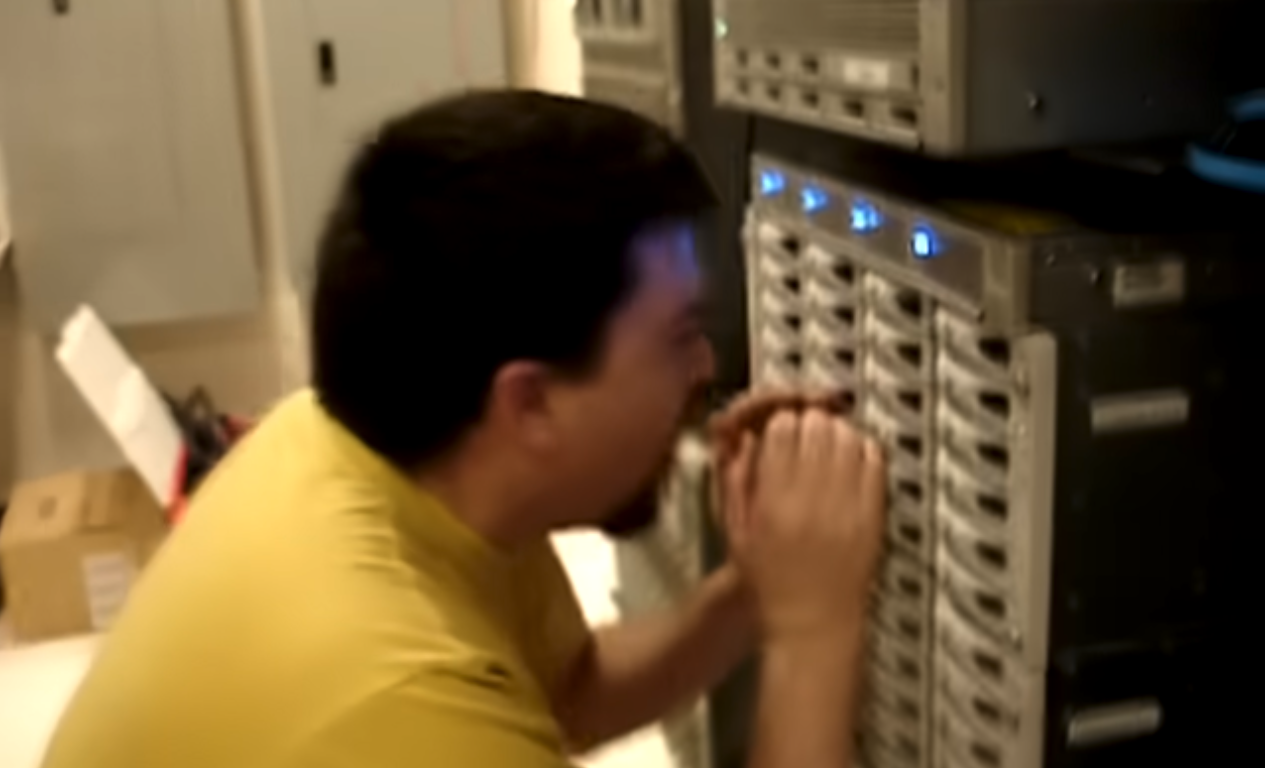
A datacenter experiment recorded in December 2008 is attracting attention again after showing a simple result: an engineer shouted at a rack of hard drives, and disk latency jumped almost instantly while read and write performance dropped.
According to a report cited from HKEPC, the video, titled Shouting in the Datacenter, has now passed 5.3 million views. The person in the clip is Brendan Gregg, who worked at Sun Microsystems at the time and is now an engineer at OpenAI. The video was uploaded by his colleague Bryan Cantrill. Gregg said in an interview that he had almost forgotten the incident until the old clip started circulating again.
Real-time monitoring showed the affected drives immediately
The setup involved a JBOD rack, a storage configuration built from multiple directly attached drives. In the clip, Gregg moves close to the rack and shouts toward an array of mechanical HDDs while an analysis tool developed by the Fishworks team tracks internal latency on each drive in real time.
The effect was clear. As soon as the shout hit, the drives exposed to the sound wave showed a sharp rise in latency, and throughput fell with it. Once the shouting stopped, the metrics gradually moved back down. The monitoring display also identified exactly which drives were affected and how severe the impact was.
Why sound can throw off a mechanical hard drive
The mechanism comes down to the structure of an HDD. Its platters spin at thousands of revolutions per minute, while the read/write head operates at an extremely small distance above the disk surface. That head has to stay aligned with the data track. Even a tiny unexpected shift can force the drive to perform a repositioning step, adding delay and reducing performance.
Sound travels through air into the drive enclosure and then through the physical structure of the device. That vibration can create a small relative movement between the platter and the head. Enterprise HDDs are built with vibration protection and can tolerate normal background noise such as cooling systems and fans, but a sudden, stronger sound pressure event can still push them past that threshold.
A pop song also became part of HDD vulnerability history
The article points to another well-known example. Engineers at Microsoft found that part of Janet Jackson’s 1989 single Rhythm Nation matched the mechanical resonant frequency of many mainstream 5400 RPM laptop hard drives from that period.
Playing the song near some laptops could cause a hard drive crash or system failure. In some cases, even a nearby laptop could be affected. That case was later documented as CVE-2022-38392, making it a rare security record tied to a pop track rather than software alone.
SSDs reduced the problem, but HDDs are still widely used
SSDs have spread across modern datacenters and consumer devices because they offer much faster performance and do not rely on spinning platters or moving heads. That means they are largely immune to the kind of sound- and vibration-induced disruption seen in the old demonstration.
Mechanical drives still have a place, though. The report notes that HDDs continue to be deployed heavily in cold storage because of their cost and capacity advantages. AI training datasets often reach tens or even hundreds of terabytes, and a meaningful share of that data still sits on mechanical disk arrays. That is why the 17-year-old video is being viewed again not just as a curious engineering moment, but as a reminder that physical limits still shape active infrastructure.