

Agibot has removed Luo Jianlan from the partner team list on its official website, a change that has intensified speculation that the company’s former chief scientist may no longer be with the robotics firm.
According to Quantum Bit, Luo’s name no longer appears on the latest version of Agibot’s partner roster. On the previous version of the site, he was identified as a partner, senior vice president and chief scientist. When Agibot first disclosed its partner team in September 2025, Luo appeared on the website alongside Deng Taihua, Peng Zhihui and Yao Maoqing, holding those same titles.
Posts suggesting Luo might be leaving had already circulated on social media before the website update. With his name now gone from Agibot’s official page, those rumors have gained another visible data point. Still, as of publication, neither Agibot nor Luo had publicly announced a personnel change, and no official confirmation had been issued.
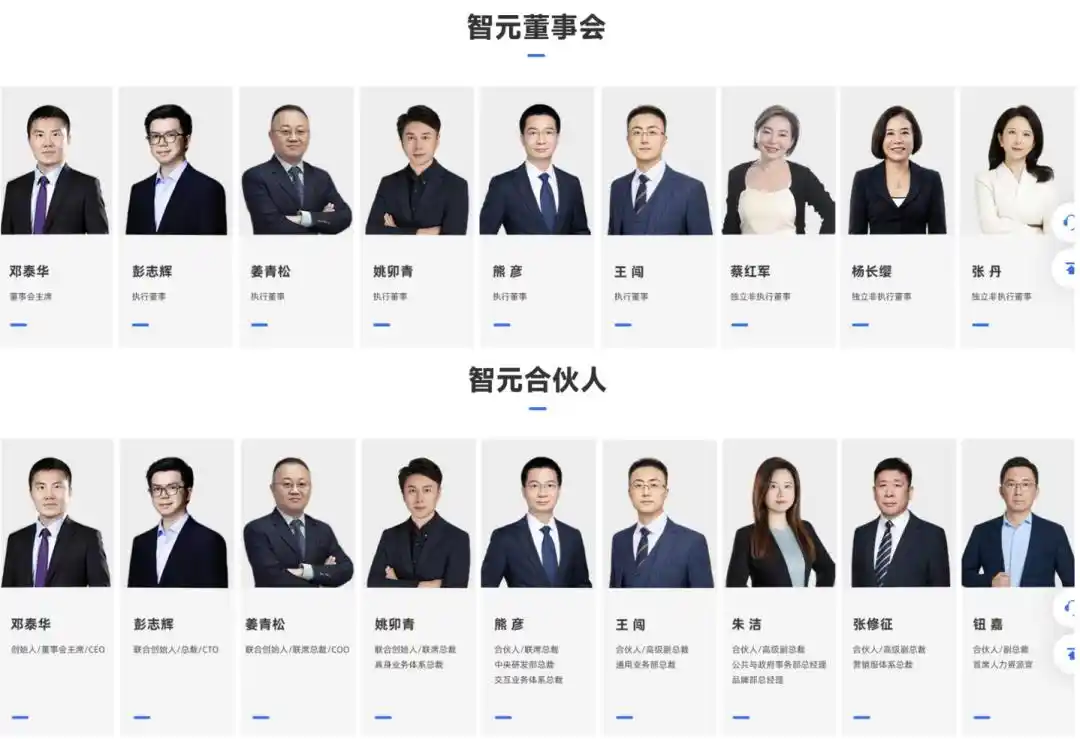
Changes also appeared on Luo’s public profiles
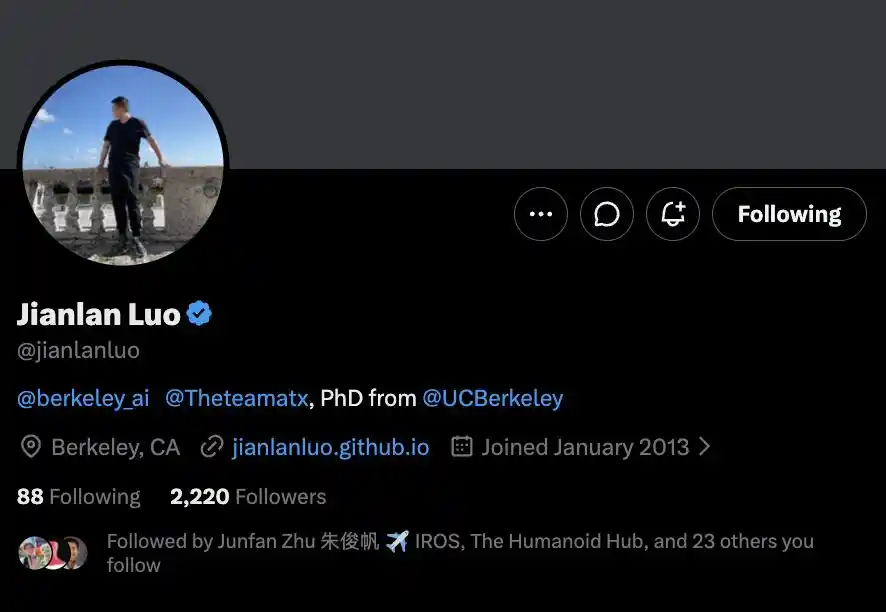
Other profile updates have surfaced at the same time. Luo’s personal webpage now only lists him as an assistant professor at the Shanghai Institute of Advanced Intelligence, and the biography no longer mentions Agibot. His bio on X also no longer includes any Agibot-related role.
If those revisions correspond to an actual job change, Luo may have already left the company.

The timing overlaps with Agibot’s Hong Kong listing process
The apparent personnel shift comes shortly after another corporate development. On July 24, 2026, Zhiyuan Innovation confirmed that it had launched the process for a Hong Kong listing.
The website and profile edits appeared around that period, but neither the company nor Luo had released a formal explanation.
Luo joined in April 2025 and served about 1 year and 4 months
Agibot formally announced Luo’s appointment as chief scientist in April 2025. At the same time, the company set up the Agibot Embodied Intelligence Research Center under his lead, with responsibility for frontier algorithm research in embodied intelligence and the engineering of related technologies.
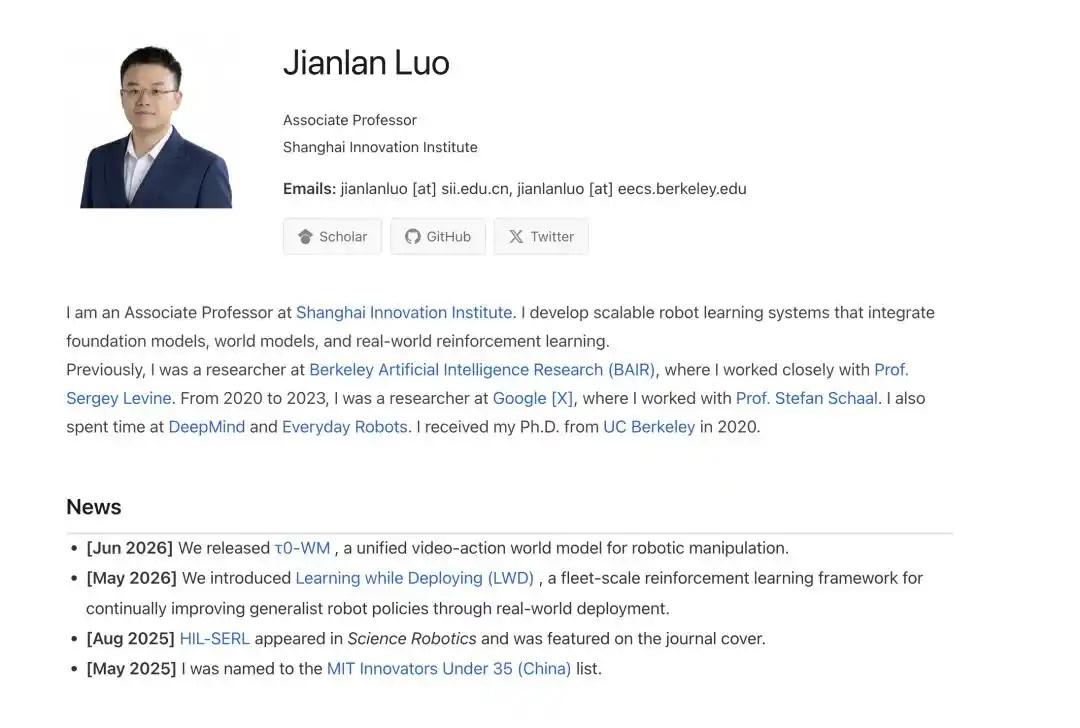
Luo’s role was later elevated to partner, senior vice president and chief scientist, placing him in the company’s core management and technical ranks. If the departure speculation is confirmed, his formal tenure at Agibot would span about 1 year and 4 months, from April 2025 to August 2026.
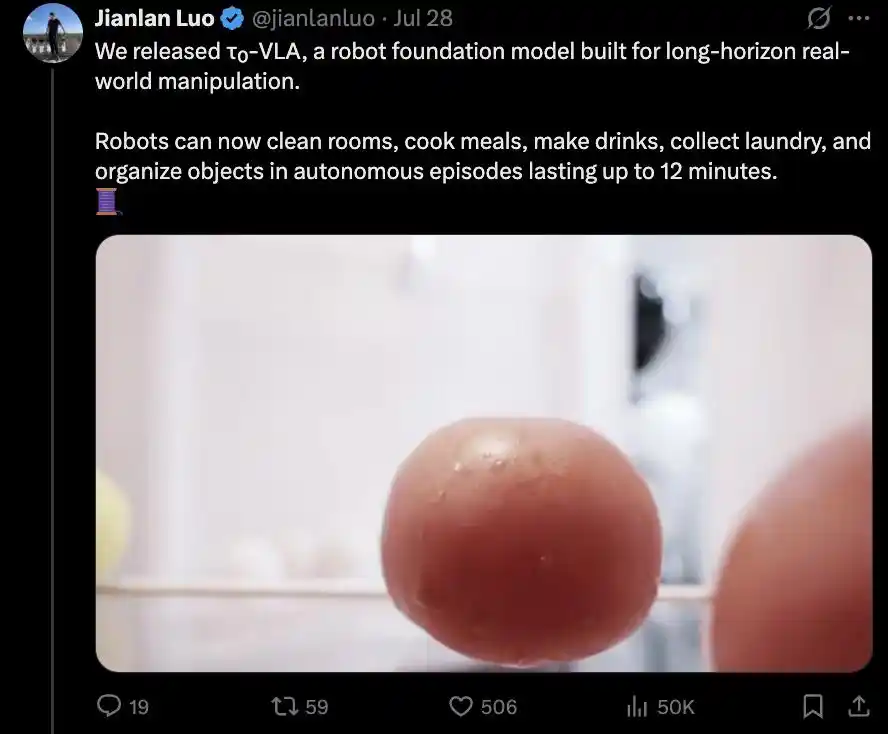
As recently as last week, Luo was still promoting his VLA-related work at Agibot on X.
Academic background and research focus
Luo’s work has focused on robot learning, real-world reinforcement learning and embodied intelligence. His Google Scholar citation count has reached 8,449.
Born in 1993, Luo earned his undergraduate degree from Wuhan University of Technology. He moved to the University of California, Berkeley in 2015 and received his PhD in 2020. At Berkeley, he studied under robotics researchers Pieter Abbeel and Alice Agogino.
After completing his doctorate, Luo joined Google X as a researcher and worked with roboticist Stefan Schaal. He also participated in related research involving DeepMind and Everyday Robots. After leaving Google, he returned to the Berkeley Artificial Intelligence Research Lab, or BAIR, where he worked as a postdoctoral researcher in Sergey Levine’s group and continued studying real-world robot reinforcement learning.
SERL, HIL-SERL and his work inside Agibot
At BAIR, Luo led the development of SERL and HIL-SERL. SERL organized the algorithms, data collection methods, reward design and robot control tools needed for real-world reinforcement learning into a reusable system. HIL-SERL added a human-intervention component: robots explore on their own under normal conditions, while a human briefly takes over only when failure is imminent or the machine gets stuck. The system then keeps learning from those small but critical correction datasets, reducing dependence on large volumes of human demonstrations.
When Luo joined Agibot in April 2025, he brought that real-world reinforcement learning path into the company. During his time there, he was involved in building Agibot’s broader research line in real-world reinforcement learning, online post-training and world models.
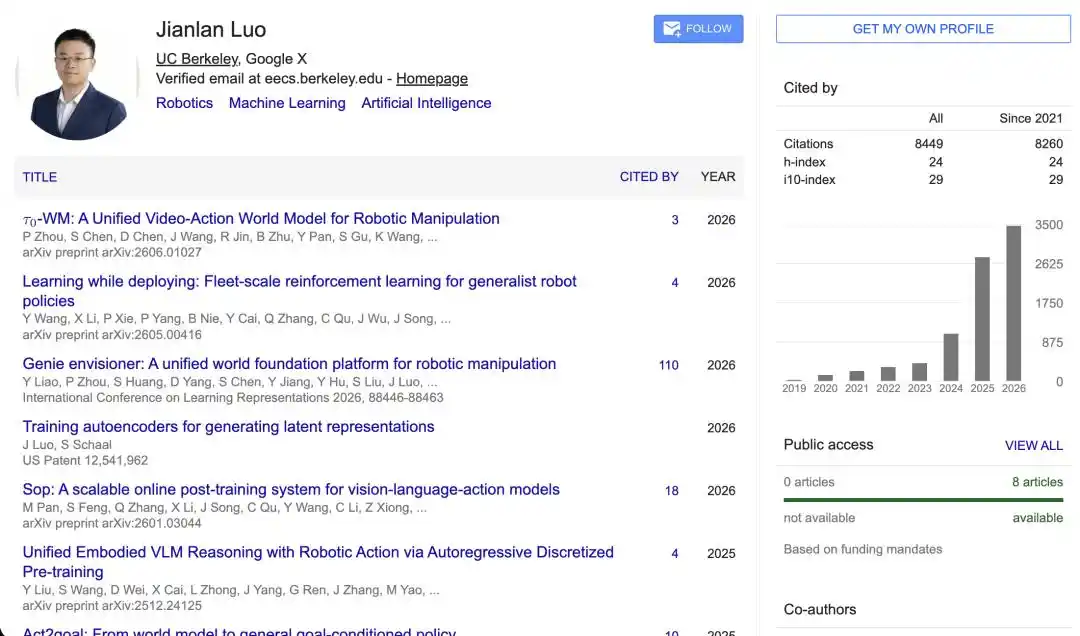
His representative work at Agibot ranged from pushing real-world reinforcement learning into industrial assembly scenarios, to connecting robot deployment, data return and model updates through systems such as SOP and LWD, and then integrating future prediction and pre-execution evaluation into robot control through projects including τ0-WM. Though those efforts covered different technical layers, they pointed to one shared goal: turning deployment itself into the starting point for the next cycle of learning.
The report was originally published by the WeChat account Quantum Bit, written by Henry. Reference links cited in the source include Agibot’s leadership page and Luo’s Google Scholar profile.