

Source: Tiger Research
Compiled and edited by BitpushNews
Crypto wallet companies are moving early on AI agent infrastructure, even though the revenue case is still largely ahead of them. According to Tiger Research, more than 10 companies are already building wallets tailored for AI agents, betting that autonomous software will eventually generate a new class of internet payments that existing card systems cannot support efficiently.
The core thesis is simple: if AI agents begin browsing the web, pulling information, calling APIs, and buying digital goods or services on their own, they will produce a very large number of tiny payments. Some of those transactions could be worth just a few cents. Others may be far smaller. Tiger Research says a single API call could cost as little as $0.001, and in an extreme case even $0.00001. That kind of flow does not fit well with legacy card rails built around human users, chargebacks, dispute handling, and fixed per-transaction fees that can run into tens of cents.
In that environment, wallets become more than storage tools. They turn into programmable payment infrastructure capable of splitting and sending funds automatically based on preset conditions, with no human intervention required during execution.
Early agent experiments have already pointed to the model
The report points to an experiment on Polymarket earlier this year that drew broad attention. An AI agent was given $50 in starting capital and told to trade on its own. The condition was that it had to generate enough profit to cover its API and server costs; if it failed, it would effectively stop existing. The agent completed trades successfully, and Tiger Research says a number of other agents have since begun operating in similar ways.
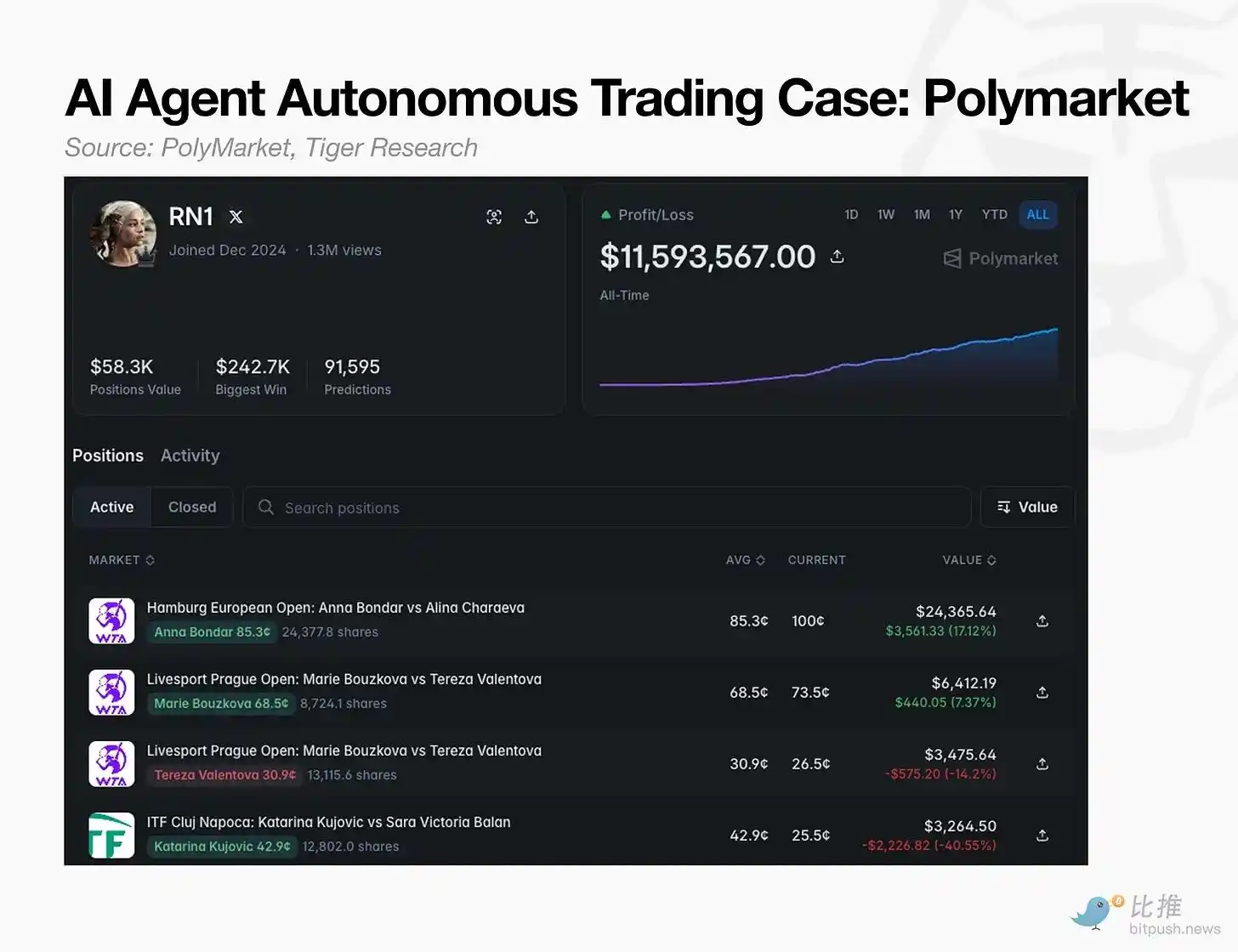
AI agents are not yet embedded in daily life. Still, the report argues that broader adoption is likely over time.
Why every agent transaction starts with a wallet
For now, the most active agent use cases remain inside crypto itself. Tiger Research describes today’s leading examples as crypto trading bots that operate independently of traditional payment networks and focus on digital asset markets.
That is only the starting point. The report says payments will eventually extend into areas that are still hard to map in detail today. Once agents, rather than humans, become the parties directly navigating and interacting online, payment behavior changes with them. The value of each transaction falls sharply, while the number of transactions rises.
A user could ask an agent to produce a research report. As the agent gathers information, every retrieval from a paid source may trigger another payment. One simple user instruction may lead to 20, 30, or even more transactions in a very short span of time.
That is why Tiger Research frames the problem around programmability. Card systems can automate the entry of payment details, but they are not built to split funds conditionally, stream payments in real time, or settle instantly as a default feature. Wallet-based networks can do that. The report places x402 in this context, describing it as part of a payment architecture built for machine-driven transactions rather than human-scale purchases.
In Tiger Research’s view, cards can still help humans transact faster. They do not solve for a world in which machines pay other machines directly. In that world, the wallet is the starting point.
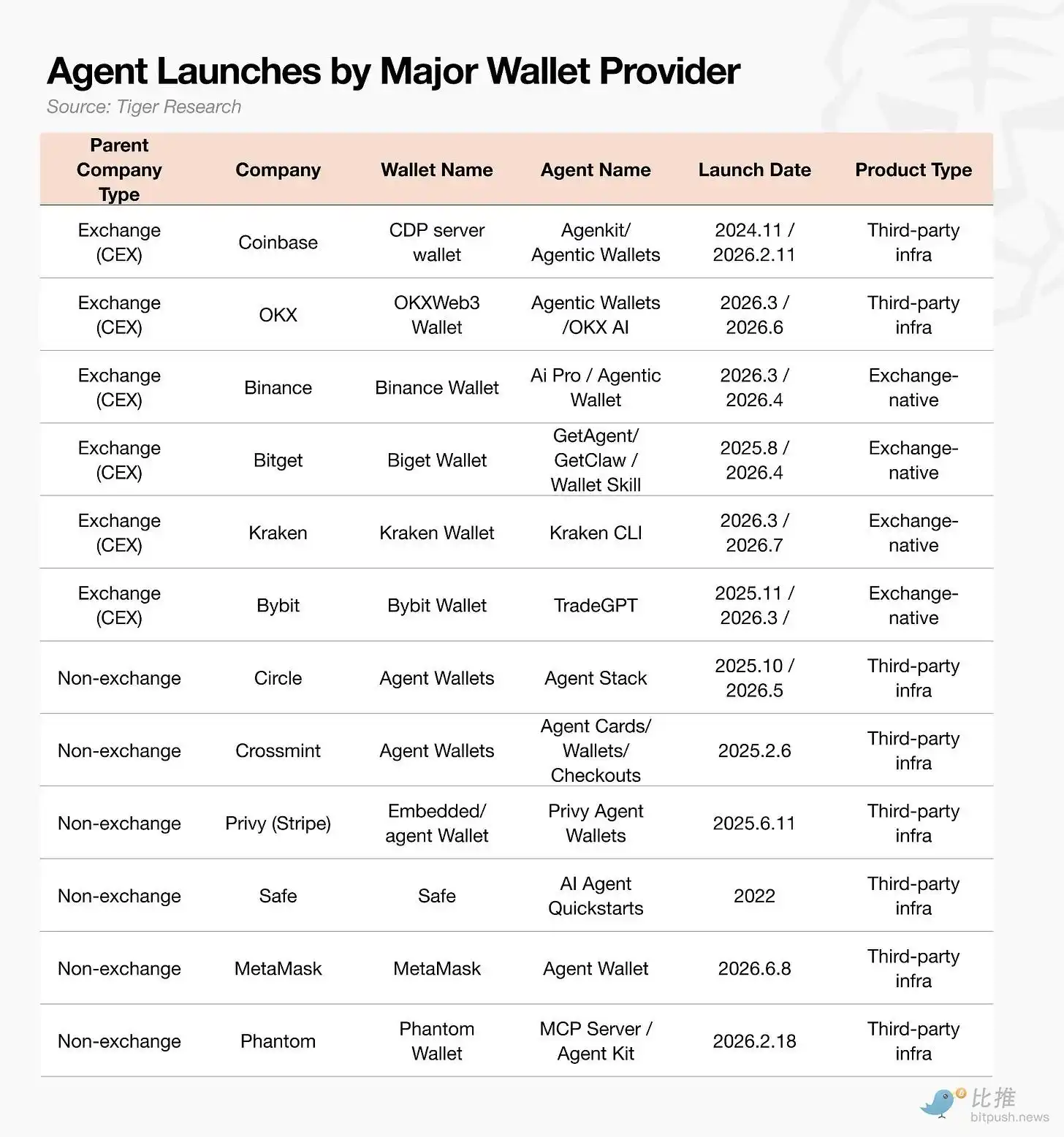
Why firms are spending now despite weak near-term monetization
The firms entering this market are not all cut from the same cloth. The report says the field includes exchanges, stablecoin issuers, and other wallet providers. What they share is the same strategic logic: they are building for future revenue, not current revenue.
Adding agent functions to a wallet does not create immediate income on its own. It builds the capacity to absorb a much larger volume of activity later, when agents begin operating at scale in browserless environments around the clock.
That distinction matters. What looks like one action to a human can become a chain of payments once an agent handles it. If agent activity reaches scale, payment volume could rise much faster than user growth alone suggests.
Coinbase scenario modeling points to a wide revenue range
Tiger Research used Coinbase’s public figures to model what that change could look like financially. The base was Coinbase’s 9.2 million monthly transacting users, or MTUs, rather than its roughly 120 million total registered users. The model used three variables: adoption rate, number of agents per user, and daily call frequency.
- Conservative case: 10% adoption, one agent per user, and 50 calls per day. Under that setup, the report estimates about $84 million in annual incremental revenue, a 1.2% increase.
- Base case: 50% adoption, two agents per user, and 200 calls per day. Estimated incremental revenue rises to about $3.36 billion, a 46.8% increase.
- Aggressive case: 100% adoption, three agents per user, and 1,000 calls per day. Annual revenue reaches about $50.37 billion, roughly seven times Coinbase’s current total revenue.
Tiger Research stresses that the spread between those cases is geometric rather than linear. Adoption increases by 10x from 10% to 100%, but modeled revenue expands by about 600x, from $84 million to $50.37 billion. That is because the three variables multiply one another. Small moves in any one of them can push the overall total much higher.
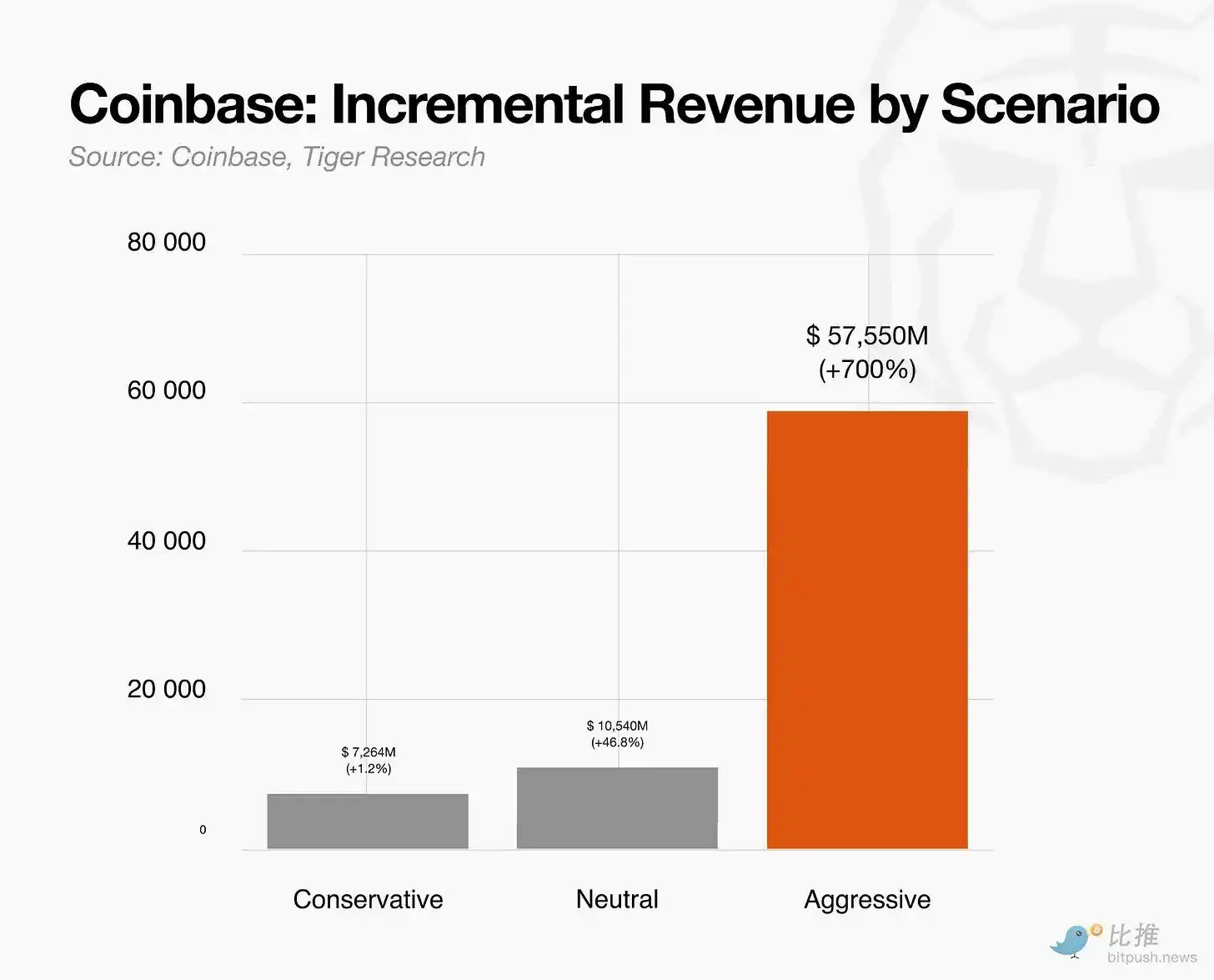
This is also why, in the report’s framing, Coinbase continues to invest in agent wallet infrastructure even without visible short-term returns. Binance is described as pursuing the same direction for a similar reason: secure market position before usage arrives in force.
Wallet data could open a path to agent finance
The report says the business case does not stop with payments. As wallets accumulate transaction histories, those records may begin to serve as a basis for credit assessment. In other words, the payment history inside an agent wallet could become evidence of whether an AI agent has real income, operating performance, and the ability to repay financing.
If that framework takes shape, wallet providers could expand naturally into new financial products, including revenue-based financing, or RBF, designed specifically for agents.
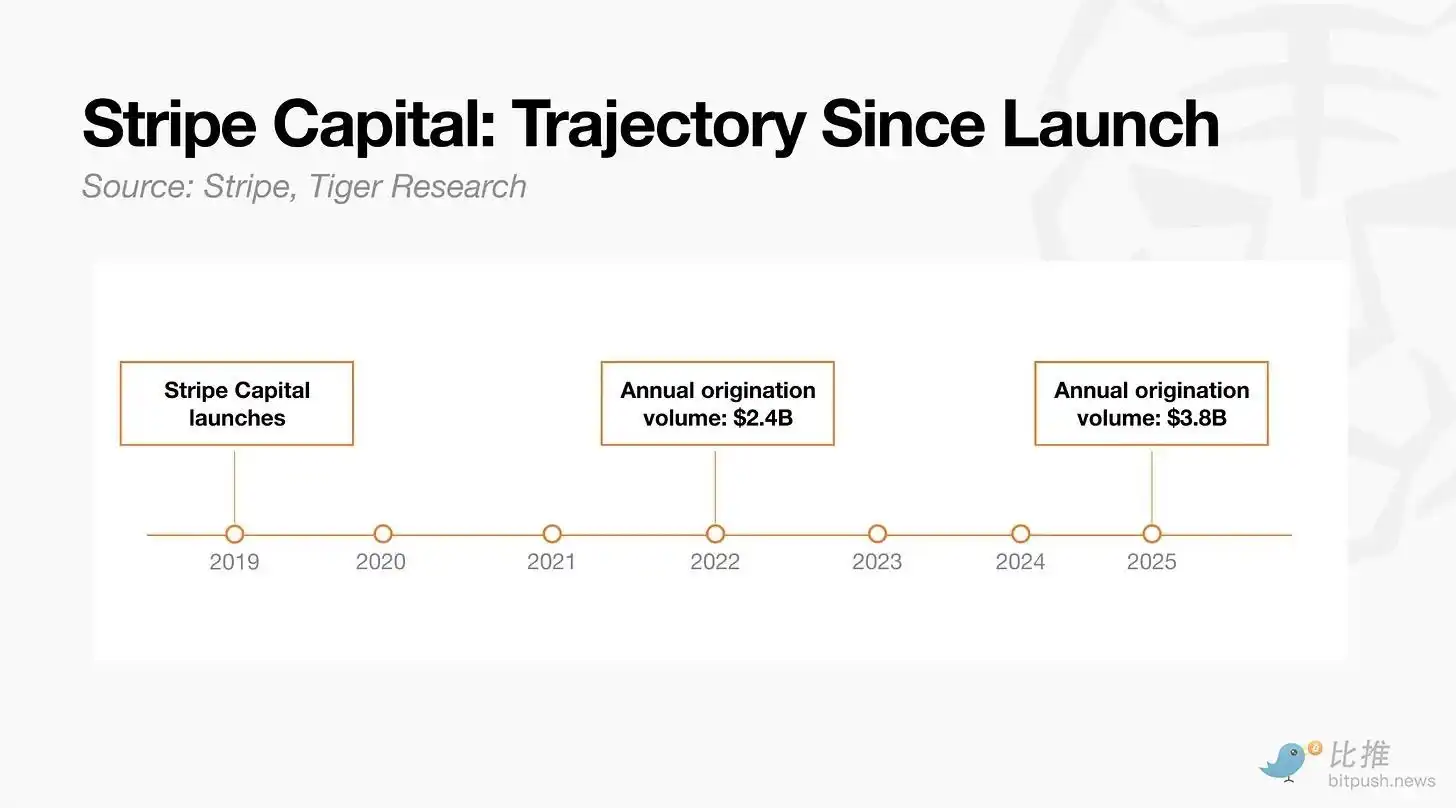
Tiger Research points to Stripe Capital as a real-world example of how payment data can support an adjacent financial business. When Stripe launched Stripe Capital in September 2019, it did not rely on outside credit bureaus or heavy loan paperwork. It used merchant sales data flowing through its own payment network to assess eligibility and offer size.
The implication is clear: a company that already controls the payment data pipeline may be able to build higher-value financial services on top of that flow, without creating a separate sales network or taking on additional marketing overhead. Tiger Research says agent wallet providers could follow a similar path if they continue collecting agent income data and use it to advance operating capital through RBF structures.
That path still depends on a major condition. AI agents would need to become more than tools that simply execute payments. They would need to hold assets, generate income, and produce enough real revenue to repay debt.
The growth case remains unproven for now
Tiger Research is explicit that the upside remains hypothetical at this stage. The sevenfold Coinbase revenue case and any expansion into RBF both rest on the assumption that agent payments become widely adopted in the real economy. That has not happened yet.
There are several obstacles. The report says there are still serious questions around conversion rates and payment reliability when agents make purchases autonomously. Agents can misfire during checkout, make incorrect payments because of hallucinations, or have transactions blocked outright by fraud detection systems, or FDS, run by card issuers. Actual payment completion rates therefore remain low.
There is also no unified payment standard. Protocols such as x402, AP2, and MPP remain fragmented. At the same time, there is still no clear KYC or financial regulatory framework for AI agents that are not legal persons. That gap is another brake on expansion.
For that reason, the current fight is not over near-term fee income. Tiger Research compares the timeline to other large platform ecosystems. Apple’s App Store took 15 years to build a fee market worth $10 billion a year, while WeChat Pay took seven years to establish its mini-program ecosystem at scale. Agent wallets, the report says, are likely to follow a similarly long buildout focused on ecosystem formation rather than immediate monetization.
In that reading, the companies moving now are not chasing today’s marginal revenue. They are trying to secure control over payment flows and transaction data before a fuller agent economy takes shape over the next five to 10 years.