


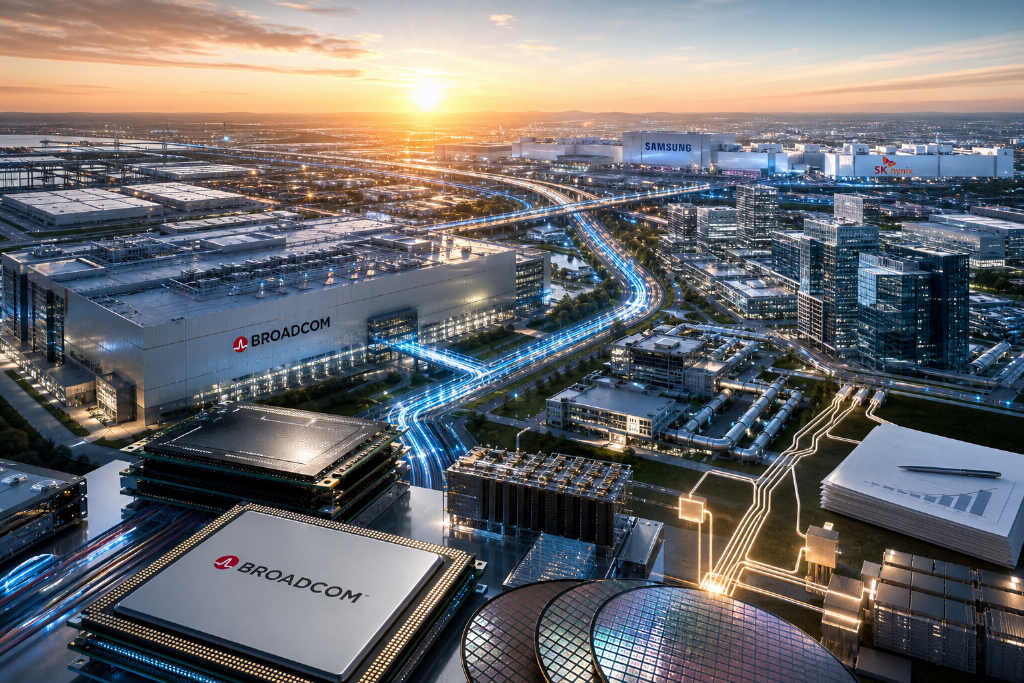
WuBlockchain’s WhiteLine Daily said the AI infrastructure story is entering a phase centered on financing, ASIC expansion, and storage companies turning AI demand into realized profits. The report framed the current setup as a chain in which hyperscalers keep adding computing capacity, GPU and ASIC demand both expand, Broadcom leans on large debt funding to support capital spending, and HBM and DRAM suppliers convert that demand into sizable cash flow.
Broadcom seeks more than $60 billion in AI financing
According to the report, Broadcom is in talks to raise more than $60 billion of debt through a special purpose vehicle. The funds would support computing infrastructure buildouts for AI customers including Anthropic and OpenAI. WhiteLine Daily added that Broadcom had already reached a $35 billion financing arrangement with Blackstone and Apollo. The first phase is expected to add 1 GW of computing capacity for Anthropic, while the broader platform is planned to support more than 20 GW by 2028.
The report said AI capital expenditure is no longer being funded only from the cash flow of large technology companies and is moving toward large-scale outside financing. In its view, the next stage requires watching not only order trends for AVGO and NVDA, but also whether this wave of very large debt raises can continue.
Google deepens custom AI chip ties with Marvell
WhiteLine Daily also said Google is expanding its custom AI chip partnership with Marvell and has been granted Marvell stock subscription rights worth as much as about $12.2 billion. If related targets are achieved, the partnership could bring Marvell as much as about $120 billion in revenue by fiscal 2033.
After the news was released, Marvell shares rose, while Broadcom at one point fell sharply, the report said. Its reading is that the direction among hyperscalers is becoming clearer: they will keep buying GPUs, but ASIC adoption is also set to grow. That leaves the AI computing trade spreading from a single-name NVDA focus into a multi-track contest across NVDA, AVGO, and MRVL.
Micron commits another $10 billion to AI memory research
Micron said it will invest $10 billion over the next 10 years in Boise, Idaho, to build a new memory and AI research center. The facility will be used for research into next-generation memory, computing systems, and future chip manufacturing technology.
The report said Micron, SK Hynix, and Samsung are no longer simply participating in a rebound typical of older semiconductor cycles. Instead, it argued, they are using cash flow generated by AI to position for the next round of HBM, DRAM, and AI storage demand. Storage remains one of the lines the market needs to keep tracking closely, according to the report.
Samsung and SK Hynix increase shareholder returns
Samsung Electronics said shareholder returns could reach as much as about $79.5 billion by 2026. Earlier, SK Hynix announced share buybacks and cancellations worth about KRW 40 trillion, or about $28.6 billion, and raised its shareholder return target for cumulative free cash flow from 2025 to 2027 to above 50%.
WhiteLine Daily said both companies are seeing profits and cash flow supported by AI memory demand. In the report’s view, the key shift in the AI storage trade is that the narrative has moved from concerns that HBM could become scarce in the future to a point where profits are already large enough to support major stock buybacks. For SK Hynix, Samsung, and MU, it said, that carries more weight than a trade built only around broad AI themes.
AI capital spending chain remains intact for now
The report’s bottom line was that the main thread has not changed: hyperscalers still want more computing capacity, GPU and ASIC capacity are expanding together, Broadcom is using large debt financing to support CapEx, and HBM and DRAM makers are already turning AI demand into large cash flows. As long as demand at the front end of the AI buildout does not fall, the capital spending chain has not yet broken, according to WhiteLine Daily.