
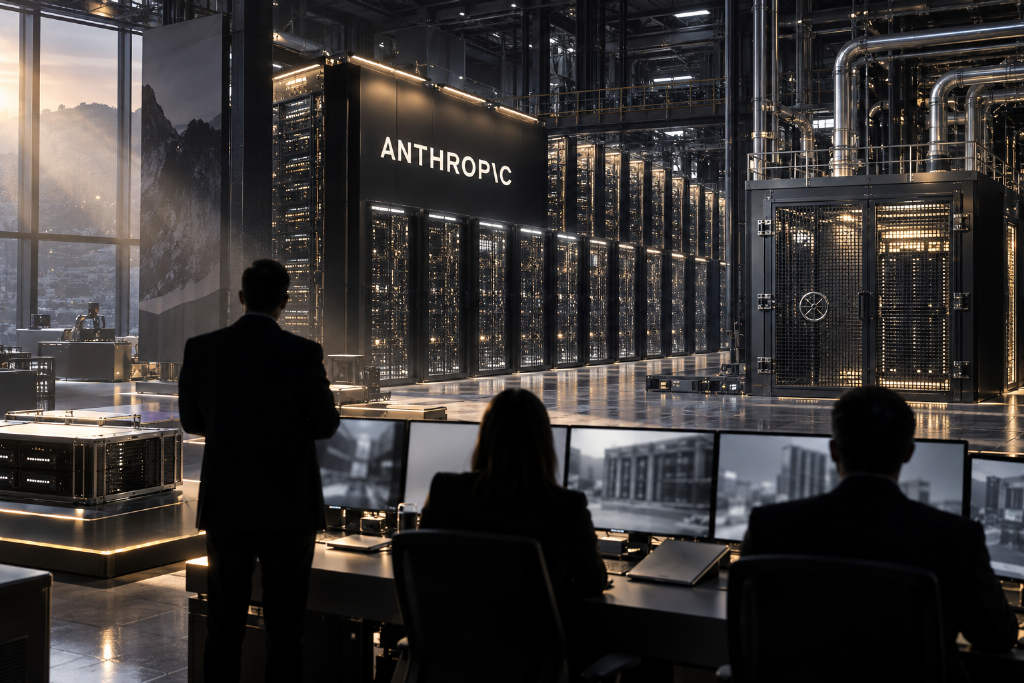
Artemis Analytics says Anthropic’s moat may look less like a single model lead and more like the early playbook that built Amazon Web Services into a cloud giant. In its latest report, Artemis says Anthropic posted $65 billion in net ARR in July 2026, up 15x from a year earlier, and forecasts ARR of $275 billion by the end of 2027, which it says would put the company ahead of AWS.
The piece, sourced from @artemis__xyz and compiled and translated by Deep Tide, argues that Anthropic is assembling a sticky, enterprise-grade AI product stack rather than relying on a standalone frontier model business. The report says that stack could include domain-specific frontier models, such as drug discovery models, along with tools for AI safety, compliance, and performance optimization.
The AWS comparison: from questioned cost center to platform giant
Artemis revisits the doubts that surrounded AWS in 2015. At the time, critics viewed AWS as a deeply unprofitable internal cost center inside Amazon, selling a commodity-like service not unlike electricity. The market size for cloud was still unclear, and there were concerns that rivals such as Google and Microsoft would crush AWS on pricing.
By 2026, the report says, Amazon had become the clear winner in cloud computing, using a one-stop product suite, scale advantages, and a developer ecosystem to build a business far larger than its original S3 service.
Artemis argues that Anthropic now faces a similar set of doubts. Even after raising and burning billions of dollars, its frontier models could still be commoditized by open-source competitors. Even so, the report says Anthropic’s team is strong enough not only to keep pushing frontier model performance, but also to build a one-stop AI platform that helps enterprises build, scale, and maintain AI systems across verticals worldwide.
That is the basis for Artemis’ broader claim: Anthropic could create enterprise lock-in, reach long-term gross margins above 60%, and build a business with AWS-like economics. The report says Anthropic’s ARR could surpass AWS in 2027.
Artemis links to its full model here: https://www.artemis.ai/anthropic-thesis
Three questions at the center of the thesis
Artemis reduces the Anthropic story to three operating questions.
- Can the company keep attracting elite researchers to build frontier models?
- Can it secure and lock in power at low enough cost, which the report places at $10 million to $15 million per megawatt?
- Can it charge a premium on tokens through its API, with the report using $50 million in ARR per megawatt as an example?
From there, the report looks at demand, supply, and margin structure.
Demand: $10 billion to $15 billion in monthly net new ARR
Artemis estimates monthly net new ARR at $10 billion to $15 billion. It says token prices may be falling, but token usage is still climbing, and that enterprise demand for frontier models and agent deployment is already substantially de-risked.
Supply: 15 GW to 16 GW of power locked in by 2030
On the supply side, Artemis focuses on total secured compute. According to the report, Anthropic has locked in 15 GW to 16 GW of power by 2030. It adds that at least 20 GW of training power would be needed to support $1 trillion in ARR, and says that target is achievable by 2030. The report also says OpenAI is reported to have locked in at least 30 GW of total power by 2030.
Margins: the spread between ARR per megawatt and cost per megawatt
Artemis says the key driver of Anthropic’s long-term profitability is the gap between ARR generated per megawatt and the cost of that megawatt. In its framing, that spread determines whether Anthropic becomes a truly exceptional business.
Why Artemis says net ARR matters more than gross ARR
The report describes Anthropic as an enterprise API business. It says 90% of ARR comes from API revenue. Whether Anthropic can eventually support a $10 trillion outcome, in Artemis’ view, depends on direct model sales and distribution through AWS Bedrock, Gemini Enterprise Agent Platform, and Microsoft Foundry. Consumer revenue is described as largely irrelevant.
Artemis also says investors should focus on net ARR rather than gross ARR. It says revenue shares paid to AWS, Gemini, and Microsoft, in the range of 15% to 20%, need to be deducted. The report also says investors should exclude Meta revenue and revenue tied to Chinese AI labs distilling Anthropic models.
How Artemis would read an S-1
The report says a lot can go right. In its base case, Anthropic secures more than 30.8 GW of total power by 2030 and supports $1 trillion in ARR. Artemis assumes total cost per megawatt of $18 million and inference ARR of $50 million per megawatt.
On those assumptions, the report lays out the following steady-state figures:
- 66% gross margin
- 30% EBIT margin
- training and R&D expense falling to roughly 25% of revenue
In that setup, Artemis says Anthropic would be highly profitable and still growing quickly as agents penetrate more of the world’s 300 million-plus businesses.
Risks, ranked by probability
The report does not stop at the bull case. It also lists risks and orders them by perceived likelihood.
High risk: Codex and OpenAI Astra take share from Anthropic
Artemis says it has already seen engineers around it start moving from Claude Code to Codex. After testing Astra and Fable over the prior weekend, the firm says the gap had narrowed materially and that customers could shift toward OpenAI.
One quote in the report, attributed to Artemis’ head of blockchain data, reads: “From personal experience, I’ve been using Codex consistently and I prefer the way it communicates. I think some people treat them as complements, using Claude Code for planning and Codex for execution. But I’m more inclined to treat them as substitutes and just use Codex. I used to be a heavy Claude Code user in the terminal, and now I’d rather use Codex in the ChatGPT app.”
An Artemis fintech analyst is also quoted saying: “OpenAI’s Codex app is insanely strong. It visualizes what the agent is doing and is clearly built for programming. Claude Code had a strong first-wave experience in the CLI, but Codex’s GUI is now much better for observing agent behavior. Claude Code created the first generation of programming experience in the CLI, but I think the second generation will emerge in GUI-based apps.”
The report also cites a product manager at a $3 billion company, relaying a remark from a friend described as a hardcore supporter of Claude Code and Claude Harness: “Wow, bro, I have to say, Astra is really strong.”
High risk: switching costs across models remain low
Artemis says 25% of second-quarter 2026 gross revenue came through third-party channels such as AWS Bedrock and Gemini Enterprise Agent Platform. Through AWS Bedrock, the report says, enterprises can more easily swap Anthropic APIs for OpenAI Astra or other open-weight models. If Anthropic loses its frontier lead, revenue could move quickly.
Medium risk: harness products may not need Anthropic
The report says harness products such as Grokbot and Instinct may not depend on Anthropic at all. It describes Grokbot as built on x.ai frontier models and directly challenging Claude Cowork and Claude’s harness layer. If Instinct and newer AI apps are built on open-source or other frontier models, Artemis says Anthropic may have to move further up the stack, either through acquisitions in harness or applications, or by continuing to launch products such as Claude Code, Claude Design, and Claude Cowork.
Lower risk: Anthropic cannot lock in enough power
Artemis says Anthropic has already secured close to 15 GW of power and needs another 15 GW to support $1 trillion in ARR. It argues that an IPO above $100 billion would be enough to secure that capacity.
Still, the report notes that Amazon, Nvidia, Google, and SpaceX are suppliers, shareholders, and competitors at the same time. Amazon has Titan, SpaceX has Grokbot, and Nvidia is moving further up the stack through its work with HuggingFace. Artemis nevertheless says it sees this outcome as very unlikely.
Lower risk: Anthropic stops shipping frontier models
Another lower-probability risk in the report is that researchers become wealthy enough after an IPO to lose motivation, or that the company runs into a technical wall. Artemis says incentives are aligned today, but asks what happens if individual researchers hold equity worth $150 million to $300 million. It notes that a $5 million to $10 million stake at a $100 billion to $200 billion valuation could become a nine-digit position at a $3 trillion valuation. Even so, the report says the odds that Anthropic stops releasing leading models are very low.
Artemis adds that even against fast-growing software and AI comparables, Anthropic looks cheap at a $2 trillion valuation on EV/ARR and EV/NTM revenue, and not unreasonable even at $3 trillion.
The valuation ceiling and the $36 trillion TAM argument
Artemis becomes more aggressive in the valuation section. The report says Anthropic will go public in the second half of October at a $2 trillion valuation, with retail and institutional demand pushing the company to $3 trillion to $4 trillion. It goes as far as saying Anthropic may be worth buying almost regardless.
The report points to Anthropic’s stated $65 billion in net ARR for July 2026 as evidence of generational growth, calling the 15x year-over-year increase extraordinary. Artemis then estimates ARR will reach $90 billion by the end of September 2026, also at 15x year-over-year growth.
Its forward estimates are:
- $125 billion in ARR by the end of 2026
- $275 billion in ARR by the end of 2027
Artemis says those figures are more conservative than SemiAnalysis’ published estimate of $300 billion in 2027 ARR. On its own numbers, Anthropic would trade at 20x expected 2026 ARR and 7.2x expected 2027 ARR.
The broader valuation framework comes from a rough estimate of enterprise AI spending. Artemis asks how to value a company that could build AGI and sell it to more than 300 million businesses worldwide, businesses that may be willing to use intelligence to replace or augment white-collar workers. Its rough math is 300 million businesses multiplied by one white-collar worker replaced per business, at $120 in ACV, producing a global AI spend opportunity of $36 trillion.
The report then runs two market-share scenarios. If Anthropic captures 20% of that market, ARR would be $7.2 trillion. At 30%, ARR would be $10.8 trillion.
Artemis also cites Ramp, which it says estimates that 56% of U.S. businesses already spend on AI, though the median spend is just $12 per month. The report interprets that as businesses paying for personal subscriptions to ChatGPT or Claude.
Its long-term view is that agents, not chat interfaces to agents through Claude or ChatGPT, are the key to accelerating AI spend across the global economy. Agent penetration in enterprises, Artemis says, remains below 1%.
That leads to one of the report’s clearest claims: even its $1 trillion ARR base case for 2030 may still be too conservative. It then pushes the upper bound further. If superintelligence arrives and Anthropic can use its own models to build models, research costs could fall sharply and margins could expand. If superintelligence is available only through Anthropic, willingness to pay could jump, and the assumption of $50 million in ARR per megawatt could itself prove conservative.
Disclosures: conflict of interest, private-market illiquidity, and speculation
The report closes with a lengthy set of disclosures. It cites a remark attributed to Anthropic’s chief financial officer: “Humans mostly think in linear and incremental ways. I’ve been at [Anthropic] for two years. That’s a paradigm I’ve had to break for myself. Stop thinking linearly and start thinking exponentially.”
Artemis then congratulates Anthropic and says it is looking forward to the company’s S-1 and its exponential growth on the path toward superintelligence.
But the report also says plainly that the article reflects Jon Ma’s personal views and is published for informational and educational purposes only. It says it is not investment, financial, legal, or tax advice, and not a recommendation or solicitation to buy, sell, or hold any security, including any interest tied to Anthropic.
Artemis Analytics says it is not a registered investment adviser or broker-dealer. The author may hold Anthropic exposure through an SPV. Anthropic is a private company, its shares are unregistered and not publicly traded, and secondary-market interests are illiquid and can only be sold through limited channels. The report says any third-party marks or secondary-market prices, including implied valuations, may not reflect prices at which real transactions could occur. Any reference to a future IPO, its timing, or pricing is speculative and carries no guarantee.
The conflict disclosure goes further. Artemis says the author and Artemis Analytics hold economic interests in Anthropic directly and or through pooled investment vehicles, and would benefit if Anthropic’s valuation rises. Those interests may be traded at any time without updating the page. Artemis also says it is an Anthropic customer and that part of its own products are built on Anthropic models. Employees cited in the report are also users of Anthropic products. Readers, the firm says, should assume the author is not a neutral observer.
On forward-looking statements, the report says its estimates, projections, scenarios, and price targets, including ARR, gross margin, compute capacity, and 2030 valuation figures, are either the author’s own views or sourced from third parties. Those include Artemis’ internal estimates and published research from firms such as SemiAnalysis. None of those figures, Artemis says, are reported financial results from Anthropic, and none have been verified or endorsed by Anthropic. Actual outcomes could differ materially. Bull, base, and bear cases are illustrative scenarios, not forecasts or guarantees.
The report adds that information from third-party sources is believed to be reliable but has not been independently verified, and Artemis makes no representation about its accuracy or completeness. All investments involve risk, including the possible loss of the full amount invested. Past performance is not indicative of future results. Artemis also says Anthropic is not affiliated with Artemis Analytics and did not review or approve the content.