


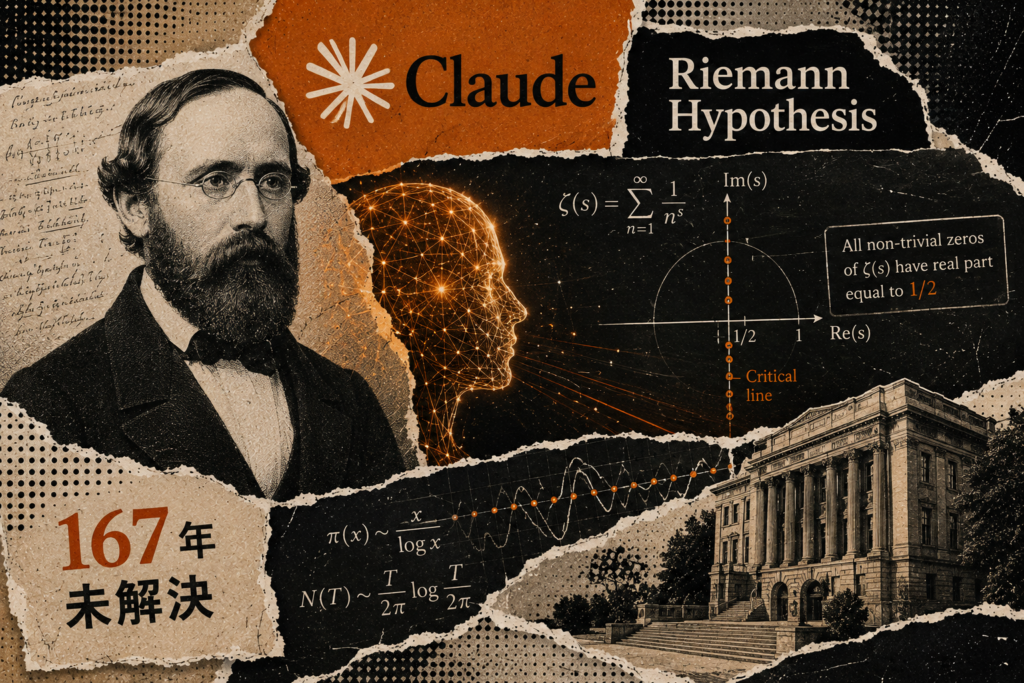
Anthropic said earlier this week that an unreleased research version of Claude was asked to make a serious attempt at the Riemann Hypothesis. The model did not prove the conjecture, but the company said it still produced a new result in number theory by raising the known lower bound on the proportion of zeta-function zeros that satisfy the hypothesis from 41.6% to 67.2%.
A 167-year-old open problem
Anthropic disclosed the work in a research post titled Learning more about Claude’s mathematical capabilities. The Riemann Hypothesis, proposed by Bernhard Riemann in 1859, is widely regarded as one of the most important unsolved problems in mathematics. It is also one of the seven Millennium Prize Problems, carrying a $1 million prize for a proof.
At the center of the conjecture is the distribution of prime numbers. Primes can appear irregular on the number line, but Riemann linked their distribution to the zeros of the zeta function. The hypothesis says those zeros all lie on the same critical line. Mathematicians have checked trillions of zeros over the past 167 years without finding an exception, yet a proof covering all zeros has remained out of reach.
Anthropic said a proof would convert many papers that currently rely on the assumption that the Riemann Hypothesis is true into unconditional theorems, strengthening foundations across number theory and cryptography. The company also noted that modern internet encryption such as RSA depends on the difficulty of factoring large numbers, not directly on whether the conjecture is proved, so a proof would not cause those systems to fail overnight.
What Claude achieved
According to Anthropic, Claude’s result combined recent work by Baluyot, Goldston, Suriajaya and Turnage-Butterbaugh with a 2000 paper by Bombieri, pushing the lower bound to 67.2%.
On the technical side, Anthropic said Claude constructed an appropriate function space and used a quadratic form introduced by Weil, together with positive-definite and negative-definite subspaces arising from zeros on and off the critical line, to write down an inequality involving the rank of the quadratic form. The company said the novelty lay in considering the positive and negative definiteness of the full space at the same time and allowing the quadratic form to take a nondiagonal form.
Two work sessions, with the first ending in failure
The full effort took place in Claude Code across two work sessions and used 31 million output tokens in total.
The first attempt went nowhere. Anthropic said Claude generated and tested 650 ideas, and all of them failed. The second attempt lasted about a day and a half. During that stretch, the model coordinated about 60 subagents, ran 2,400 shell commands, wrote hundreds of Python scripts and carried out thousands of numerical checks against known zeta zeros.
The challenge was initiated by Jarred Sumner, an Anthropic employee who is not a mathematician. Anthropic said his involvement was mostly limited to sending encouragement such as 「continue」 and 「believe in yourself」. The post said those prompts appeared to help Claude get past its initial doubt about whether it could make meaningful progress.
Internal review, outside review and Lean verification
Anthropic said it used several layers of verification. Internally, mathematicians Levent Alpöge and Ralph Furman checked the result, while Eric Easley helped produce a formal proof in Lean. Claude also searched for counterexamples, downloaded 54 arXiv papers to check that it was not duplicating earlier work, and independently reproved the result once more, according to the company.
Externally, Brian Conrey and Dan Goldston reviewed the paper on short notice. Anthropic added that the materials passed formal verification through Lean’s comparator tool. The Lean proof has been open-sourced on GitHub, alongside Claude’s full paper, an explanation of the process and detailed records.
Still far from a proof of the conjecture
Anthropic said it does not expect the technical route used in this experiment to lead all the way to a full proof of the Riemann Hypothesis. The 167-year-old problem remains unsolved.
Even so, the company presented the result as a fresh example of how fast AI mathematical capability is moving. In Anthropic’s account, an AI system working with little human intervention produced an original mathematical contribution in about a day and a half, and that contribution cleared formal verification and drew recognition from leading experts. Anthropic said this points to AI’s potential to amplify the reach of mathematicians’ thinking.