

A model ID named azure_ai/claude-fable-5-5 has surfaced in Microsoft Azure East US 2, where its status is shown as "GenerallyAvailable." Combined with a LiteLLM code commit that developers said they noticed on Oct. 14, the listing has added fresh momentum to speculation that Anthropic may be close to a wider Fable 5.5 release.
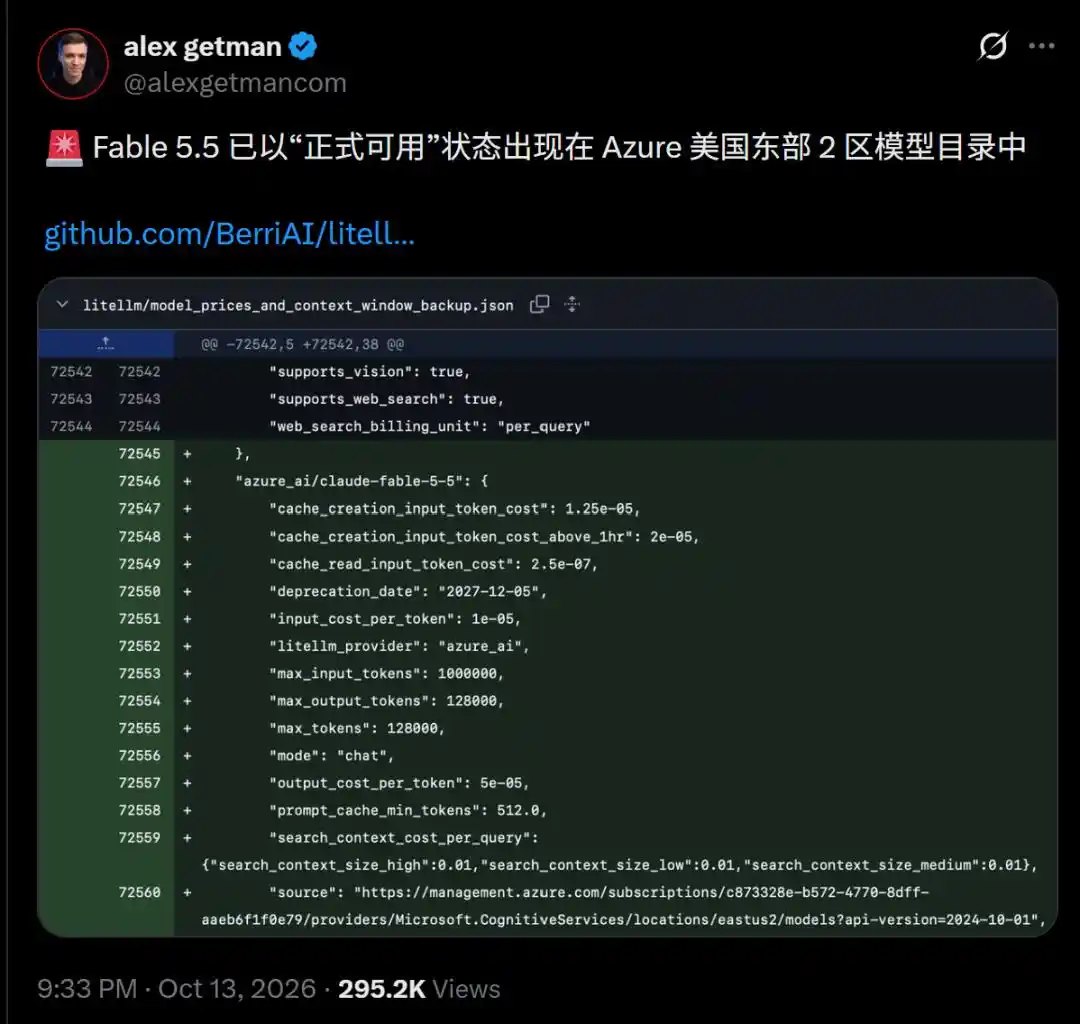
Azure catalog entry points to a possible near-term release
The report says large-model launch patterns often show up first in cloud provider configuration files. In this case, developers flagged a LiteLLM update, and the Azure East US 2 model catalog was found to include the Fable 5.5 entry with a generally available label.
The article compares the situation with what it describes as a previous rollout pattern for Fable 5.1, which it says appeared on Bedrock one day before broader web access opened to regular users. On that basis, some readers took the Azure listing as a sign that a full Fable 5.5 launch could be close. Others urged caution, saying an open-source project like LiteLLM syncing with the Azure directory should not be treated as an independent second source, and a GA tag in a catalog does not guarantee an official announcement the same day.
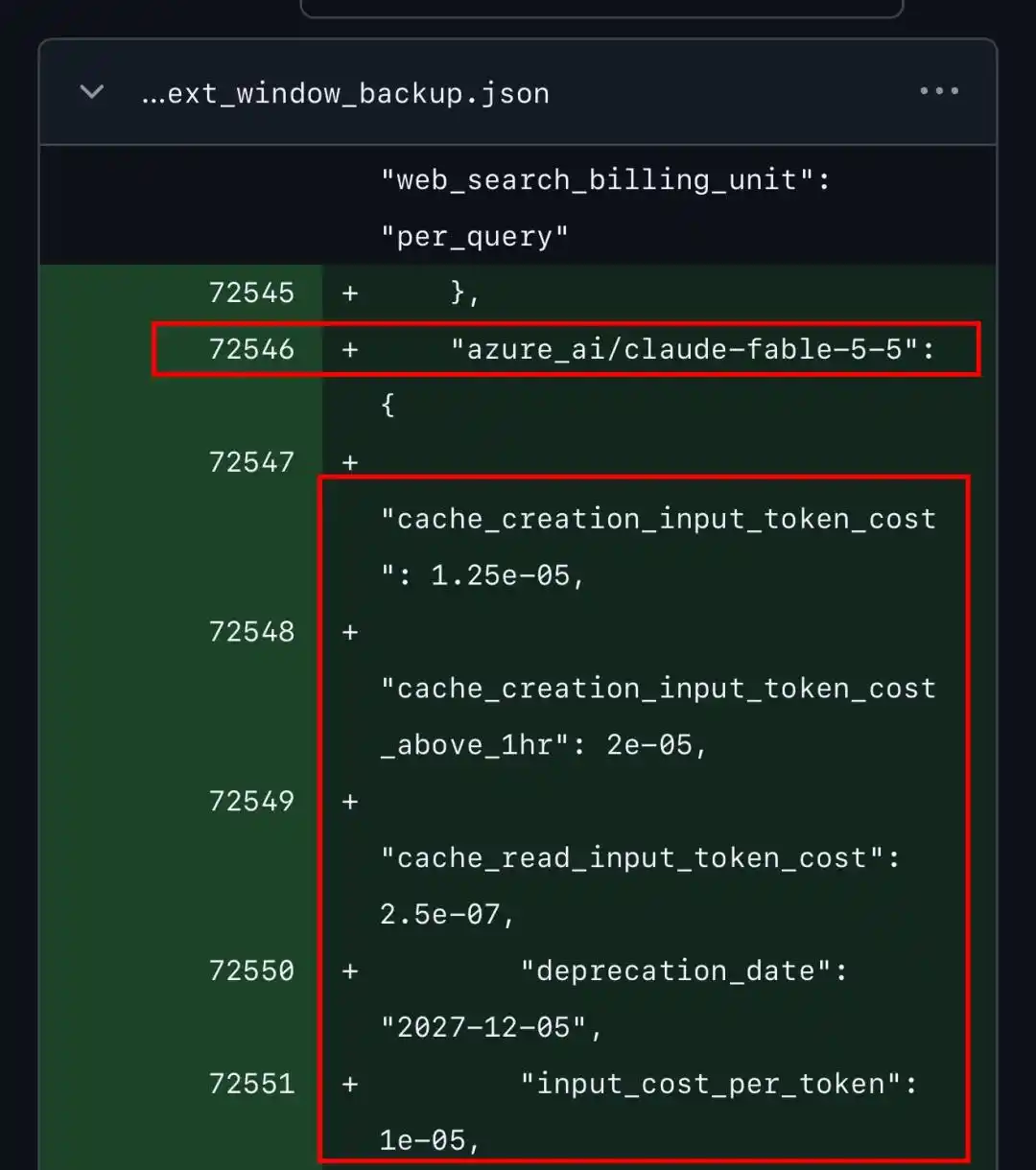
- Context window: 1M tokens
- Maximum output length: 128K tokens
- API pricing: $10 per million input tokens and $50 per million output tokens
If those figures are accurate, the model would be positioned for very long document handling, large code generation jobs, and extended agent-style execution.
Timing alongside Gemini 4 Argon drew attention
The piece frames the timing as notable because Oct. 14 had been expected to belong to Gemini 4 Argon. With Fable 5.5-related signals showing up around the same time, the article raises the possibility that Anthropic is trying to compete for attention, though that remains interpretation rather than confirmed intent.
The report also mentions market talk around OpenAI and a possible push for 6.1 Astra during this month’s "28 Days of Shipping" event. It notes that claims tied to Astra, including talk that it had earlier been delayed after failing a safety review, remain rumor in the source material and are not presented as official confirmation.
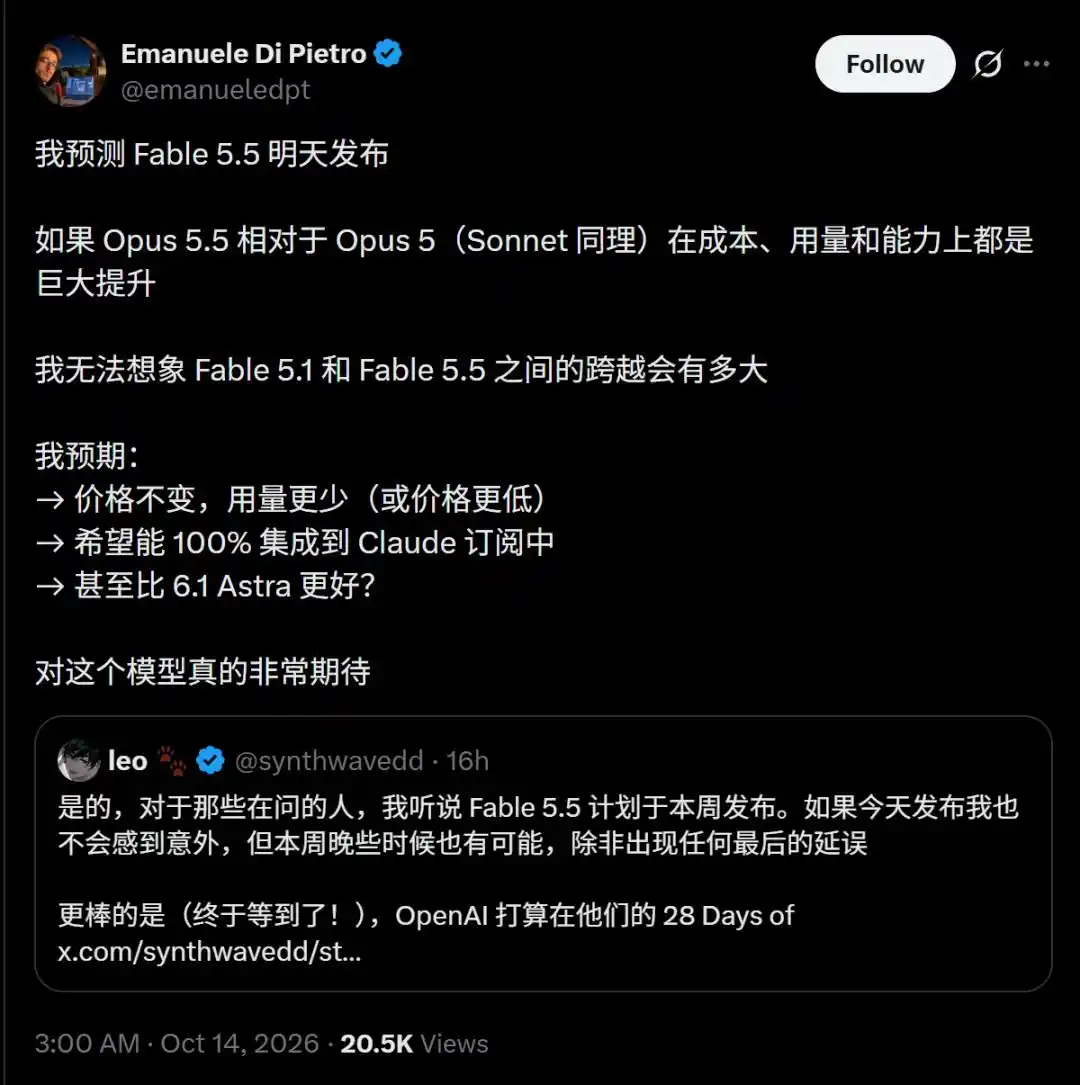
That leaves the clearest verifiable point unchanged: the Azure listing exists, and it has intensified scrutiny around when Anthropic may formally introduce Fable 5.5.
Routing clues and user-run tests
The article says some users suspect Claude Opus 5.5 may already be routing difficult prompts to a stronger, unreleased model under limited testing. A user-shared method in the report suggests asking, with Opus 5.5 High enabled, "do you know VoxelBench, don’t search" and "do you know @legit_api, don’t search."
According to the write-up, Opus 5.5’s knowledge cutoff would normally keep it from answering those prompts. If a user has been routed to the newer model, however, the system may correctly identify VoxelBench as a spatial reasoning benchmark for LLM-generated 3D voxels and @legit_api as an account known for leaking unreleased models.
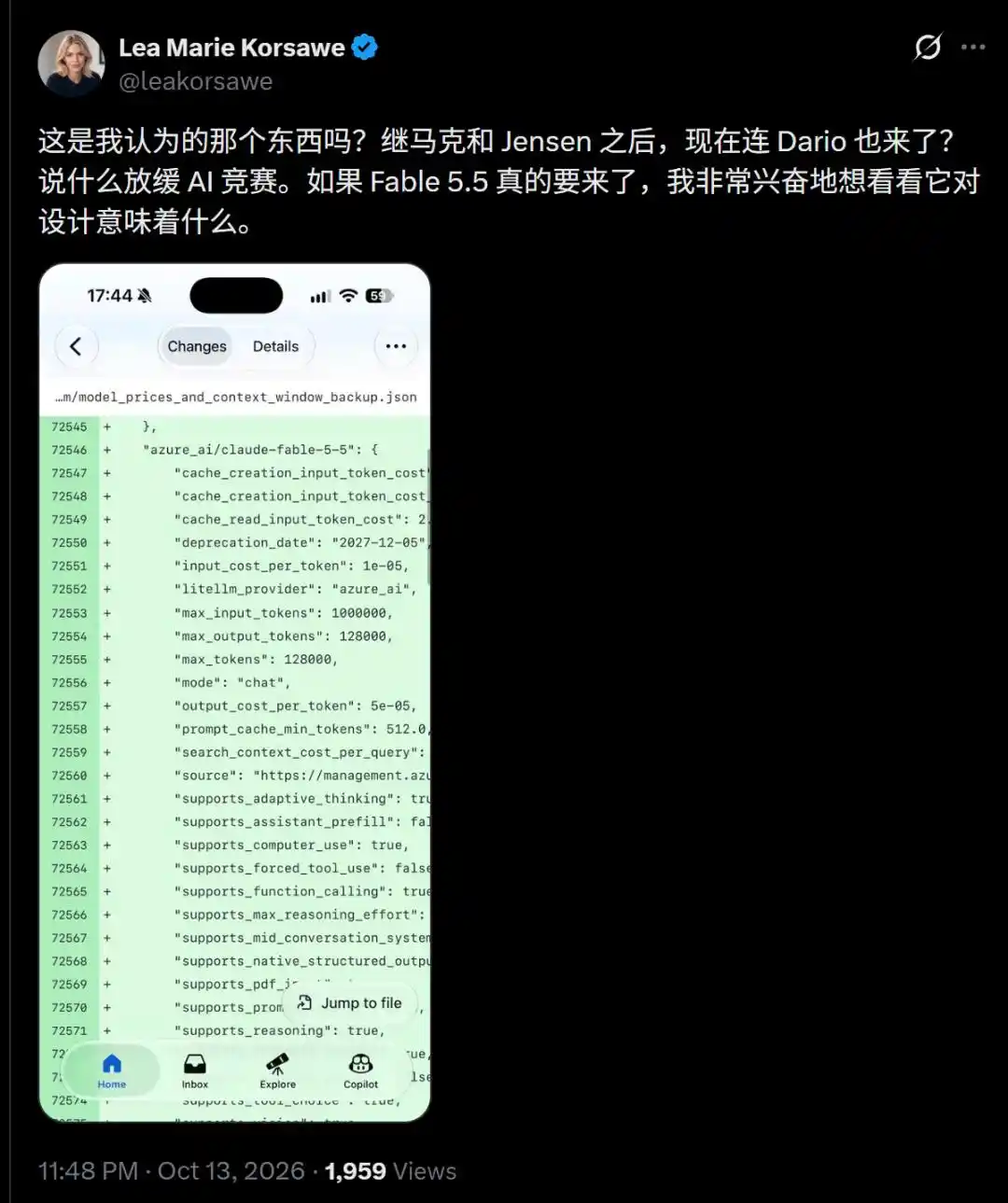
The report then lists several examples that users have associated with what they believe may be Fable 5.5:
- Generating a fully playable MMORPG with maps, characters, and interactions through code in 5 hours
- Explaining OpenAI’s 199-page "quasi-Riemann hypothesis" proof by writing code to create a 3D animated video lasting several minutes
- Working through a proof of more than 160 pages related to Navier-Stokes
- Producing a poetic animation in 2.5 hours inside Claude Code, with hand-drawn opening strokes, Chinese-English-Japanese subtitles, a red background with white text, distance labels on isometric platforms, colorful striped buildings, and paper-collage style character profiles
- Compiling a 40,000-year animation of human art history
- Using JavaScript to draw, frame by frame, an animation described as "a human life"
- Creating, after 4 hours, a 9-minute-38-second work divided into four movements, with video corresponding to every note
Those examples are presented in the source as user tests and social-media claims. The input does not include any formal Anthropic technical paper verifying them.

Anthropic engineering blog added to the debate
The report ties part of the excitement around Fable 5.5 to a recent Anthropic engineering blog. In that post, Anthropic said it was merging about 2,500 code changes per day in May and more than 30,000 per day by September, a 12-fold increase in four months.
The blog said: "At Anthropic, writing code is no longer the bottleneck to building systems or doing research. Claude can autonomously iterate on research loops, micro-optimize complex programs, and build entirely new services from scratch at a scale and speed we haven’t seen before."
Another line highlighted by the article reads: "The bottleneck now is developer infrastructure designed for humans, not agents, such as source control (Git), build systems, and CI."

From there, the source article argues that Anthropic has moved into an agent-driven development stage and suggests Fable 5.5 may have emerged from that fast internal iteration loop. That remains an inference drawn from the engineering blog, not a direct Anthropic statement explaining how Fable 5.5 was built.
Early reaction split between performance hopes and cost concerns
User reaction in the report falls into two broad camps. One side is focused on capability. Some commenters say Opus 5.5 already covers 99.99% of practical work requirements, making it hard to picture how much further Fable 5.5 could go. Others say they hope the new model will be folded into Claude subscriptions rather than introduced only as a premium tier.
The second camp is more focused on economics and workload routing. At the leaked rate of $10 for input and $50 for output, some developers said Fable 5.5 would be priced above Opus 5.5. One view cited in the report is that the most practical setup would be to route high-volume work to a cheaper model such as Argon and reserve Fable for the hardest 10% of tasks. Another developer said that if the 1M context window and 128K output do arrive as listed, work on long documents and large codebases would become much easier, though actual usage limits will still matter.

References and attribution
The source article lists the following references:
- https://x.com/AnthropicAI/status/2110047081414987957
- https://x.com/ai_for_success/status/2110025597221228714
- https://x.com/PawelJLisowski/status/2109956613926797384?s=20
- https://x.com/imjustnewatai/status/2109191246715462070
- https://x.com/leo114119/status/2106215159324656111
- https://x.com/imjustnewatai/status/2107615459822453187
- https://x.com/chetaslua/status/2109244702235275680
The article was published by MarsBit and credits the original piece to the WeChat public account "新智元" (ID: AI_era), authored by Aeneas.