

Axis opened its retail-focused Origin Vault on July 29 and filled the vault’s initial $50 million capacity within 22 hours. The protocol then raised the cap to $100 million. For an early-stage DeFi project with no native token in circulation, that pace stood out.
The response points to a simple market read: even in a crowded yield-bearing stablecoin segment, users are still looking for returns that do not rely on the same underlying drivers used by most existing products.
Axis is packaging institutional arbitrage for on-chain users
Founded in 2025, Axis says it is bringing institutional-grade market-neutral trading on-chain. Its core idea is straightforward. Crypto markets remain fragmented across venues, and the same asset can trade at different prices on different exchanges because of liquidity gaps and timing differences in quotes. Axis uses an automated system to capture those spreads and pass profits through to users.
That puts it in a different lane from the two dominant models in yield-bearing stablecoins today. One bucket leans on U.S. Treasury rates, which leaves yields exposed when the Federal Reserve cuts rates. The other leans on perpetual futures funding rates, as seen in products such as Ethena’s USDe, where yields can fall sharply or reverse when funding turns negative. Axis is pitching cross-market price dislocations as a source of returns that can still exist across different market conditions.
Who is behind the project
Axis ties much of its early credibility to the background of its founding team.
Founder Chris Kim was the first employee at QCP Capital and was involved during the early growth of crypto trading markets. He later co-founded quantitative fund Alphanonce, which has run market-neutral strategies since 2018. According to publicly disclosed figures cited in the article, Alphanonce posted roughly 36% annualized returns, a 4.9 Sharpe ratio, and peak assets under management of about $400 million. Axis notes that Alphanonce and Axis are completely separate legal entities.
The broader team has experience across traditional finance, stablecoin issuance, trading, and DeFi, including backgrounds at BlackRock, Blackstone, Tether, QCP Capital, Alphanonce, Ondo, Maple, and Velodrome. The co-founders are listed as CEO Chris Kim, CTO Justin Im, CIO Changsung Kim, and COO Jimmy Xue.
Backers and private funding
In December 2025, Axis announced a $5 million private funding round led by Galaxy Ventures. Other participants included OKX Ventures, CMT Digital, FalconX, GSR, Maven 11, CMS Holdings, and Marc Zeller, founder of Aave Chan Initiative. The round was said to be four times oversubscribed.
The investor roster reflects a strong trading and market-structure bias. The article notes that Galaxy Digital and its venture arm have backed synthetic dollar and on-chain yield projects before, including Ethena and M^0. FalconX and GSR are established institutional trading and liquidity firms with long experience in cross-exchange arbitrage and market making. OKX Ventures has also invested across stablecoin and payment infrastructure.
Axis says those firms are doing more than providing capital. They are also contributing technical resources tied to liquidity access, market-making strategy, and cross-market execution. The protocol disclosed that $100 million in private capital has already been run through its arbitrage engine in closed testing.
How the product works
Axis revolves around two core assets.
- USDx: a dollar-pegged synthetic asset used as the base settlement unit and hedging instrument inside the arbitrage engine. It does not generate yield on its own. Axis describes it as a settlement coin that sits between the protocol’s internal system and fiat settlement.
- sUSDx: a yield-bearing receipt users receive after staking USDx. Its value rises as the engine captures profits. Axis says profits from cross-market trading and funding-rate income are reflected in the token’s value in real time.
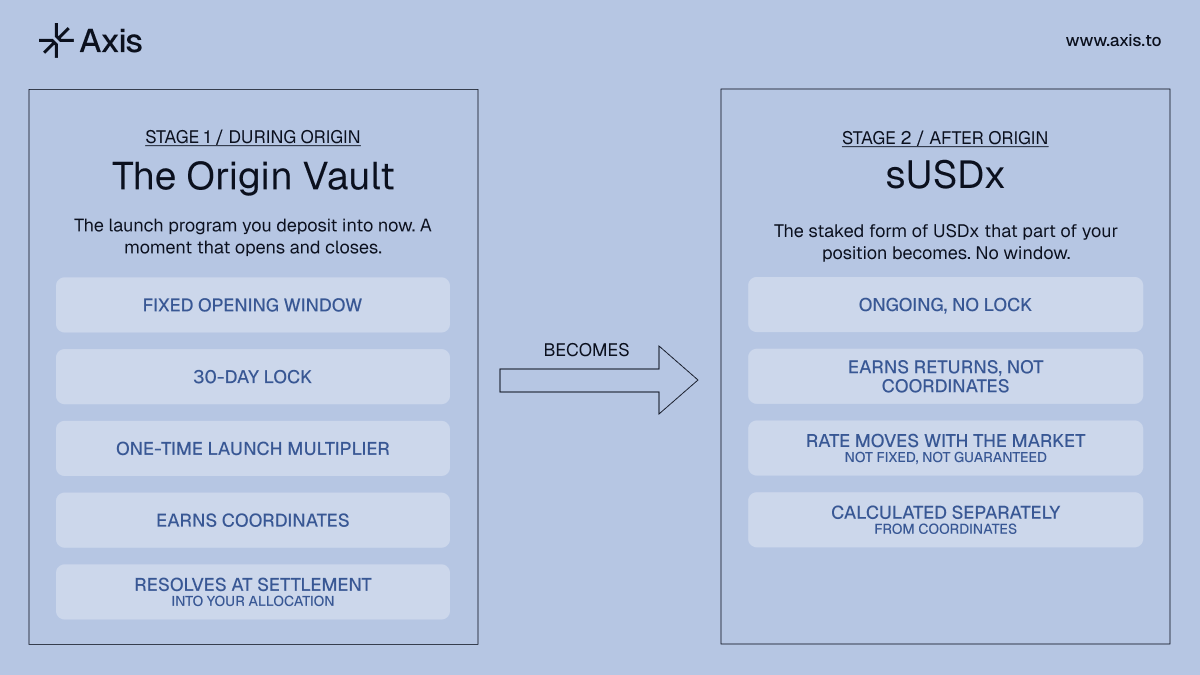
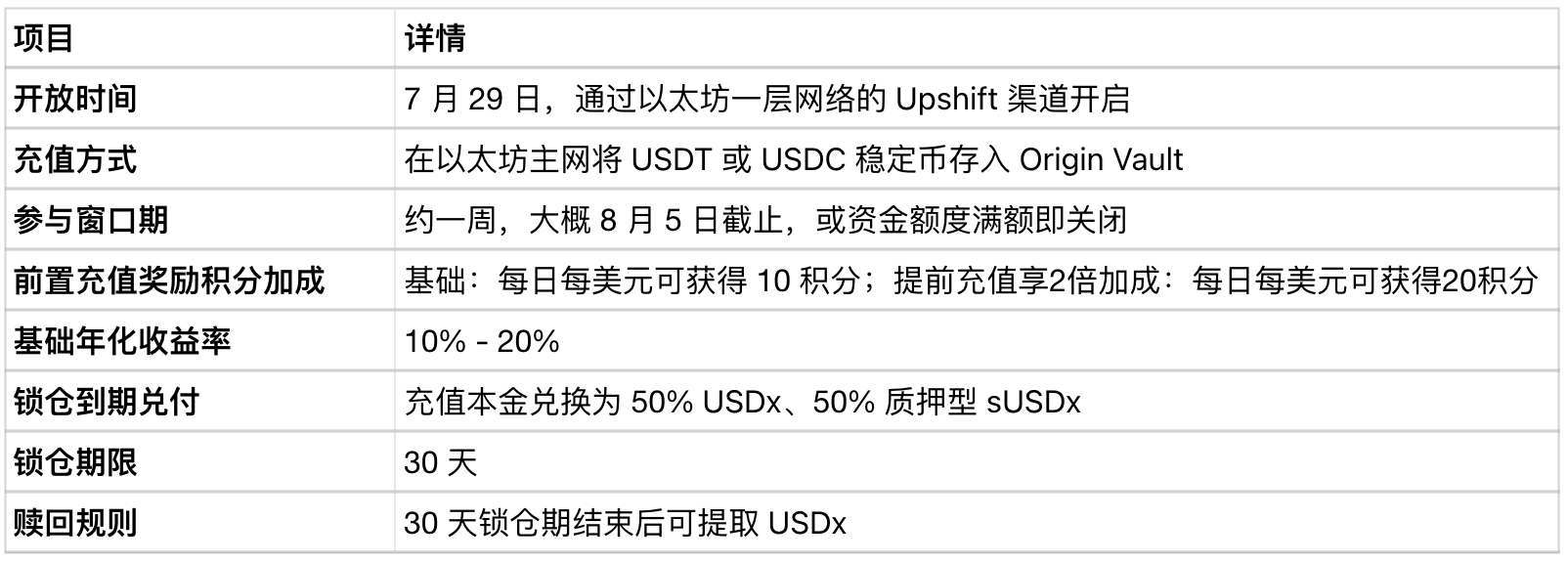
Origin Vault is the first retail-facing stablecoin vault from Axis. Users deposit stablecoins such as USDT and USDC on Ethereum mainnet and receive ogUSDx as a position receipt. After the lockup period ends, the system allocates funds on a 50-50 basis between USDx and sUSDx.
As of July 31, the vault had a $100 million deposit cap and was about 58.7% filled. The multiplier stood at 1.75x, while the first $50 million of deposits received a 2x multiplier. The displayed APY was about 10.4%. Deposits are locked for 30 days, and withdrawals take seven days after a redemption request is made.
The protocol uses on-chain vault infrastructure from Upshift and works with Veda for vault custody, Accountable for independent reserve and performance verification, and Chainlink for on-chain proof of reserves and price feeds.

Axis also disclosed that the first $10 million of USDx was minted on April 8, 2026. As of July 9, institutional-side TVL was about $40 million and APY at that point was 10.54%. The protocol plans to launch on Ethereum and Plasma, which the article describes as a stablecoin-focused chain supported by Bitfinex.
Where the yield comes from
Axis says returns come from real arbitrage spreads rather than token inflation or directional market exposure. The strategy set described in the article has three main buckets:
- Cross-market arbitrage, where the same asset trades at different prices on different exchanges because of liquidity differences.
- Cross-asset arbitrage, including opportunities between crypto markets and foreign exchange markets.
- Funding-rate arbitrage, plus supplementary OTC and RFQ-based strategies.
Axis frames this as going “beyond basis.” In its telling, classic basis trading is only one building block inside a broader allocation engine. The system monitors spot spreads across exchanges, CEX-DEX pricing gaps, cross-currency premiums, and funding-rate opportunities. When one source of return compresses or turns negative, capital can be reallocated to another strategy where spreads still exist. The result, Axis says, is that sUSDx yield should reflect a blended strategy book rather than a single dependence on perpetual funding.
Risk control through delta-neutral positioning
To reduce principal risk from large market swings, Axis uses a delta-neutral approach. Before an arbitrage trade is executed, the strategy sets offsetting positions of equal size in spot and derivatives markets. A long spot position, for example, can be paired with a short futures position of the same notional size, limiting exposure to the underlying asset’s price moves.
Axis says its arbitrage engine posted a 4.9 Sharpe ratio during closed testing. The team also said performance was not materially affected even during periods of sharp price moves in Bitcoin, Ether, or gold. The protocol’s target annualized yield range is 10% to 20%.
How Axis compares with Ethena
The article draws a direct comparison with Ethena, focusing on the mix and stability of yield sources.
Both systems use delta-neutral structures to limit directional risk, but the return profile differs. Ethena’s sUSDe relies heavily on perpetual futures funding rates, supplemented by staking income from assets such as stETH. In periods of one-way bullish sentiment and positive funding, yields can climb sharply, with historical peaks above 50% cited in the article. When sentiment flips and funding turns negative, those yields can drop quickly and may require support from a reserve fund.
Axis says its own return stream is built from a dynamic mix of cross-exchange spot spreads, CEX-DEX spreads, cross-asset arbitrage, and funding-rate opportunities. If the funding backdrop deteriorates, capital can move elsewhere. That should leave the product less tied to the direction of any single funding-rate regime. The current Origin Vault APY, as cited in the article, is about 10.4%.
Roadmap and longer-term plan
Axis lays out a three-phase roadmap.
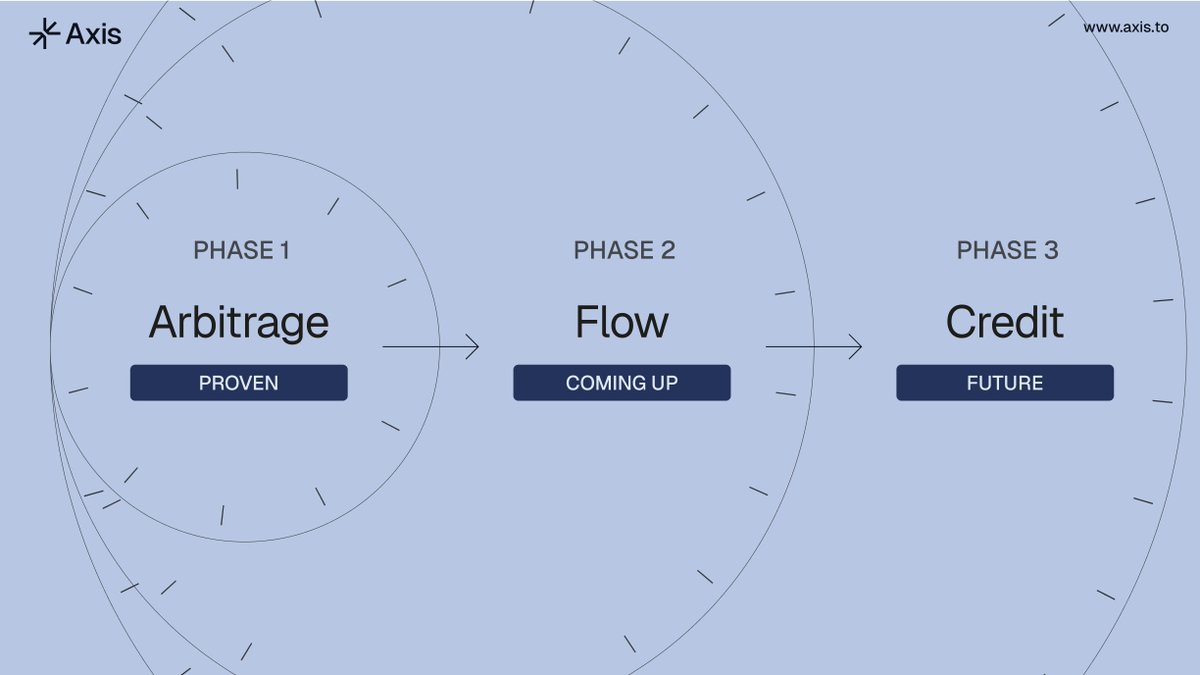
- Phase 1: scale the core engine by expanding eight years of market-neutral trading capability through quantitative research, execution infrastructure, and operating discipline.
- Phase 2: extend beyond USDx to BTCx and GOLDx, using synthetic assets as rails that connect a broader set of institutional balance-sheet exposures to the same engine.
- Phase 3: add a second use case on top of yield generation by enabling RFQ-based conversion into arbitrary assets for brokers, cross-border payments, crypto cards, and, potentially later, trade finance and credit lines.
Axis has not launched a native governance token. The project says returns come from market arbitrage rather than token emissions. Origin Vault introduces a points system called Coordinates, which gives early depositors a multiplier based on when they entered. The team has said early participants may qualify for future governance token allocations and that a public token sale could follow the Origin Vault rollout, though no tokenomics or timetable has been published. Governance remains under multisig control for now.
On transparency, Axis says it gives real-time visibility into reserve assets through dashboards and third-party verification from Accountable, while keeping strategy attribution and detailed profit-and-loss decomposition private. The article summarizes the approach this way: prove the assets exist, but do not disclose how they are deployed.
Risks and open questions
Capacity constraints
Arbitrage strategies face an inherent tension between return and size. As more capital chases the same spreads, those spreads can narrow, and each trade can reduce the very edge it targets. Origin Vault is designed with a long-term goal of handling as much as $1 billion in deposits, but whether the strategy can maintain a Sharpe ratio above 4 while scaling beyond the current $100 million test size remains a central question.
Counterparty exposure
Cross-exchange arbitrage requires capital to sit on multiple centralized exchanges. Even with reserve and performance verification from Accountable and Chainlink, exchange failures, hacks, or asset freezes remain part of the risk picture.
Strategy opacity
Axis uses third-party attestations and verifiable on-chain reserves to improve transparency, but the execution logic itself, including trade frequency and spread-capture rules, remains proprietary. Users therefore have limited ability to independently verify the strategy in detail.
Execution risk and opportunity depth
As assets under management rise, the available spreads may become thinner and less frequent. Actual APY could end up below historical figures cited during testing.
Depeg risk
USDx is a synthetic dollar, not a fully collateralized stablecoin. Axis explicitly says the token can trade away from $1. The article points to a November 2025 example in which another synthetic dollar, USDX, also built around a delta-neutral framework, fell below $0.60 at one point. That case highlighted how off-chain hedging execution, liquidity stress, and redemption pressure can combine into a severe depeg. Axis says it has mint-redeem arbitrage mechanics and an overcollateralization buffer, but it does not claim those features fully eliminate the possibility.
Smart contract and security risk
The protocol’s contracts have been audited by OpenZeppelin. Even so, smart contract risk remains. Reserve assets are also largely held on centralized exchanges, so exchange-level security incidents could affect the safety of those reserves.
Origin Vault participation details
The article also highlights several points retail users need to keep in mind before joining the vault.
- Redemptions: after the lockup expires, users redeem into USDx rather than the original USDT or USDC deposited. Anyone who wants another stablecoin must swap out of USDx separately. A withdrawal request also carries a seven-day waiting period.
- Coordinates points: the 1.75x multiplier applies to deposits made during the early stage of the vault and is set to decline over time. The article says the market broadly expects Coordinates to be linked to future governance token allocation, but Axis has not published final tokenomics, so the points should not be treated as a guaranteed token claim.
- APY is variable: the 10% to 20% figure is a target range. As of July 31, the live Origin Vault APY was about 10.4%, and it moves with actual strategy performance.
- Referral system: Origin Vault has launched a referral feature. Users who share their referral code and bring in deposits can receive extra Coordinates points, and the referred user also receives an added points boost. The exact rate depends on the official page.
- Gas costs: interacting through Ethereum mainnet means users bear network gas fees.
- Official access point: the article advises users to verify links through the official Axis X account, @AxisFDN, or through the official site at https://app.axis.to/origin to avoid phishing sites and fake contract addresses.
What the market is watching now
Axis is trying to answer a long-running DeFi question: can a protocol offer transparent, sustainable yield without leaning on market direction or token incentives. Its answer is cross-market arbitrage, a return source long established in traditional finance but less widely productized for on-chain users.
The team background, funding base, and test data give the project a visible starting point. The first-day response to Origin Vault shows there is appetite for that pitch. The harder part comes next: whether the strategy can hold up as assets scale from tens of millions into larger size, and whether on-chain reserve visibility is enough to offset user concern over centralized exchange counterparty risk.