
Global semiconductor sales rose 131% year over year in July, according to Bernstein’s WSTS tracker released on Sept. 8. The reading stayed high after a 144% increase in June. On a month-over-month basis, sales fell 9.5%, a slightly smaller decline than the historical average seasonal drop of 8.5%.
Bernstein said memory remained the core growth driver. Memory sales jumped 452% from a year earlier and had contributed about $355 billion in incremental industry revenue through July, accounting for nearly 70% of the semiconductor sector’s 111% increase since the start of the year. The report said memory pricing alone explained most of the industry’s gains in 2026.
Even with memory removed, industry sales still rose 35% year over year, showing that demand in non-memory products also remained healthy. On a three-month rolling basis, total industry sales grew 30.4%, well above the historical average of 5.5%. Within that, memory rose 48.3% and non-memory products increased 10.8%.
Most product categories outperformed seasonal patterns in July
Total sales fell 9.5% from June, but most product categories held up better than normal seasonal trends.
- Discrete devices fell 5.9% month over month, better than the seasonal average decline of 10.2%.
- Standard analog linear products rose 8.6%, ahead of the seasonal average of 2.7%.
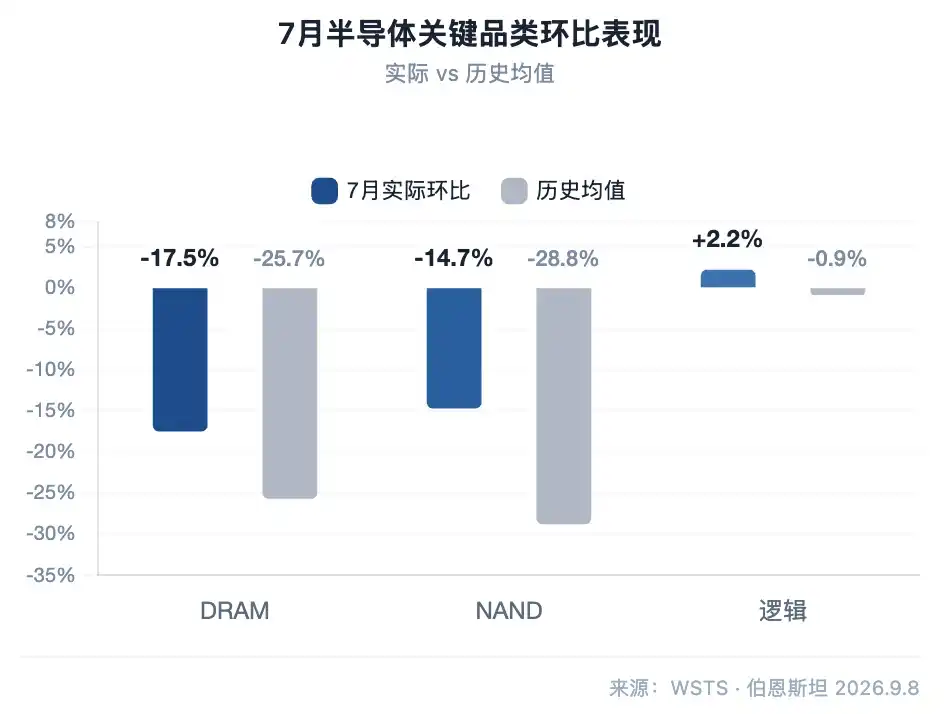
- Logic devices rose 2.2%, compared with a historical average decline of 0.9%.
- MCUs fell 1.5%, better than the seasonal average decline of 9.1%.
- DSPs rose 6.8%, compared with a historical average decline of 5.1%.
- DRAM fell 17.5%, better than the seasonal average decline of 25.7%.
- NAND fell 14.7%, better than the seasonal average decline of 28.8%.
MPUs fell 8.2% month over month, weaker than the seasonal average decline of 5.7%, making them one of the few categories that underperformed historical trends. Optoelectronics, sensors, and application-specific analog products were broadly in line with historical averages.
Regional performance diverged sharply, with China down 28%
On a year-over-year basis, every region posted growth. Sales in the Americas rose 172.6%, Europe increased 89.8%, Japan gained 58.4%, China climbed 97.5%, and the rest of Asia-Pacific advanced 140.3%.
Month over month, regional results were far more mixed. The Americas slipped just 0.4%, Japan rose 1.6%, Europe fell 4.4%, the rest of Asia-Pacific declined 4.7%, and China dropped 28.0%.
Excluding memory, regional month-over-month changes were +13.3% for the Americas, -5.9% for Europe, +0.2% for Japan, -5.9% for China, and -0.9% for the rest of Asia-Pacific. Bernstein said the sharp decline in China was mainly tied to swings in memory pricing.
Shipments were flat while ASP stayed supported by memory prices
Overall shipment volume was nearly unchanged in July, down 0.3% from the prior month, while average selling price, or ASP, fell 9.3% month over month. On a year-over-year basis, shipment volume rose 16.3% and ASP increased 98.8%. Memory pricing remained the main reason ASP posted such a large annual gain.

Shipment performance varied by category. Discrete devices, optoelectronics, and DSPs recorded month-over-month shipment increases. Sensors, standard analog linear, logic, MPUs, MCUs, DRAM, and NAND posted shipment declines. On a three-month rolling basis, total shipment volume rose 10.2%, and every category showed growth.
Memory ASP continued to move higher. DRAM bit pricing rose 6.5% month over month and NAND bit pricing rose 9.5%. That stood in contrast to memory shipment volumes, which fell more than 20% from the prior month, indicating that price remains the dominant force behind industry growth.
Autos and computing outperformed seasonal trends
ASIC sales rose 0.5% month over month, better than the historical average decline of 2.5%. In end markets, computers and peripherals rose 2.8%, ahead of the seasonal decline of 3.0%. Automotive fell 0.5%, better than the seasonal decline of 5.3%. Multifunction and other categories declined 3.6%, better than the seasonal decline of 5.6%.
Consumer electronics fell 8.2%, weaker than the seasonal decline of 6.0%. Wireless communications dropped 6.1%, weaker than the seasonal decline of 0.1%. Wired communications rose 1.2%, below the seasonal increase of 3.9%.
Based on Bernstein’s figures, the semiconductor sector in July continued to show a price-driven and structurally uneven pattern. Memory price increases remained the main source of aggregate growth, while the 35% year-over-year increase in non-memory sales suggested the industry’s fundamentals were not concentrated in a single category. Regionally, China’s sharp month-over-month decline was notable, but under Bernstein’s framework, the move was mainly linked to memory price volatility.
This article is a整理与解读 of a third-party brokerage research report from Bernstein dated Sept. 8, 2026, combined with public market information, according to the source text. It added that any ratings, target prices, earnings forecasts, and related judgments cited in the piece were the views of the brokerage’s analysts, represented only their institution, did not represent Chaoxiang Research, and did not constitute investment advice.
The source text also stated that markets carry risk, decisions should be made independently, and the article should not be used as a basis for buying or selling any securities.