
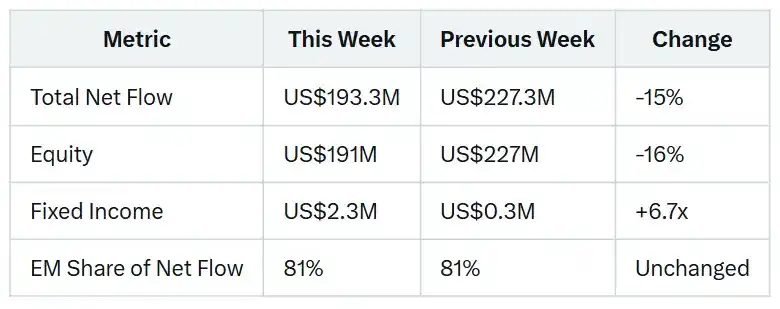
More than a month has passed since Binance announced its stock trading business on June 1, and the first batch of operating data now offers a clearer view of how the product is being used. According to official disclosures, more than 700 names have already traded out of a universe of over 7,000 listed U.S. stocks and ETFs available on the platform. That means roughly 10% of the product shelf saw activity in the first month. For the week ending July 1, Binance stock users added $193.3 million in net equity exposure, following $227.3 million the previous week. While that was down around 15% week over week, it still marked the second consecutive week above the $190 million threshold.
Spot stock trading shows real early demand, led by emerging markets
Binance’s spot stock offering currently covers more than 7,000 U.S.-listed stocks and ETFs, with fractional share purchases, stablecoin settlement, and extended trading hours. On July 6, the platform added more names including ANTA, CBRS, DISK, FOTO, KMEM, QNT, and STRC. In terms of market structure, Nest Trading handles order routing, while Alpaca Securities is responsible for execution, clearing, settlement, and custody.
The usage data suggest the business is not merely a headline launch without follow-through. Having over 700 instruments trade in the first month indicates genuine participation. At the same time, the figures also show that demand has not spread evenly across the full universe of available names. Users are not approaching Binance as a complete U.S. brokerage replacement with broad portfolio construction across thousands of tickers. Instead, they are selectively trading a smaller set of highly watched names and themes.
Flow data point even more clearly to where this demand is coming from. Binance Research said that 81% of net inflows for the week ending July 1 came from emerging markets, a share that remained unchanged for two consecutive weeks. In a separate earlier study, Binance Research also said nearly 93% of Binance stock-trading users were from emerging markets. That suggests Binance is not primarily winning users in the most mature brokerage markets. Rather, it is finding traction in regions where cross-border access, local brokerage quality, and direct U.S. dollar asset allocation may be more limited or less convenient.
That geographic profile matters. For many users in emerging markets, buying U.S. thematic stocks, leveraged ETFs, or high-profile private-market names transitioning toward public-style exposure often comes with higher friction, longer funding paths, or weaker local market infrastructure. By placing stablecoins, crypto assets, and U.S. equities inside the same account environment, Binance appears to be lowering the execution barrier for cross-asset thematic trading rather than recreating the full experience of a traditional long-term investing platform.
Technology drew 83% of net inflows as event-driven thematic trading took over
The bigger question is not whether there is demand, but what kind of demand it is. Binance’s weekly data show that for the week ending July 1, the technology sector absorbed $159 million in net inflows, accounting for 83% of all stock-related net inflows on the platform. That concentration points to a very specific user behavior: thematic, catalyst-driven trading rather than broad market exposure.
The clearest trigger that week was Micron’s earnings release. After Micron reported strong results after the close on June 24, the AI memory theme swung from a $1 million net outflow the previous week to a $47 million net inflow. Semiconductor inflows rose from $22 million to $108 million, almost a fivefold increase. At the single-name level, MU, MUU, SNDK, AMAT, and INTC attracted meaningful buying tied to AI memory and semiconductor supply-chain narratives. MU together with the 2x leveraged product MUU pulled in a combined $58 million, equal to about 30% of that week’s total stock net inflows.
Importantly, the flows do not appear to be pure momentum chasing. Binance’s weekly report said users were net sellers of $11 million in MUU in the week before the earnings release, then turned into net buyers of $24 million after the results were confirmed. That pattern suggests users are actively managing event risk. In other words, this is high-risk appetite, but not necessarily indiscriminate leverage. Traders reduced exposure before the catalyst and rebuilt positions once the outcome became clearer.
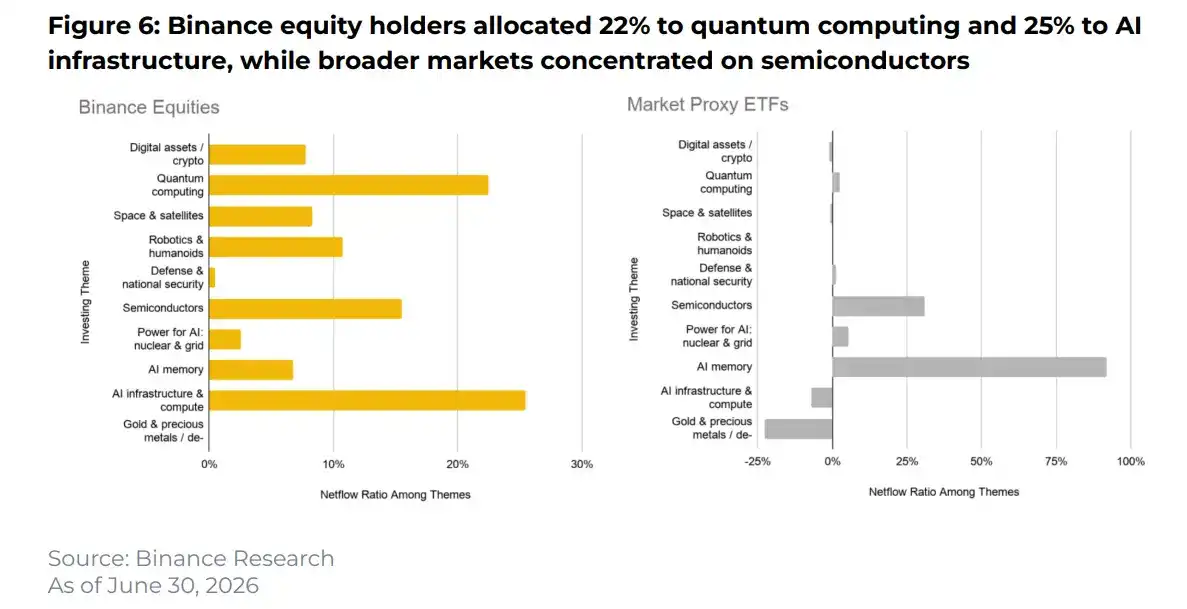
The concentration in technology also shows up in holdings. Binance said roughly 71% of stock-product holders’ equity positions were allocated to the tech sector, with about 48% of capital going specifically to semiconductors. The trading volume in that category was said to be around 23 times higher than in other categories. Looking at sub-themes, 25% of flows went to AI infrastructure and compute, 22% to quantum computing, while frontier themes such as space and satellites, robotics, and humanoid robots also saw elevated allocations. By contrast, broader ETF flows in the same period were centered mainly on semiconductors and AI memory.
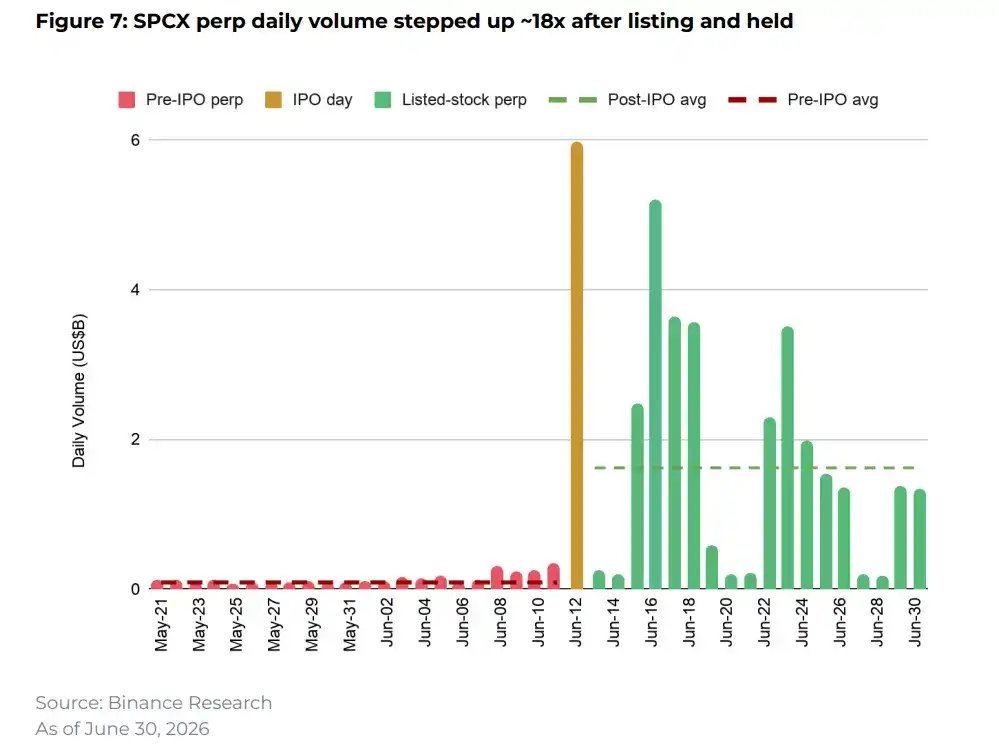
The flip side is how quickly attention rotates. The defense and national security theme, which had been the hottest trade in the previous week, fell from $150 million in net inflows to just $3 million, a drop of 98%. SpaceX-related flows also pulled back from their prior highs, though SPCX still logged $29 million in net inflows and remained among the leaders at the single-name level.
Taken together, the data suggest Binance stock users are not building conventional long-duration U.S. equity portfolios. They are trading narrative-heavy assets linked to AI, semiconductors, quantum computing, SpaceX, Tesla, Circle, and similar stories. Their framework revolves around earnings, policy, M&A, and sentiment shifts. In that sense, the trading logic looks much closer to what crypto-native users already know: catalysts, volatility, positioning, and rapid theme rotation.
bStocks found an after-hours use case, but market share is far from settled
Beyond spot stocks, Binance launched its tokenized stock product bStocks on June 11. The company describes bStocks as tokenized securities, or certificates representing specified financial instruments, rather than direct ownership of the underlying listed shares. If spot stocks answer whether users can buy U.S. equities on Binance, bStocks answers a different question: whether users still want to trade U.S. equity exposure when the regular stock market is closed.
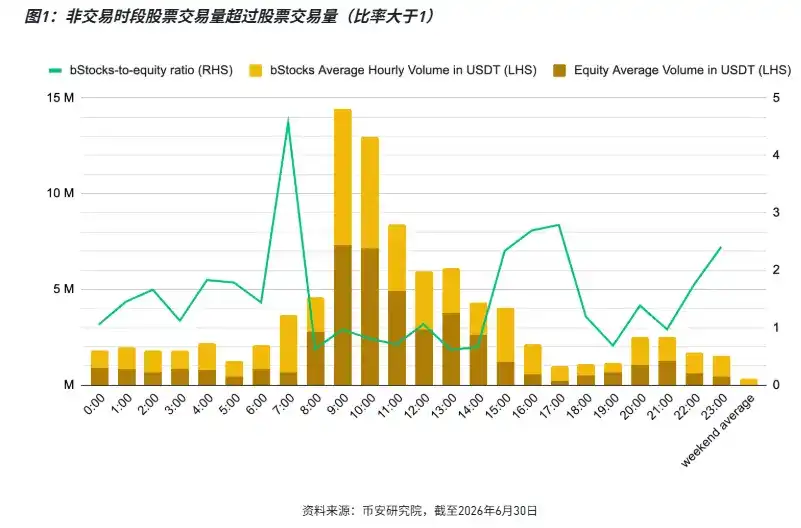
A Binance Research report published on July 2 indicated that about 44% of bStocks trading volume occurred outside regular U.S. stock market hours, compared with roughly 32% for the matching spot stock product. On weekends, when U.S. equity markets are fully closed, bStocks still averaged around $346,000 per hour in trading volume. Across three holiday-weekend stress tests, bStocks captured 87% of the Monday opening move in advance and got 21 out of 22 directional calls right, implying a 96% hit rate. During the Juneteenth long weekend, the average price gap between bStocks and regulated markets was about 0.12%, the narrowest among the three tests.
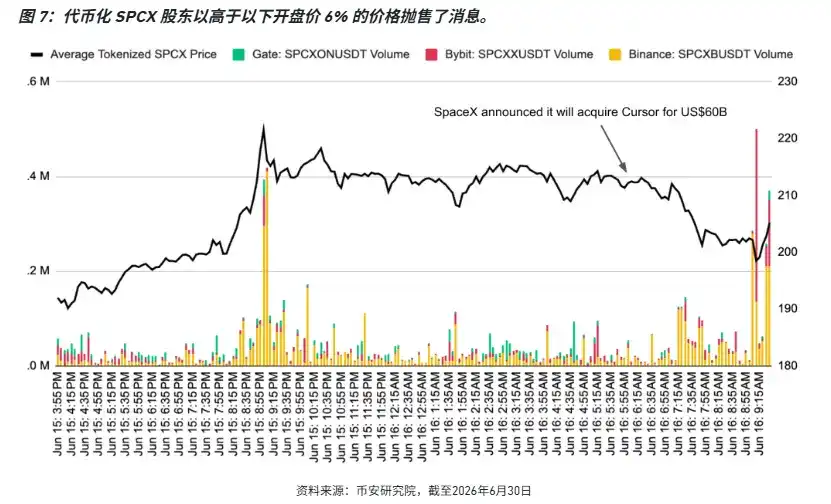
The case studies are equally telling. News that SpaceX had confirmed a $60 billion acquisition of Cursor emerged before the U.S. stock market opened, and tokenized SPCX had already moved up and then retraced before the cash market started. In another example, Micron released earnings two minutes after the regular close. MUB rose 7% within five minutes and 13% within an hour, with most of the repricing effectively complete before the next market open.
Those results point to a concrete product-market fit for tokenized equities: the ability to express U.S. stock exposure when Wall Street is closed. The use case is not that every investor wants every stock “on-chain” by default. It is that some traders want uninterrupted access to price discovery and directional positioning around earnings, headlines, and macro or corporate events that happen outside regular market hours.
That said, validated demand does not automatically mean Binance’s own tokenized product is capturing most of it. On June 26, BNB Chain said there were already more than 709 tokenized stocks and ETFs on the chain, with cumulative trading volume above $5 billion and market capitalization above $1 billion. The same underlying company may also exist in multiple tokenized wrappers at once. SpaceX, for example, appears in bStocks as SPCXB, in Ondo as SPCXon, and in xStocks as SPCXx.
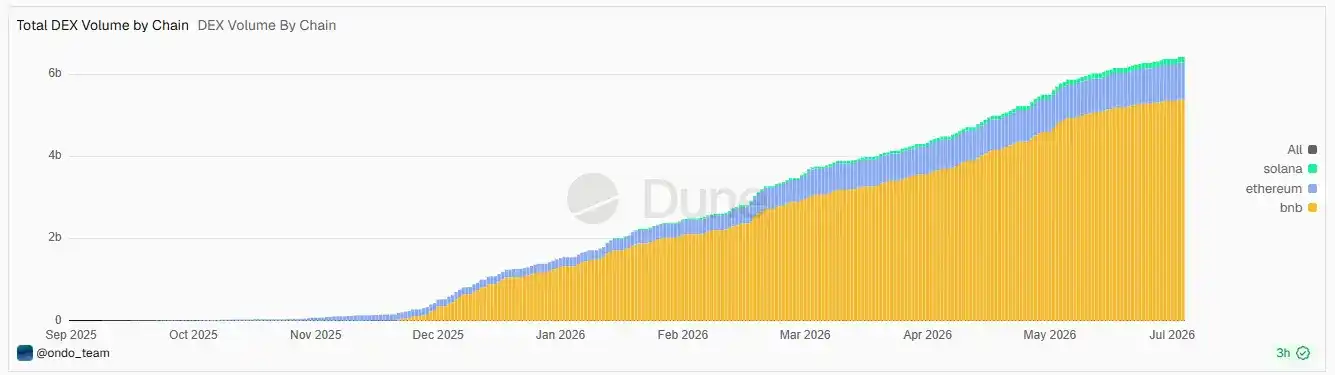
More importantly, much of the observed on-chain activity seems to be happening outside bStocks. According to Dune data cited in the report, BSC accounted for $5.12 billion of Ondo’s roughly $6 billion cumulative DEX trading volume. That implies the broader demand for tokenized equities may already be proven, but a large share of the incremental volume is not necessarily accruing to Binance’s proprietary tokenized product.
After one month, Binance has demand, but it looks distinctly crypto-native
After 30 days, Binance’s stock business appears to have established genuine early demand. Roughly one-tenth of its more than 7,000 available stock and ETF instruments have already seen trading, and weekly net exposure growth has stayed above $190 million for two straight weeks. But the demand profile is narrow: heavily concentrated in emerging-market users, focused on a limited set of heavily watched assets, and overwhelmingly tilted toward technology narratives such as AI memory and semiconductors.
Meanwhile, bStocks has shown that off-hours trading of U.S. equity exposure is a real use case, and its price discovery has held up through several holiday stress tests. Even so, Binance does not yet appear to have clear evidence that it dominates the tokenized equity stack, especially with third-party protocols such as Ondo already capturing substantial volume on-chain.
All of this has unfolded against a challenging regulatory backdrop. On June 24, Binance withdrew its MiCA license application in Greece. After the EU transition period ended on July 1, the exchange notified users in multiple European countries that some services would be suspended and new user registrations halted. Even in that environment, the stock business has still found traction. Based on the first month of data, however, what Binance has unlocked looks less like traditional long-term U.S. equity allocation and more like crypto-native users carrying their catalyst-driven trading habits into the stock market.