
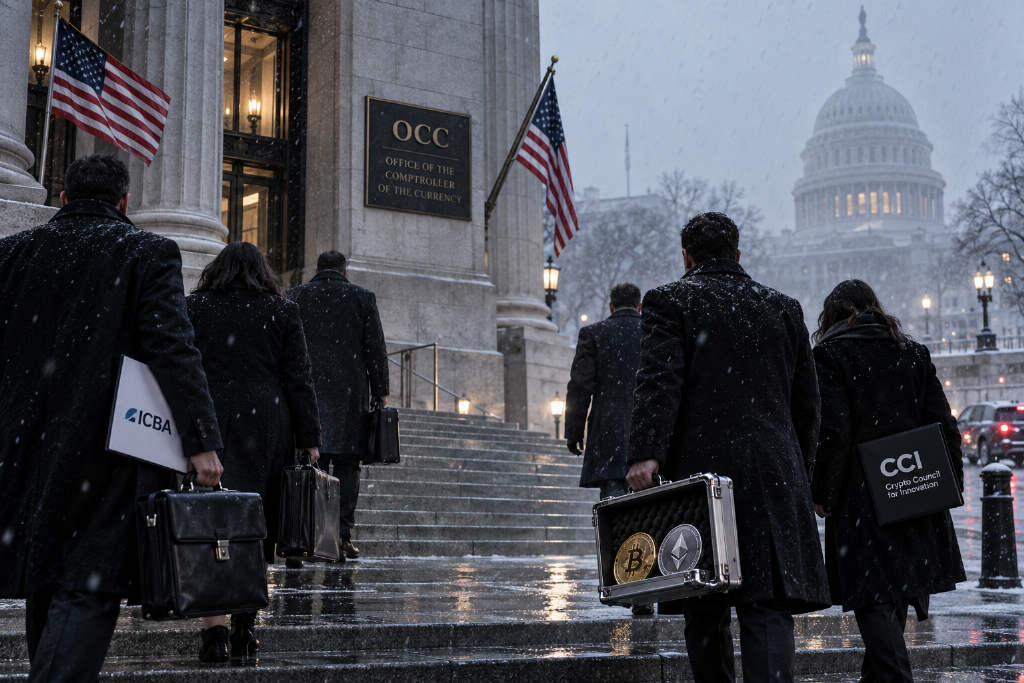
Crypto Council for Innovation (CCI) has answered back after the Independent Community Bankers of America (ICBA) sued the Office of the Comptroller of the Currency (OCC), saying crypto companies seeking national trust bank charters are pursuing lawful financial innovation and should not be blocked by incumbent banking interests.
CCI CEO Ji Hun Kim said Monday that the ICBA lawsuit is a 「clear attempt to resist national trust charters, payment innovation, and competition in financial services」. He also said CCI remains 「confident」 that the OCC will continue approving charter applications from crypto firms, even as some lawmakers argue that exchanges are trying to avoid the basic safeguards and obligations that come with being a bank.
ICBA’s lawsuit targets OCC charter approvals
ICBA filed its complaint last Friday in federal district court in Washington, D.C., accusing the OCC of approving bank charters for multiple entities, including crypto companies, without sufficient safeguards. The banking group argues that these firms benefit from the credibility attached to a federal bank charter while not following the same rules that apply to insured depository institutions.
In a statement, ICBA President and CEO Rebeca Romero Rainey said: 「Congress did not establish the national trust charter so crypto companies could use it as another entry point into the banking system, gain the credibility of a federal bank charter, and still avoid Community Reinvestment Act obligations, uniform supervision, capital and liquidity standards, and FDIC deposit insurance requirements.」
Which crypto firms have received OCC approval
According to the report, the OCC has approved or conditionally approved several crypto-related charter applications during President Donald Trump’s current term. The list includes:
- World Liberty Financial
- Circle
- Ripple
- Fidelity Digital Assets
- BitGo
- Paxos
The report identifies World Liberty Financial as a crypto company co-founded by members of the Trump family. It describes Circle as the issuer of USDC, Ripple as the operator of the XRP platform, Fidelity Digital Assets as Fidelity’s digital asset business, BitGo as a crypto custodian, and Paxos as a platform focused on stablecoins and tokenized assets.
Those approvals have drawn attention from lawmakers in both parties. The charter for World Liberty Financial has received particular scrutiny. The report says it was approved under the leadership of OCC Comptroller Jonathan Gould, a Trump appointee who has been in office since July 2025 and is viewed as a crypto-friendly regulator.
Political pressure is building around the approval process
World Liberty Financial’s approval has become especially controversial. The report says the company was co-founded by members of the Trump family and has faced questions over alleged ties to the royal family of the United Arab Emirates. Democratic senators have pressed the OCC to explain whether the approval process was handled properly.
Senator Elizabeth Warren, through the Senate Banking Committee, questioned the OCC’s approach and said crypto exchanges 「want to avoid the basic safeguards and obligations that come with becoming a bank」. She called on the agency to revisit its chartering standards.
CCI says the charter path should continue
CCI’s response shows that the crypto industry is strongly backing the OCC’s trust charter route. The report says the agency’s approval process is expected to continue even with the ICBA lawsuit in motion.
For crypto companies, a national trust bank charter carries major weight. The report says it would allow firms to legally offer deposit accounts, payment settlement, and interbank transfer services, narrowing the gap between crypto assets and the fiat financial system. Circle, Ripple, and Fidelity Digital Assets already hold significant market share in stablecoins, institutional custody, and tokenized assets. A bank charter would let them connect directly with mainstream finance under a compliant structure.
At the same time, the lawsuit highlights pressure felt by traditional banks as crypto competitors move closer to the banking system. The report says the United States has more than 4,500 community banks, many of which have long relied on relatively low-competition local markets. If large crypto firms can secure federal bank charters with lower compliance costs, that could squeeze the room available to community banks.
The report adds that the case is unlikely to change the OCC’s approval pace in the short term. Over a longer horizon, though, it could shape how Congress approaches legislation around the charter system, especially if Democrats retake the House after the midterm elections and push for tighter oversight.