
U.S. investors are a step closer to trading stock perpetuals onshore through regulated venues.
On Nov. 3, Commodity Futures Trading Commission Chair Michael S. Selig issued a statement formally allowing equity perpetual futures to be listed on regulated U.S. exchanges. Perpetual futures have long been one of crypto’s signature market structures: they do not expire, they avoid repeated rollovers, and they use funding rates to keep prices aligned with spot markets. With the CFTC’s approval, a product that first took shape in offshore crypto trading is now moving into the tightly regulated U.S. equity market.
That would give U.S. investors a way to go long or short stocks such as Apple, Nvidia, and Tesla without directly holding the shares. For trading platforms that have been trying to bring onchain-style derivatives into the U.S., the move marks a major opening. Wall Street firms reacted almost immediately. As soon as the CFTC decision landed, traditional market players led by Citadel Securities and Cboe moved to challenge it in court.
Four venues are positioned to move first
According to Selig’s statement, the contracts are being classified as Security Futures Products under the Commodity Futures Modernization Act. They are treated as approved under CFTC Regulation 40.3. That means they are not governed by the CFTC alone. They also sit within the legal and regulatory framework shared with the U.S. Securities and Exchange Commission.
Selig said innovative products such as security futures had remained in a gray area for years because the CFTC and SEC lacked coordination. The two agencies signed a memorandum of understanding this year, and the latest approval is part of that coordination effort.
Even with the regulatory path opened, not every platform can launch immediately. Bankless founder David Hoffman summarized four conditions for venues that want to list stock perpetuals right away:
- They must hold a CFTC-registered Designated Contract Market, or DCM, license.
- They must clear trades through a registered Derivatives Clearing Organization, or DCO.
- They must complete dual registration with the SEC by filing Form 1-N and becoming a notice-registered national securities exchange.
- They must have submitted rule changes for equity perpetuals during the filing window from late September to early October and completed the 45-day review period.
At this stage, only four U.S. venues have completed the full process and appear positioned for the first wave.
Kalshi
KalshiEX LLC is one of the earliest movers. After securing the first BTC perpetual contract in May, Kalshi filed for equity perpetuals in late September. Its filing shows an initial lineup of 58 popular U.S. stock contracts, including Apple, Tesla, and Nvidia. The rules set a 15.50% initial margin floor, equal to roughly 6.5x maximum leverage. Trading would run 23 hours a day, five days a week, from 6 p.m. Sunday to 5 p.m. Friday Eastern Time. Funding would be settled daily based on observations from regular U.S. stock trading hours.
Coinbase Derivatives
Coinbase Derivatives, LLC filed with both the SEC and CFTC on Sept. 18. Its design uses cash settlement and does not involve delivery of actual shares. Trading hours would run from 8 p.m. Sunday to 5 p.m. Friday Eastern Time. Funding would be calculated hourly and settled in cash through margin accounts. With the statutory 15% margin floor for security futures, the leverage cap works out to about 6.7x.
Kraken through Bitnomial
Kraken is using Bitnomial Exchange, LLC, a derivatives venue under parent company Payward, which filed its rule change on Sept. 18 as well. Bitnomial set a 15.25% customer margin floor for unhedged positions. Through that route, Kraken and other major U.S. retail platforms would be able to distribute onshore stock perpetual products to eligible users.
Nadex / OG.com under Crypto.com
Nadex, now also operating as OG.com Markets within Crypto.com’s North American derivatives structure, filed a new Chapter 16 of its rulebook with the CFTC on Sept. 24 after receiving SEC acknowledgment of its Form 1-N filing. The filing establishes trading in cash-settled perpetual single-stock futures, or Perpetual SFPs, along with a real-time funding-rate pricing mechanism.
The article also notes that Robinhood recently designated OG.com as the clearing infrastructure partner for its prediction market business, a detail that could expand the practical reach of that license.
Getting through the approval gate does not mean exchanges can list any stock they want. They still have to follow the listing standards in their filings, including requirements tied to public float, trading volume, pricing reliability, and resistance to manipulation. The regulator has opened the door to the product category, but each exchange still has to screen which stocks qualify.
Lighter and Hyperliquid are working on separate routes
Beyond the four licensed centralized venues, crypto-native perpetual DEXs are also trying to build compliant access to the market.
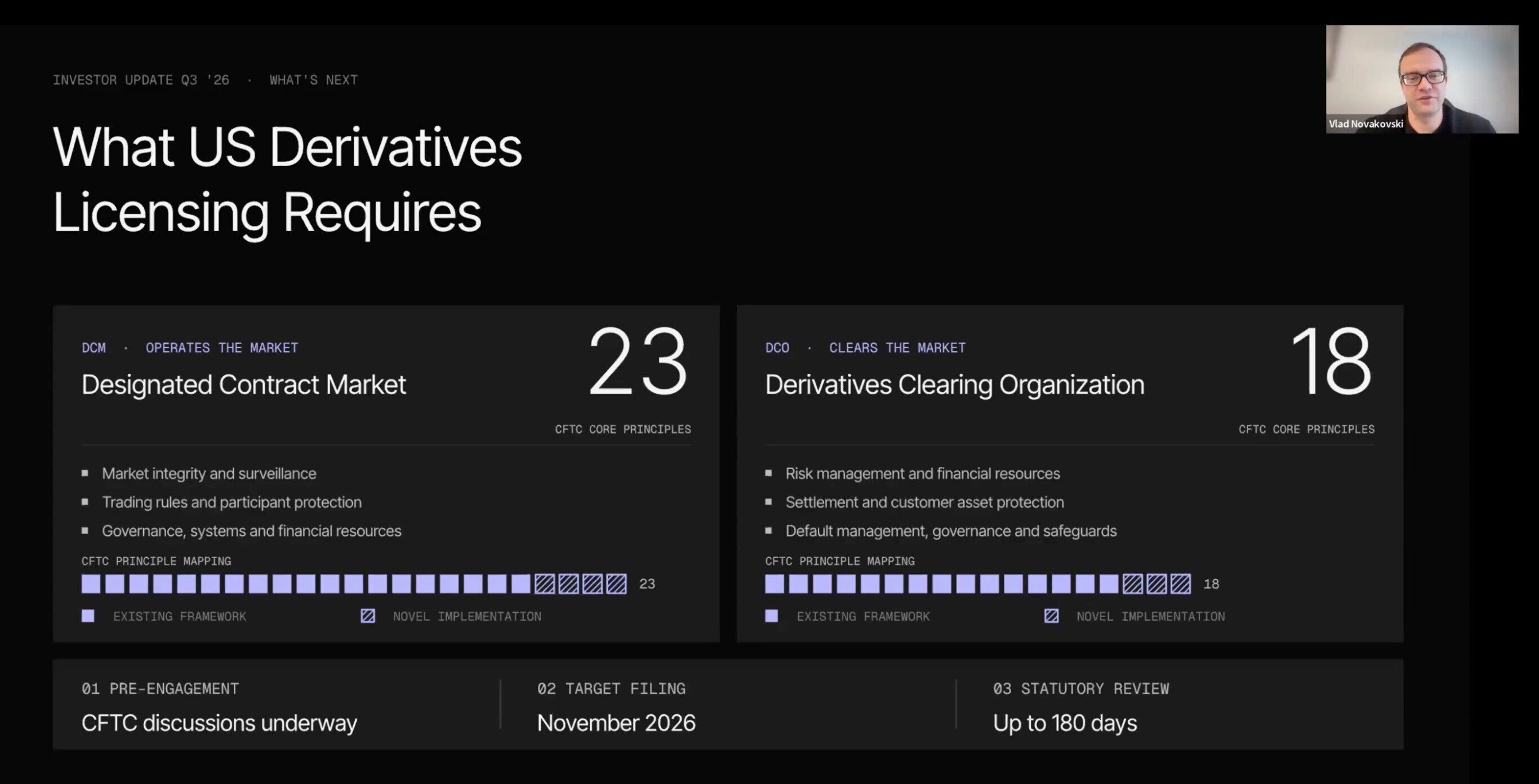
Lighter has given the clearest public timeline. During its third-quarter investor call on Oct. 21, founder Vladimir Novakovski said the team planned to apply in November for Designated Contract Market status with the CFTC and also seek registration as a Derivatives Clearing Organization. The first license would cover the trading venue itself. The second would cover post-trade clearing and risk management.
Novakovski said, 「After the application is submitted, regulators have a statutory review period of up to 180 days. Because we have already had extensive engagement with the CFTC and completed all preparatory work, we expect the review process to go very smoothly.」
Hyperliquid is also pushing forward, though the route appears different. In August, Trump publicly said that Selig was working to bring Hyperliquid into the U.S. market in a fully compliant and lawful way. A policy advocacy group closely tied to the project, Hyperliquid Policy Center, later submitted comments to both the SEC and CFTC arguing that perpetuals with futures-like characteristics should be classified as security futures, allowing exchanges overseen by both agencies to participate.
On Oct. 29, Intercontinental Exchange, the parent company of the New York Stock Exchange, announced a partnership with TradeXYZ, a HIP-3 market in the Hyperliquid ecosystem. The plan is to build a regulated perpetual futures market and clearing system in the U.S. based on Hyperliquid. The proposal still needs regulatory approval, but it points to another model: Hyperliquid may not need to convert its existing DEX directly into a licensed U.S. exchange if a partner can build a separate compliant market while Hyperliquid continues to provide the underlying infrastructure.
Wall Street files suit the same day
The pushback came almost as soon as the approval did.
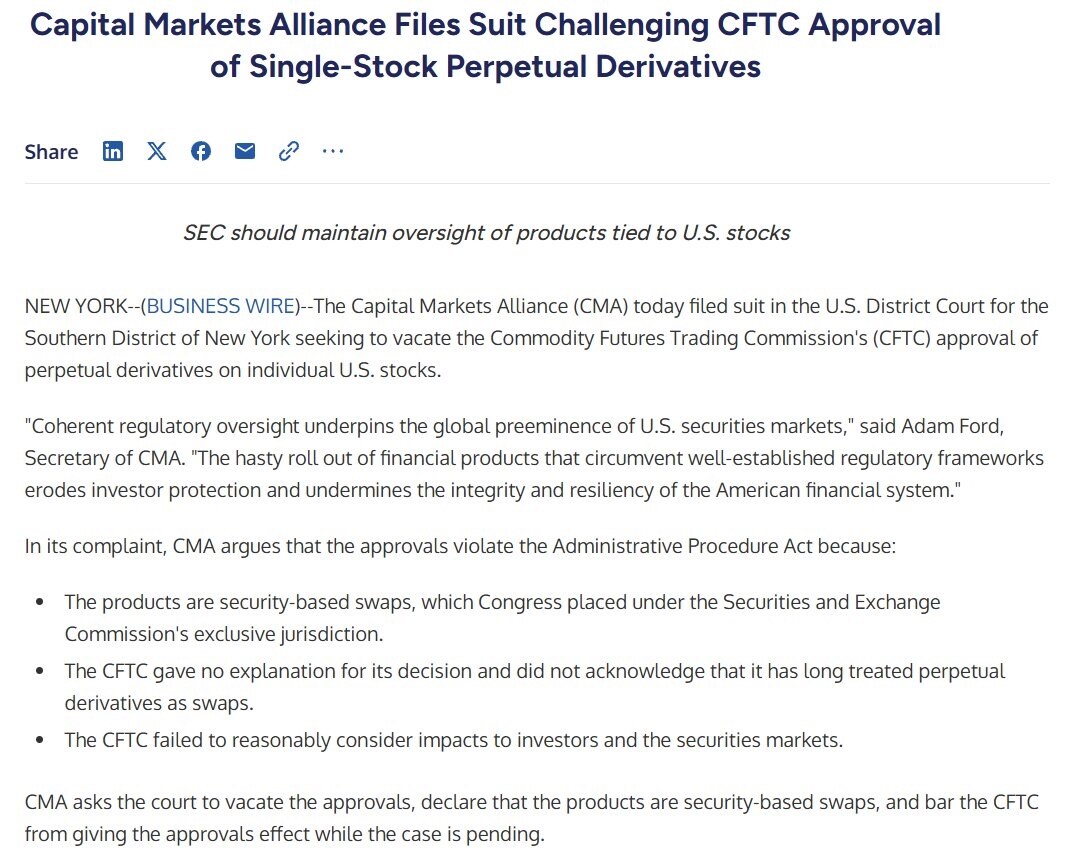
On Nov. 3, Capital Markets Alliance, a lobbying group backed by Cboe Global Markets, Citadel Securities, Healthy Markets Association, and others, filed suit in the U.S. District Court for the Southern District of New York. The group is asking the court to vacate the CFTC’s approval of equity perpetual futures.
CMA’s central argument is that perpetual contracts have no expiration date, so they do not fit the statutory definition of traditional security futures. In its view, they are securities-based swaps. Under U.S. law, swaps tied to a single stock fall under the SEC’s exclusive jurisdiction, which means the CFTC cannot approve them on its own.
CMA also argues that the CFTC’s action violated the Administrative Procedure Act. The group says the agency bypassed formal rulemaking and full review by allowing the products to take effect through the 45-day self-certification process. CMA Secretary Adam Ford said, 「Rushing out financial products that evade mature regulatory frameworks will weaken investor protection and undermine the integrity and resilience of the U.S. financial system.」
CMA is not alone. The Securities Industry and Financial Markets Association, or SIFMA, and Nasdaq have also recently sent letters to the SEC opposing the product. They warned that thin liquidity during overnight trading could make stock perpetuals vulnerable to price manipulation and cascading retail liquidations. They urged the SEC to use its statutory authority to nullify the four exchanges’ rule changes during the 60-day window following the CFTC approval.
The dispute centers on product classification and market share
The article points to a straightforward reason for Wall Street’s sensitivity. For incumbent options and futures groups such as Cboe, 0DTE options and traditional stock options are core profit centers. If stock perpetuals that do not require rolling, are easier to trade, and support near round-the-clock access gain traction on platforms such as Coinbase, Kraken, and Kalshi, order flow could shift away from the traditional options market and its market makers.
The clash that surfaced on Nov. 3 has become a direct confrontation inside the U.S. regulatory and market structure. On one side, regulators are trying to import a mechanism proven in crypto markets into U.S. equities and pull offshore liquidity back onshore. On the other, firms such as Citadel and Cboe are using securities law and administrative law arguments to build a federal court challenge.
What happens over the next 60 days will matter. The response from the CFTC and SEC, and whether a federal court issues a temporary injunction, will shape whether Coinbase, Kalshi, and others can ring the opening bell for stock perpetuals in the U.S. It will also affect whether newer onchain players such as Lighter and Hyperliquid can move into the next phase of their compliance plans.



