
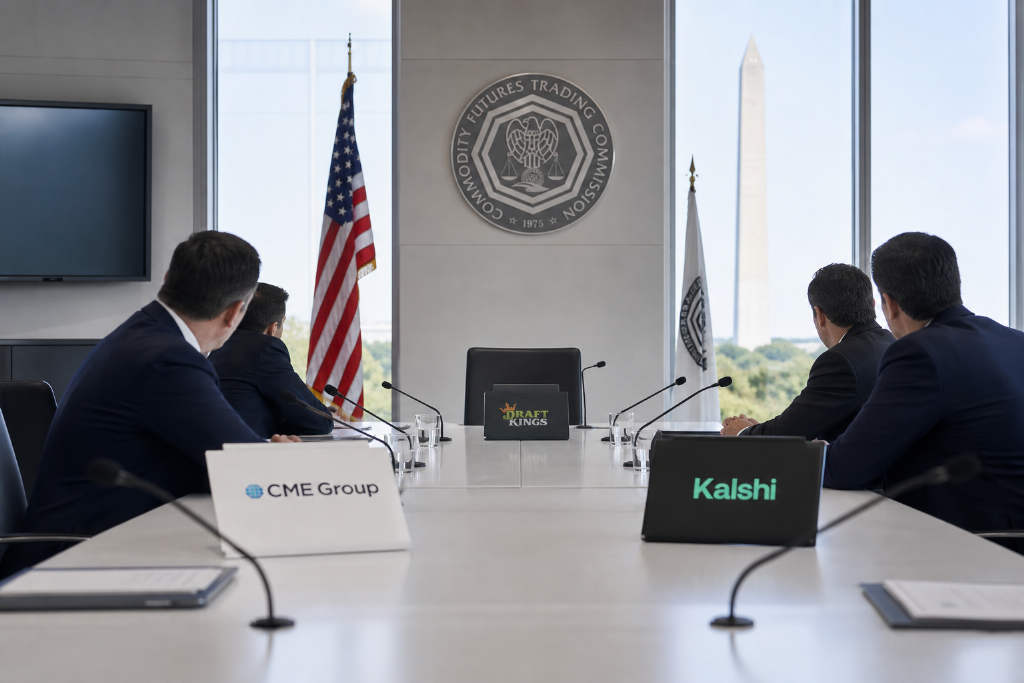
A Commodity Futures Trading Commission roundtable on prediction markets grew heated on Thursday when CME Group Chairman Terry Duffy and Kalshi co-founder Luana Lopes Lara traded barbs over manipulation, credibility, and regulation.
The clash took place during a CFTC meeting in Washington, D.C., where executives from traditional finance, crypto, and prediction market firms were debating how event contracts should be regulated.
Duffy attacks prediction market contracts, Lara fires back
Duffy, whose CME Group runs the world’s largest futures exchange by volume, said he was "a lot concerned" about prediction markets and argued that some contracts are susceptible to manipulation.
"We're not a bunch of carnival barkers at a circus," Duffy said. "We are running the most envious markets in the world in the United States of America."
He then took direct aim at the kinds of contracts Kalshi lists and mocked one example in particular.
"There's another really economic contract that has been massively important for the United States. That's a Nathan's hot dog eating contest," Duffy said sarcastically.
Duffy also questioned why Kalshi could offer a compute prediction market while CME’s proposed compute contracts were still under review.
After Kalshi was mentioned by name, Lara pushed back by pointing to CME’s own record.
"I just wanted to respond since we were called by name here," Lara said. "I would actually have to ask Terry: Has CME ever had any issues with any market manipulation, any issues ever in its history?"
"If you'd like to have a debate, I'm happy to have a debate with you," Duffy replied.
"I'm just asking a simple answer to a question," Lara said.
Duffy then highlighted the size gap between the two firms. "I have more people in my regulatory department than you have in your whole company," he said.
"Maybe you should learn a bit about efficiency then," Lara answered.
"Well, maybe you should learn about credible markets," Duffy replied before moderator Walt Lukken stepped in.
Lara later said the issues Duffy raised were not specific to prediction markets.
"Every market has risk and every nascent market will have risks as well, and there have been issues in every single traditional market and every single exchange here, onshore and offshore," she said. "And I think the point of having regulation is that you find these issues, you address these issues, and there's a way to address them in a correct way."
Later in the session, DraftKings CEO Jason Robins called on participants to stop attacking each other’s businesses.
"I would just ask everybody, both in this hearing and then also in future communications, to try to refrain from taking shots at each other's business models or decisions you may not 100% agree with," Robins said. "That doesn't advance the discussion."
Prediction markets remain in a broader U.S. regulatory fight
Prediction markets let users wager on the outcome of almost any event through futures contracts that settle at $1, with the contract price implying the odds of that outcome.
Decrypt gave one example from Myriad, a prediction market run by its parent company Dastan. On Myriad, the event contract for "Bitcoin highs in August" was priced at 59 cents on the $75K outcome, implying users saw a 59% chance that Bitcoin would reach $75,000 before the end of the month.
Platforms operating in the United States, including Polymarket and Kalshi, have become a focal point in a dispute between federal regulators and states over whether contracts tied to sports, elections, and other real-world events should be treated as federally regulated derivatives or as gambling products governed by state law.
CFTC Chair Selig has defended the agency’s authority over federally regulated prediction markets and warned states that challenged that authority in February.
"We will see you in court," Selig said in a video posted to X. The agency has since taken legal action against states seeking to regulate event contracts under their gambling laws.
CFTC proposals and state court actions add pressure on Kalshi
In June, the CFTC proposed restrictions on certain contracts involving war or assassination, along with some sports proposition bets viewed as especially open to manipulation.
Earlier this month, nine Democratic senators urged Selig to ban wildfire event contracts, warning that such products could create incentives for arson, insider trading, and disaster profiteering.
Kalshi has also run into legal setbacks in several states. Last week, a judge in Washington ordered the company to stop offering contracts on sports, elections, politics, and other events in the state, finding that the products likely violated state gambling and consumer protection laws.
Two days earlier, in a separate dispute over New York’s effort to block Kalshi’s contracts, the CFTC ordered the company to keep trading.