
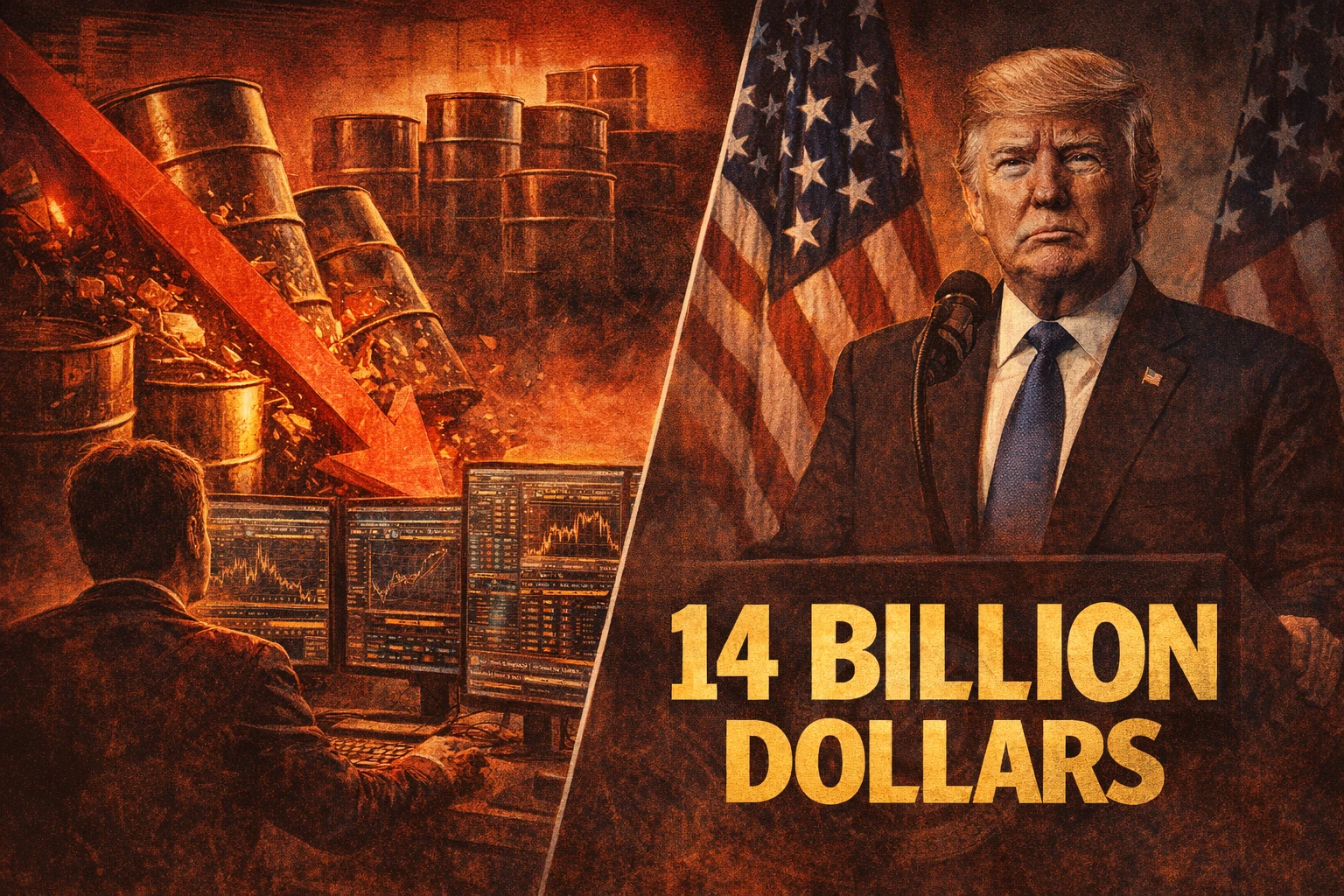
The U.S. Commodity Futures Trading Commission is investigating two suspicious oil futures trades worth more than $1.4 billion in total. Both positions were opened shortly before Donald Trump made major public statements related to Iran, and both were followed by sharp declines in oil prices. The timing has drawn intense scrutiny from regulators and lawmakers.
Two trades placed just before market-moving statements
The first trade took place on March 23. According to the report, more than $500 million in crude oil futures positions were built roughly 15 minutes before Trump posted on Truth Social that he would pause strikes on Iranian energy infrastructure. After the message became public, oil prices fell by more than 10%.
The second trade came on April 7. Before Trump announced a two-week ceasefire involving Iran, someone placed about $950 million on falling oil prices. Once the announcement was made, oil prices dropped sharply again. The size of the trades and the precision of the entry points pushed the case into the spotlight.
Regulators seek Tag 50 data to identify traders
The probe is centered on futures platforms operated by CME Group’s NYMEX and ICE. The CFTC has requested Tag 50 identification data from both exchanges, which can be used to trace the actual individuals behind the orders. In futures markets, Tag 50 functions as a trader identity marker and is commonly used in enforcement work.
Brian Young, a partner at Jones Day and former director of the CFTC’s enforcement division, said regulators have a strong incentive to pursue cases like this because gasoline prices are closely tied to oil futures and have a direct effect on U.S. consumers. Current CFTC enforcement director David Miller said on March 31 that the idea that insider trading rules do not apply to prediction markets is simply wrong.
Congress presses for action as prediction markets tighten rules
Representative Ritchie Torres called the case “potentially one of the largest insider trading schemes in history” and formally asked both the SEC and the CFTC to investigate. Senator Elizabeth Warren also pushed for CFTC involvement. The White House has already warned staff not to use their positions to trade in futures or prediction markets.
The investigation is also affecting crypto-linked prediction markets. Polymarket and Kalshi have introduced new anti-insider-trading rules. The central issue is whether a market designed to aggregate information can still function fairly when that information comes from nonpublic government decisions. At the same time, the Public Integrity in Financial Prediction Markets Act of 2026 was introduced in late March 2026 to create a clearer prohibition framework for insider trading in prediction markets.